



Most roofing contractors waste money chasing the wrong ideas. The fastest way to grow a roofing business in 2025 is to stack proven channels in the right order: local SEO and Google Business Profile first, then referrals and reviews, then paid ads like Google Local Services Ads, then social and traditional tactics layered on top. That’s it. No silver bullet, no secret hack.
This guide walks through every roofing marketing idea worth running, ranked by return on dollars spent. You’ll get specific tactics, realistic budgets, and the patterns that separate roofers who book jobs every week from the ones burning cash on clicks that never convert.
Here’s the short list before we go deeper.

Quick overview: best roofing marketing ideas
Want to know what actually fills your job board? It’s not one magic channel. The best roofing marketing ideas stack a few proven plays together so leads come in from multiple directions, week after week.
Here’s what this guide covers, ranked by return on dollars spent:
- Local SEO and Google Business Profile optimization — your foundation for showing up when homeowners search “roof repair near me.”
- Google Local Services Ads (LSAs) — pay-per-lead ads with the Google Guarantee badge that put you above everything else.
- Referral and word-of-mouth programs — the highest-converting lead source most roofing contractors never systematize.
- Online review generation — the single most controllable lever for both rankings and close rate.
- Facebook and Instagram marketing — local awareness, before-and-after content, and affordable lead generation.
- Nextdoor neighborhood marketing — hyper-local trust where homeowners already ask for recommendations.
- Google Ads search campaigns — high-intent traffic for storm damage and roof replacement keywords.
- Content marketing and SEO blogging — long-term organic traffic that compounds for years.
- Email marketing to past customers — keeps you top-of-mind between jobs and drives referrals.
- Traditional and community marketing — yard signs, vehicle wraps, canvassing, and direct mail layered with your digital work.
The roofers who win don’t pick one. They build the digital foundation first, then layer paid and traditional on top. Skip the foundation and you’re pouring ad money into a leaky bucket.
Let’s start with the channel that delivers the highest return for most roofing contractors: local search.
Local SEO and Google Business Profile
When a homeowner spots a missing shingle, where do they go first? Google. The top three local map pack results capture 87% of clicks — and that’s why local search is typically the highest-ROI channel for any roofing contractor.
How to optimize your Google Business Profile
Treat your Google Business Profile like the front door to your shop. A complete profile beats an incomplete one by a wide margin in conversion rate.
- Primary category: Roofing Contractor. Add secondary categories like Roof Inspection Service or Gutter Cleaning Service.
- Local phone number, never an 800 number.
- Photos weekly — real jobs, real crews, file names like “denver-shingle-replacement.jpg.”
- Use Posts for storm response, promotions, and seasonal offers.
- Answer Q&A yourself before competitors or strangers do.
Citations and NAP consistency
Your name, address, and phone must match exactly across every directory. Inconsistent NAP details can tank local rankings hard. Audit Yelp, BBB, Angi, HomeAdvisor, and Apple Maps quarterly.
Reviews move the needle most
Review volume is the single most controllable ranking lever you’ve got — and the heart of roofing reputation management. Ask every customer the day the job wraps, while the new roof is still the highlight of their week. SMS requests beat email roughly two-to-one on response rate.
Want to see what’s possible? The Plum ProExteriors case study shows 10x organic traffic from this exact playbook. Curious what it costs? Check local SEO pricing for roofing companies.
Once you’re visible in local search, a structured referral program turns happy customers into your best salespeople.
Referral and word-of-mouth marketing
Why does almost every roofing contractor say “most of our work comes from word-of-mouth” — yet almost none of them have a real system behind it? That gap is where the money leaks out.
A structured referral program typically converts 3–5x higher than paid channels and costs a fraction per job. Among all roofing marketing ideas, this is the one most owners leave sitting on the table.
Build the incentive right
Use a dual-sided reward. Pay the referrer with something unrelated to roofing — a $100 Visa gift card, Amazon credit, or cash. Give the new customer a discount tied to the job, say $250 off installation. Stack the referrer reward so it grows with each successful close.
Ask at the right moment
The window is narrow: 24 to 72 hours after job completion, while the new roof is still the story they’re telling neighbors. Hand them three business cards or a text link. Don’t wait two weeks — momentum dies fast.
Track every referral source in your CRM
If you can’t tell which customer sent which lead, you can’t reward them or scale what’s working. Tag the source field on every new lead in JobNimbus, AccuLynx, or whatever you run.
Build vendor partnerships
Insurance adjusters need contractors who document damage cleanly. Realtors need pre-listing roof inspections to close deals faster. General contractors need a reliable sub. Set up branded QR codes and revenue-share terms with each partner type.
Beyond referrals, social media gives roofing companies a way to stay visible in their service areas between jobs.
Social media marketing for roofers
Three platforms move the needle for roofers. The rest are a distraction. Focus your social media marketing on Facebook, Instagram, and Nextdoor — and match the content to each.
Facebook: where homeowners live
Facebook’s audience skews homeowner. Join your local neighborhood and community groups, then actually show up — answer roofing recommendation requests, post weekly, run targeted ads to homeowners 35+ inside your service radius. Targeted lead ads here often land cheaper than Google search clicks.
Instagram: before-and-after is king
Before-and-after Reels are the single highest-performing content type for roofers. Show the damage clearly, name the shingle and warranty, tag the neighborhood. Stories work for daily progress: tear-off in the morning, finished deck by lunch, new roof by sunset. Time-lapse installs and crew spotlights humanize your brand fast.
Nextdoor: neighborhood trust
Nextdoor users trust ads at more than twice the rate of Facebook or Google, and three-quarters of users own their home. Claim your business page, ask happy customers to recommend you by name, and sponsor neighborhoods after storms.
Content ideas that actually work
- Storm damage tips after local weather events
- Crew spotlights — names, years on the job
- Time-lapse install videos
- Polls: “Architectural or standing seam?”
Posting frequency
Three posts per week is your baseline. Drop below that and engagement craters. Among roofing company marketing ideas, social is cheap — but only if you stay consistent.
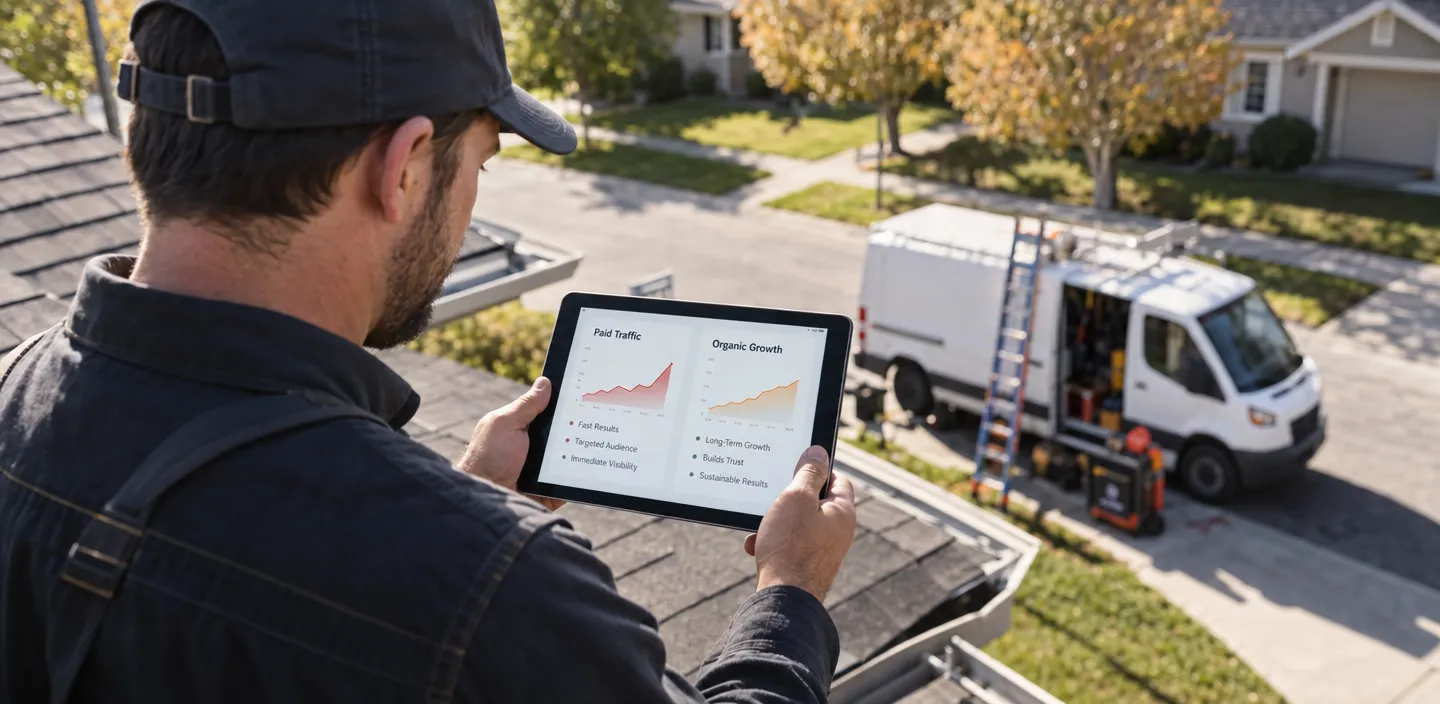
When you need leads faster than organic and social can deliver, paid advertising is the lever to pull.
Paid advertising: Google Ads and beyond
Want leads this week, not next quarter? Paid is the lever — but pull the right one first.
Google Local Services Ads (LSAs)
LSAs sit above everything else on the search page and run on a pay-per-lead model: you only pay when a homeowner actually calls or messages. The green Google Guaranteed badge backs your work with up to $2,000 in coverage and signals trust before they’ve even spoken to you. In most cases, LSA leads convert at 31% versus 12% for traditional PPC.
Setup requires verification: business license, insurance, and background checks on owners and field staff. Budget 2–4 weeks for approval. Expect $45–$120 per lead in most markets, climbing during storm season.
Traditional Google Ads search campaigns
Run separate campaigns for high-intent keywords: “roof replacement [city],” “storm damage repair,” “hail damage roof inspection.” Use call-only ads on mobile. Pair every campaign with a dedicated landing page — generic homepages waste clicks. Costs run high for a roofing contractor, so review counts and load speed matter.
Facebook and Instagram retargeting
Most site visitors leave without calling. Retargeting brings them back cheap — pixel your traffic and serve before-and-after Reels for 30–60 days after their visit.
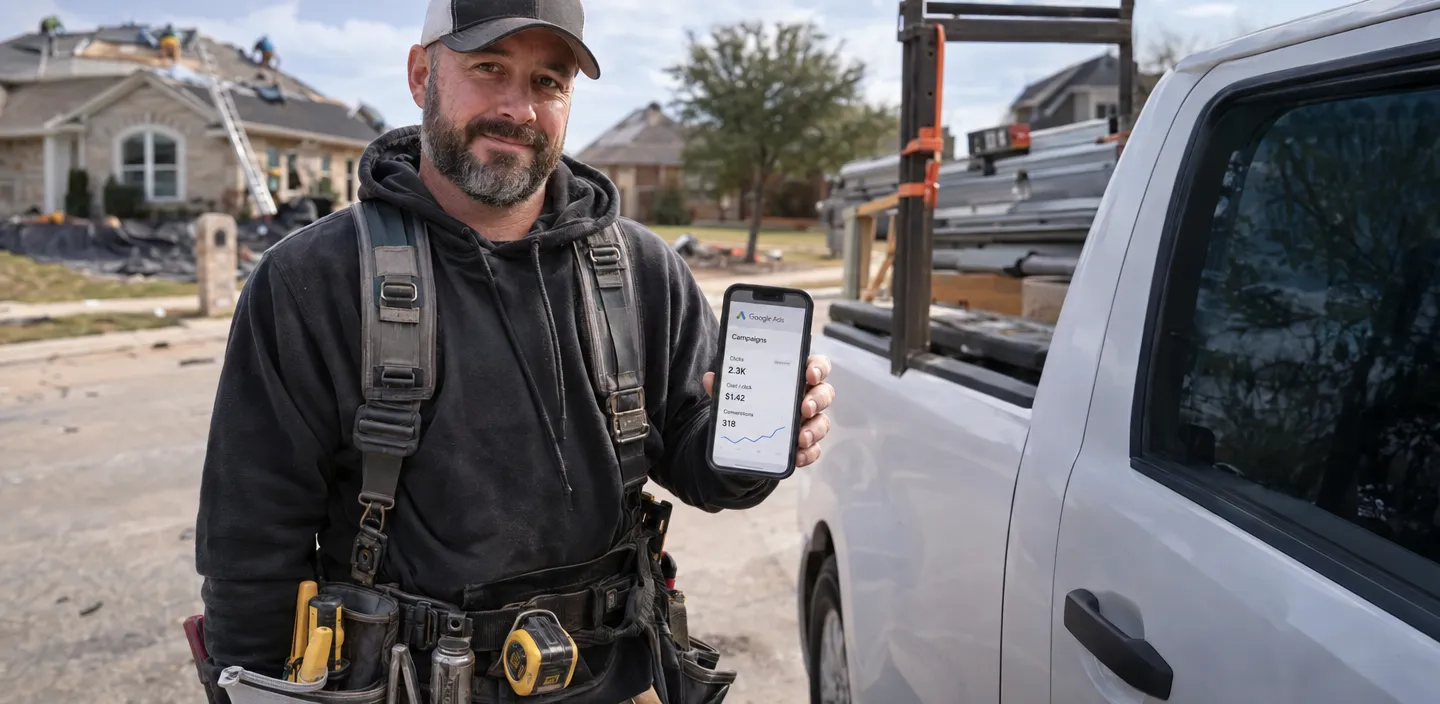
Track everything in your digital marketing dashboard and check your Google rankings monthly to spot wasted spend. Ready to fill the schedule? Get a free estimate and start generating more leads for your construction business today.
Paid ads generate immediate leads, but content marketing and email build the long-term pipeline that keeps your business steady year-round.
Content marketing and email for roofing companies
Think of content marketing as the foundation slab and email marketing as the porch light. One builds long-term traffic. The other keeps you visible to people who already know you.
Blog content that earns rankings
Write what homeowners actually search. Three formats win for roofing:
- Storm prep guides tied to your region’s weather season
- “Signs you need a new roof” posts with photos of curling shingles, granule loss, sagging decks
- Shingle comparisons — architectural vs. three-tab, GAF vs. Owens Corning, metal vs. asphalt
These hit long-tail searches with real buying intent. Nail your on-page basics — start with SEO title tag best practices on every post.
Long-term ROI
A blog post can rank for years, not weeks. That’s the quiet power of content marketing: a single article written today can continue delivering leads long after your ad spend resets each month. Your ad budget resets every 30 days. A good post doesn’t.
Email marketing that brings work back
Past customers are gold. Your roofing company marketing ideas list isn’t complete without an email program. Build the list from every closed job, then send seasonal campaigns:
- Spring inspection reminders in February
- Post-storm outreach within 48 hours of hail or high winds
- Fall gutter and flashing checks in September
- Referral asks twice a year
Send monthly. Twice a month at most. Any more and you train people to ignore you; any less and they forget your name.
Done right, email marketing turns one roof job into three over a decade.
Not every effective marketing tactic lives online — traditional and community-based strategies still deliver real results for roofing companies, especially when layered with digital.
Traditional and community marketing ideas
Digital isn’t the whole game. The roofers who dominate their market layer offline tactics on top of search and social — and these traditional roofing marketing ideas still pull real leads.
Yard signs with QR codes
Every completed job is a free billboard. Plant the sign before the crew rolls out, leave it 2–3 weeks, and add a QR code linking to a landing page with project photos and a free-inspection offer. Neighbors notice. Neighbors call.
Vehicle wraps
A wrapped truck parked at a jobsite gets thousands of impressions a week. Keep it simple: company name, phone number, website, one trust signal (Google Guaranteed, GAF Master Elite). Cluttered wraps don’t get read.
Door-to-door canvassing after storms
After hail or high winds, canvass the affected radius within 48–72 hours. Free inspection offer, clipboard, branded polo. The crews that knock first book the jobs.
Direct mail for targeted ZIP codes
Mail works when targeting is sharp. Three plays for any marketing ideas for roofing company plan:
- Post-storm radius mailers within 48–72 hours of an event
- Roof-age targeting — homes 15–20+ years old by ZIP
- EDDM saturation for ZIP-level coverage at roughly 37% lower cost than targeted lists
HOA partnerships and event sponsorships
Sponsor the neighborhood 5K, Little League team, or HOA newsletter. Offer free roof inspections at community events. You’re buying trust at the local level — cheaper than any click.
Layered with digital, traditional tactics give you maximum coverage. Here’s what we’ve actually seen deliver results when working directly with roofing and exterior contractors on their marketing.
What we’ve seen work: lessons from real roofing marketing campaigns
After working directly with roofing and exterior contractors on their digital marketing, a few patterns show up again and again — and most generic advice misses them entirely.
Pattern 1: Local SEO before paid ads wins long-term. The roofers who dominate their market lock down their Google Business Profile, citations, and reviews first. Then they scale paid. Plum ProExteriors in Massachusetts is a good example — 10x organic traffic and double the domain rating came from the local SEO foundation, not from spending more on ads.
Pattern 2: Review volume is the lever nobody pulls hard enough. It’s the single most controllable ranking factor a roofing contractor has. Most owners ask sporadically. The winners ask every single customer, by SMS, the day the job closes.
Pattern 3: Referral programs are the highest-ROI tactic nobody systematizes. A real program with tracked incentives, CRM tags, and a 72-hour ask window beats almost any paid channel on cost per job. Yet most contractors still rely on hope.
Pattern 4 — the costly mistake: Paid ads without the conversion foundation. We’ve watched contractors burn thousands a month on Google Ads while sitting on a handful of Google reviews and a broken contact form. The clicks come. The jobs don’t. Among the best roofing marketing ideas, building infrastructure before scaling spend is the one rule that separates winners from money-pits.
Need a roofing marketing agency that follows this order? Below are the most common questions roofing business owners ask about marketing strategy.
The bottom line on roofing marketing
Foundation first. Paid second. Always.
The roofers winning their market aren’t the ones spending the most — they’re the ones stacking proven plays in the right order. Lock down your Google Business Profile, build review volume relentlessly, systematize referrals, then scale with LSAs and Google Ads. Layer social and traditional on top.
Skip the foundation and every dollar leaks. A homeowner who finds your ad but sees a handful of reviews and a slow site won’t call. Would you?
Pick two channels from this list and run them hard for 90 days before adding a third. Consistency beats variety every time.
Ready to stop guessing and start booking? Get a free estimate and start generating more leads for your construction business today — and we’ll map out which plays fit your market first.
FAQ
01 What is the best roofing advertising method?
Google Local Services Ads. You pay per verified lead, the Google Guaranteed badge builds instant trust, and LSAs sit above every other result. Pair them with an optimized Google Business Profile for the strongest short-term and long-term lead foundation.
02 How do roofing companies get customers?
Most roofers win through a mix of word-of-mouth referrals, Google search, and repeat customers. Roughly 73% of homeowners find a roofer through personal recommendation, so referral systems are a must. Google Business Profile, LSAs, and social fill the rest.
03 How much should a roofing company spend on marketing?
Budget 5%–10% of gross revenue. Newer companies push closer to 10% to build share. A $500K shop spends $25K–$50K yearly, or $2K–$4K monthly across SEO, ads, and referrals. Start with measurable channels like LSAs and GBP.
04 Do referral programs actually work for roofers?
Yes. Referral programs deliver around a 5.7x ROI, and referred customers convert 3–5x higher than cold leads. The trick is structure: clear incentive, ask within 72 hours of job completion, and track every source in your CRM.
05 What is the 25% rule in roofing?
The 25% rule is a building code guideline used in many jurisdictions: if more than a defined threshold of a roof is repaired or replaced within a set period, the whole roof must be brought to current code. The exact threshold and timeframe vary by jurisdiction.
Love what you’re reading? Sign up for our newsletter to get our newest articles, helpful tips, and fresh marketing updates delivered right to you. No spam, just the good stuff.