




For financial services companies, SEO is not only about ranking higher in Google. It is about earning trust before a prospective client fills out a form, books a consultation, applies for a product, or compares your firm with a competitor. Banks, lenders, investment firms, insurance providers, fintech companies, accounting firms, and financial advisors all operate in a high-trust environment where accuracy, transparency, and credibility matter as much as visibility.
A strong financial services SEO strategy should connect search demand with user intent, compliance-aware content, technical performance, expert review, and conversion tracking. In this guide, we’ll break down how finance companies can improve organic visibility, create trustworthy YMYL content, build E-E-A-T signals, optimize local and service pages, and turn search traffic into qualified leads through a structured SEO strategy.
The importance of SEO for financial services industry
Competition in financial search results is intense because users compare providers carefully before making decisions. They may research loan options, insurance coverage, retirement planning, wealth management, bookkeeping, business funding, or fintech tools across several websites before contacting a company. SEO helps financial brands appear in these decision moments, but the content must be credible enough to deserve the user’s trust.
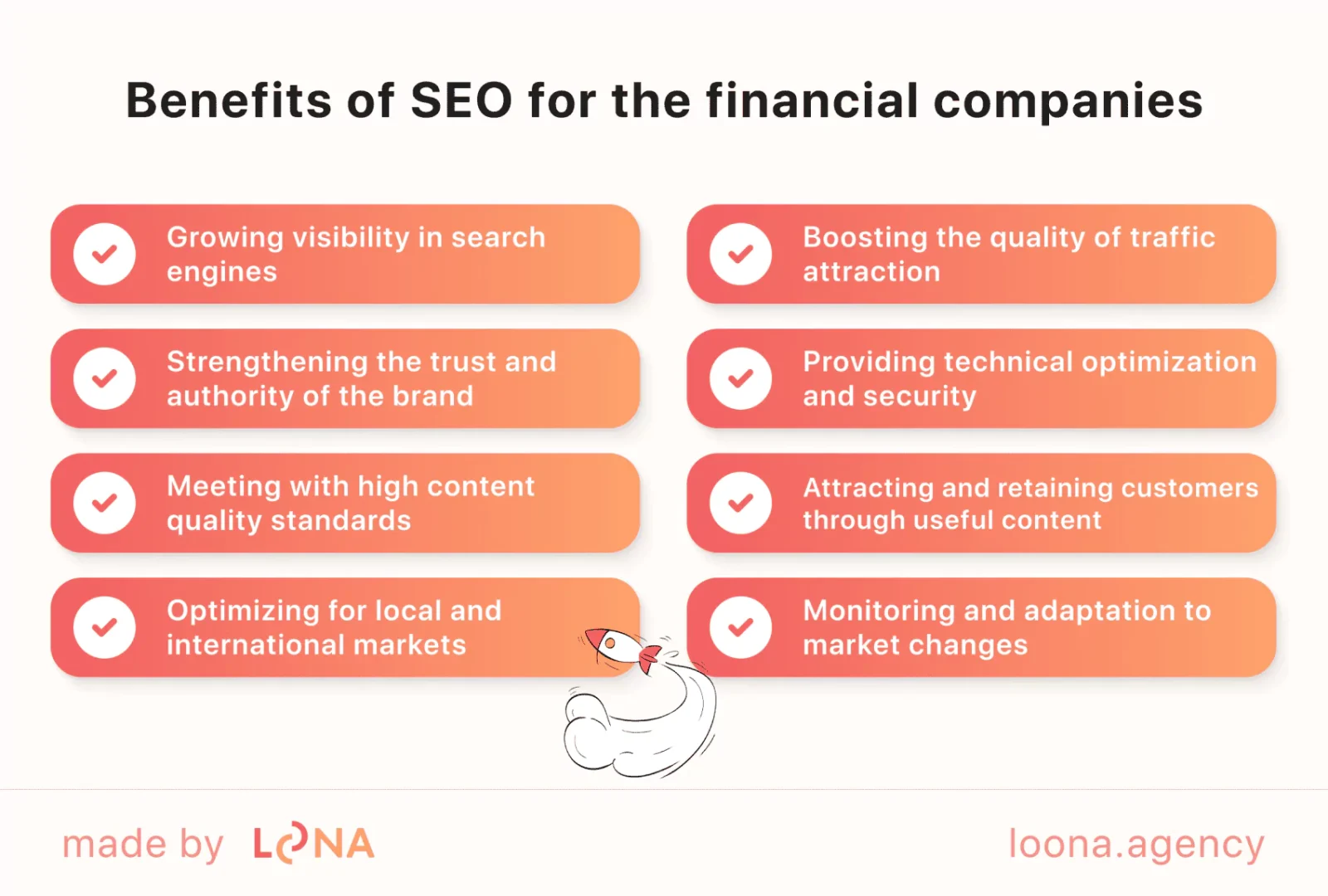
Growing visibility in search engines
When potential clients search for terms such as “financial advisor near me,” “business loan options,” “tax planning for small business,” “commercial insurance broker,” or “retirement planning services,” your website needs to appear with content that matches their intent. The goal is not just to reach the first position. The goal is to rank for searches that can bring qualified users to the right service, location, or educational page.
Strengthening the trust and authority of the brand
In finance, trust cannot come from rankings alone. Users look for signs that the company is legitimate, experienced, transparent, and careful with claims. Strong financial SEO should make this trust visible through expert-authored or expert-reviewed content, clear disclosures, accurate service descriptions, client education, secure website experience, reviews, case studies, and transparent contact information.
Meeting with high content quality standards
Financial content falls into a high-stakes category because it can influence decisions about money, credit, investments, taxes, retirement, insurance, and business risk. For this reason, finance SEO content should be accurate, specific, reviewed when necessary, and written in a way that helps users understand both benefits and limitations.
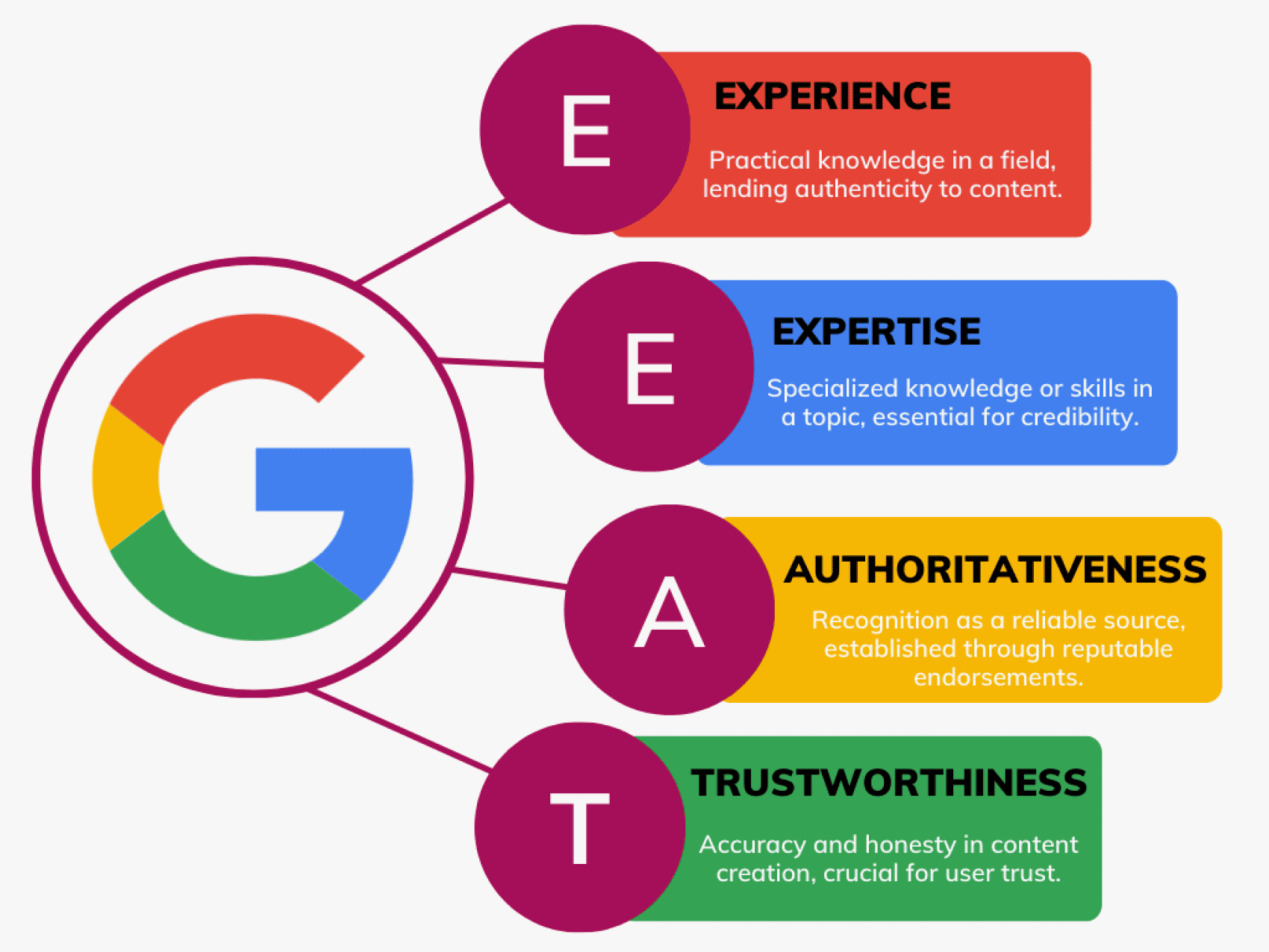
E-E-A-T — Experience, Expertise, Authoritativeness, and Trustworthiness — should be visible on the page. Add author names, reviewer credentials, updated dates, clear sources, disclaimers where needed, product limitations, methodology notes, and links to relevant service pages. This is especially important when publishing comparison content, investment-related education, loan guidance, insurance explanations, or financial calculators.
Optimizing for local and international markets
Financial companies may need local, national, or international visibility depending on their business model. A local advisor, credit union, insurance agency, or accounting firm may need location pages and Google Business Profile optimization. A fintech platform, lender, or investment company may need broader service pages, educational content, and international SEO if it serves users across multiple markets.
For financial companies expanding into new regions, on-page SEO should clarify service eligibility, regulatory limitations, location relevance, product availability, and audience fit. This helps users understand whether the company can actually serve them and helps search engines connect each page with the right market.
Boosting the quality of traffic attraction
Financial SEO should prioritize traffic quality over traffic volume. A broad blog post may bring visitors who are not ready to act, while a page targeting “SBA loan consultant in Miami” or “fiduciary financial advisor for business owners” may attract fewer users but stronger intent. A good strategy maps keywords to the buyer journey: informational content for education, comparison content for evaluation, and service pages for conversion.
Providing technical optimization and security
Technical SEO is especially important for finance websites because users may submit sensitive personal, business, or financial information. A strong technical SEO setup should include HTTPS, crawlability, indexability, fast loading, mobile usability, clean URL structure, correct canonicals, structured data, secure forms, and reliable tracking. Technical issues can weaken both rankings and user confidence.
Attracting and retaining customers through useful content
Useful financial content should help users make better-informed decisions without overpromising outcomes. Examples include budgeting guides, loan comparison explainers, tax planning checklists, retirement planning FAQs, insurance coverage guides, financial calculators, glossary pages, and risk explanations. Strong SEO content for finance should educate, disclose limitations, and guide users toward the right next step.
Monitoring and adaptation to market changes
SEO for financial services must be reviewed regularly because regulations, interest rates, market conditions, products, competitor content, and search behavior change. Reporting should track rankings, organic traffic, conversions, lead quality, assisted conversions, local visibility, technical issues, and content decay. For finance companies, it is also important to review older content for outdated claims, broken sources, and compliance-sensitive language.
How much does a finance company pay for SEO
SEO for financial services is usually a higher-investment channel because the work requires more research, stronger content quality, careful compliance review, technical accuracy, and trust-building. The cost depends on the type of financial business, competition level, geographic coverage, website condition, number of services, content needs, backlink profile, and whether the strategy is local, national, or international.
Most finance companies should think about SEO in terms of scope, not only monthly price. A small local accounting firm may need technical cleanup, local SEO, service pages, and review growth. A national fintech company may need technical SEO, content hubs, digital PR, product-led pages, structured data, and advanced analytics. Larger financial brands may also need legal or compliance review built into the content workflow.
| Package type | Description | Price per month |
| Basic | Basic Technical audit, keyword research, on-page optimization, local SEO basics, and limited content updates | $1,000 – $2,500 |
| Comprehensive | Technical SEO, content strategy, service-page optimization, expert-reviewed blog content, local SEO, reporting, and conversion tracking | $3,000 – $7,000 |
| Intensive | National or international SEO, advanced technical work, content hubs, digital PR, link-building, analytics, compliance workflow support, and ongoing optimization | $8,000 – $20,000+ |
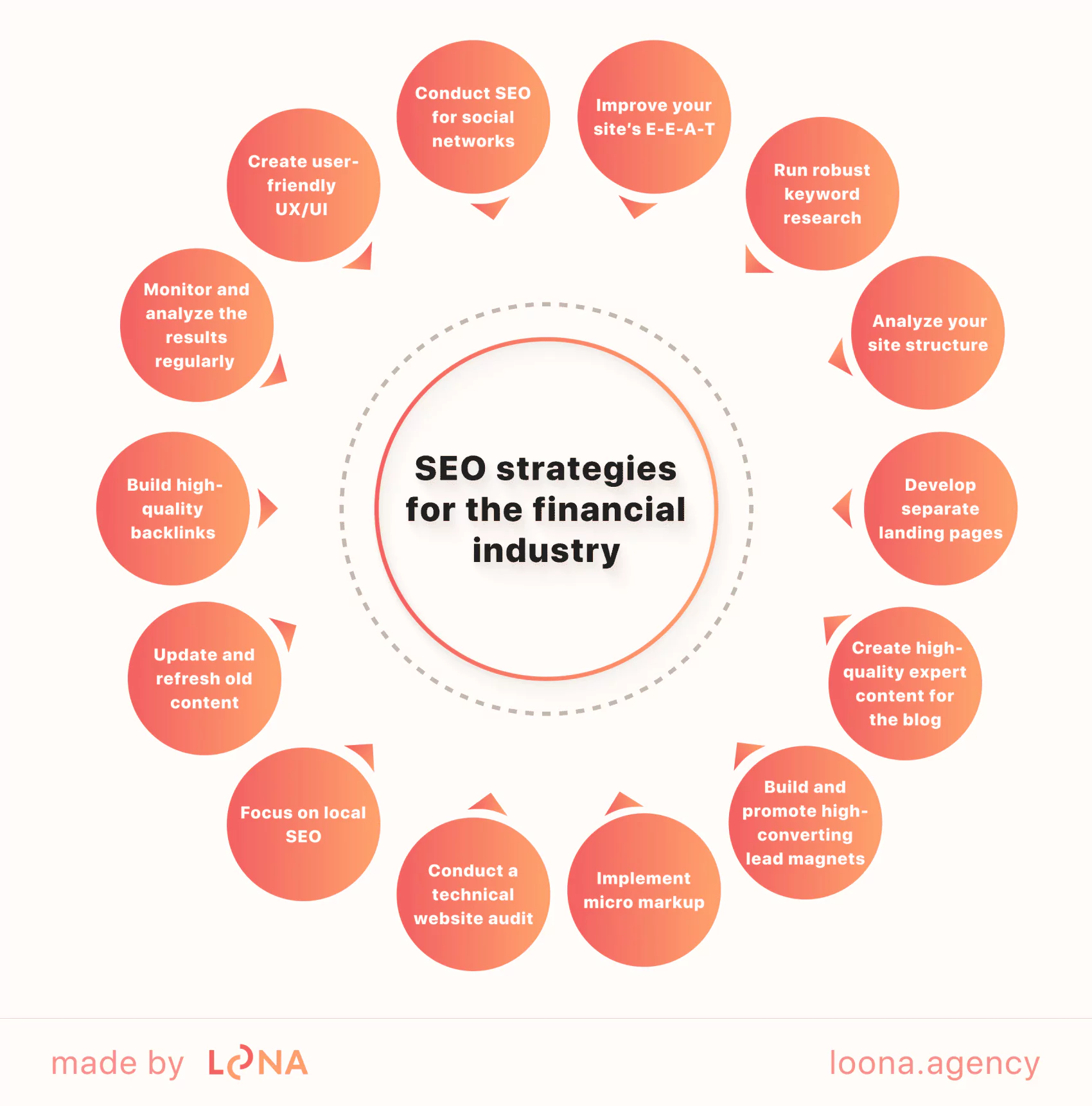
How to do SEO for the financial industry: 14 steps guide
SEO for financial services requires a more careful approach than many other industries. The content must satisfy search intent, demonstrate expertise, avoid misleading claims, protect user trust, and support conversions without ignoring compliance considerations.
A successful finance SEO strategy should include technical SEO, keyword and intent research, E-E-A-T improvements, expert content, structured data, local SEO where relevant, authority-building, analytics, and a review process for compliance-sensitive messaging. The steps below show how to build that foundation.
1. Improve your site’s E-E-A-T
E-E-A-T is one of the most important quality frameworks for financial SEO. It does not mean adding generic “expert” language to every page. It means showing real experience, qualified expertise, recognized authority, and trustworthiness in ways users can verify.
Start with transparent authorship. Add author bios, reviewer bios, credentials, licenses where appropriate, editorial policies, update dates, sources, and disclaimers. For sensitive topics such as investments, loans, taxes, insurance, or retirement planning, content should be reviewed by a qualified internal expert or external professional before publication.
Trust also depends on the user experience around security and transparency. Use HTTPS, secure lead forms, clear privacy policies, accessible contact information, visible company details, accurate disclosures, and no exaggerated guarantees. For financial websites, trust is not a design element — it is a conversion requirement.
These signals help users understand why they should rely on your content and why your company is qualified to help. They also make your website better aligned with Google’s people-first content expectations for high-stakes topics.
2. Run robust keyword research
Keyword research for financial services should start with intent, not search volume. Users searching “what is APR,” “best business loan for startups,” “fiduciary advisor near me,” and “apply for commercial insurance” are at different stages of the journey. A strong keyword research process separates educational, comparison, local, branded, and high-conversion queries.
Long-tail keywords are especially valuable in finance because they often reveal the user’s exact situation, such as “tax planning for small business owners,” “term life insurance for young families,” or “cash flow management for construction companies.” Map these terms to the right page type: blog articles for education, landing pages for services, comparison pages for evaluation, and contact-focused pages for conversion.
3. Analyze your site structure
Site structure is critical for financial services because users need to understand services, eligibility, risks, requirements, pricing factors, and next steps quickly. Build clear navigation around service categories, audience segments, locations, resources, calculators, FAQs, and contact options. Each important page should be reachable through logical internal links.
Internal linking should guide users from educational content to relevant service pages. For example, an article about retirement planning can link to a retirement advisory page, a guide about business lending can link to a business loan consultation page, and a tax checklist can link to a tax planning service. This supports both crawlability and conversion flow.
4. Develop separate landing pages
Create separate landing pages for distinct services, audiences, and locations when they represent real business offerings. A financial company may need dedicated pages for wealth management, business loans, tax planning, bookkeeping, retirement planning, insurance, mortgage services, or fintech product features.
Each landing page should explain who the service is for, what problems it solves, what the process looks like, what users should prepare, what limitations apply, and what the next step is. Avoid thin doorway-style pages that only swap keywords or locations. In finance, every landing page should provide real value, not just target another search term.
5. Create high-quality expert content for the blog
Blog content can be powerful for financial SEO when it answers real client questions with accuracy and nuance. Strong topics include “how to choose a financial advisor,” “what affects business loan approval,” “term vs whole life insurance,” “tax planning checklist for business owners,” or “how cash flow forecasting works.”
Financial blog content should avoid generic advice and unsupported claims. Add examples, definitions, assumptions, source links, methodology notes, and “who this applies to” explanations. Visuals, calculators, tables, and videos can help, but the core value should come from accurate guidance and expert review. A finance-focused content marketing strategy should also include a process for updating content when laws, rates, or product terms change.
Financial content teams often face the same core challenges: producing content that is useful enough to rank, accurate enough to trust, and clear enough to convert. This is why finance SEO content should be planned with both SEO specialists and subject-matter experts involved.

6. Build and promote high-converting lead magnets
Lead magnets can work well in financial services when they provide genuine value and set clear expectations. Examples include budgeting templates, loan readiness checklists, retirement planning worksheets, tax preparation checklists, risk assessment quizzes, calculators, webinars, or downloadable guides for specific audiences.
A high-converting financial lead magnet should explain what the user will receive, who it is for, what it does not replace, and how the company will use submitted information. Promotion can happen through SEO pages, email, social media marketing, paid search, LinkedIn campaigns, and remarketing — but every claim should remain clear, balanced, and compliant.
7. Implement micro markup
Structured data helps search engines understand page content and can make eligible pages appear with enhanced search features when the markup follows Google’s requirements. For finance websites, useful schema types may include Organization, LocalBusiness, FinancialService, Article, FAQPage, BreadcrumbList, Review, Product, or Event, depending on the page and what is visible to users.
Do not use schema to mark up information that is not visible on the page, and do not assume that structured data guarantees rich results. Use it to support clarity: business details, author information, FAQs, breadcrumbs, office locations, events, calculators, or review content where appropriate.
8. Conduct a technical website audit
A technical audit is essential for finance websites because users and search engines need a secure, fast, accessible experience. Review crawlability, indexability, Core Web Vitals, mobile usability, HTTPS, form security, broken links, redirects, canonicals, XML sitemaps, duplicate content, JavaScript rendering, and analytics tracking.
A technical audit should also check whether important financial content is accessible on mobile, whether forms work properly, whether tracking captures conversions, and whether sensitive pages are handled appropriately. A strong finance SEO strategy needs technical reliability before content and authority-building can reach their full potential.
9. Focus on local SEO
Local SEO is critical for financial advisors, accounting firms, insurance agencies, credit unions, banks, mortgage brokers, and tax professionals that serve defined regions. Start with an optimized Google Business Profile, accurate business categories, consistent name/address/phone data, office hours, service areas, appointment links, photos, and review management.
Local service and location pages should include real local relevance, not just city-name keyword swaps. Add office details, service availability, advisor or team information, FAQs, reviews where compliant, local proof, and links to related financial services. For firms with multiple branches, each location page should have unique content, accurate contact information, and a clear conversion path.
10. Update and refresh old content
Refreshing old content is especially important in finance because laws, rates, product terms, tax rules, eligibility criteria, market conditions, and compliance expectations can change. Outdated financial content can weaken rankings, reduce trust, and create business risk.
Update old pages by checking facts, refreshing examples, replacing outdated sources, adding expert review, improving internal links, clarifying disclaimers, and removing unsupported claims. Do not change the publication date unless the content has been meaningfully updated. For YMYL topics, accuracy matters more than appearing “fresh.”
11. Build high-quality backlinks
Backlinks can support authority, but financial brands should prioritize relevance and credibility over volume. Valuable links may come from industry publications, local business organizations, professional associations, partner resources, podcasts, research reports, expert commentary, and reputable media mentions.
Avoid link schemes, irrelevant guest posts, paid placements without proper handling, and low-quality directories. For financial services, authority-building should reflect real expertise: original research, market insights, data reports, expert quotes, calculators, case studies, and useful educational resources that other sites have a reason to reference.
12. Monitor and analyze the results regularly
SEO performance should be measured by business impact, not rankings alone. Track organic traffic, priority keyword visibility, qualified leads, booked consultations, application starts, form submissions, phone calls, assisted conversions, local actions, and revenue-influenced opportunities.
Use Google Analytics, Google Search Console, CRM data, call tracking, rank tracking, and reporting dashboards to understand which pages generate qualified demand. Review not only traffic, but also lead quality, drop-off points, content decay, and conversion paths. This helps finance companies update their SEO roadmap with evidence instead of assumptions.
13. Create user-friendly UX/UI
UX/UI is especially important for finance websites because users often need to compare complex information before taking action. Clear navigation, readable layouts, trust signals, simple forms, accessible design, and mobile-friendly pages can improve user confidence and conversion rates.
A strong UI/UX design approach should make it easy for users to find service details, understand eligibility, compare options, read disclosures, contact the company, and submit secure forms. Good finance UX reduces confusion instead of pushing users into a decision too quickly.
14. Conduct SEO for social networks
Social media can support financial SEO indirectly by increasing brand visibility, content distribution, referral traffic, and trust. However, social engagement should not be presented as a direct Google ranking factor. For financial companies, LinkedIn, YouTube, email, and industry communities can help distribute expert content and strengthen reputation.
Use social channels to share educational explainers, webinars, market commentary, company updates, case studies, and links to useful website resources. Keep financial promotions accurate, balanced, and properly reviewed before publishing. For firms regulated by FINRA, public communications should be fair, balanced, and not misleading, which is a useful standard to apply across SEO content and social content.
15. Add a compliance review process
Financial SEO should include a content review workflow before publication. SEO specialists can identify search opportunities, but subject-matter experts and compliance reviewers should confirm whether claims, examples, performance statements, testimonials, disclosures, and calls to action are appropriate. This is especially important for investment advisors, broker-dealers, lenders, insurance providers, and fintech companies operating in regulated markets.
Remarkable SEO financial services at Loona
Loona approaches financial services SEO as a trust-building and demand-generation system. We begin with a detailed audit of your website, competitors, keyword opportunities, content quality, technical SEO, analytics, backlink profile, and conversion paths. Then we build a strategy that connects organic visibility with qualified leads, not just traffic.
Our work can include technical SEO, keyword research, on-page optimization, content strategy, expert-driven blog content, internal linking, structured data, local SEO, link-building support, reporting, and conversion tracking. For financial brands, we also pay close attention to content accuracy, author transparency, trust signals, and the review process behind every important page.
Working with Loona means getting a systematic SEO content and optimization process that supports long-term organic growth. Let’s look at how this approach helped one of our clients improve visibility, traffic quality, and conversion performance.
Case study: Intobi
For Intobi, our team built a website and SEO strategy designed to improve organic visibility, attract higher-quality leads, and support stronger sales performance. The work included in-depth keyword research, on-page optimization, technical improvements, content planning, and authority-building.
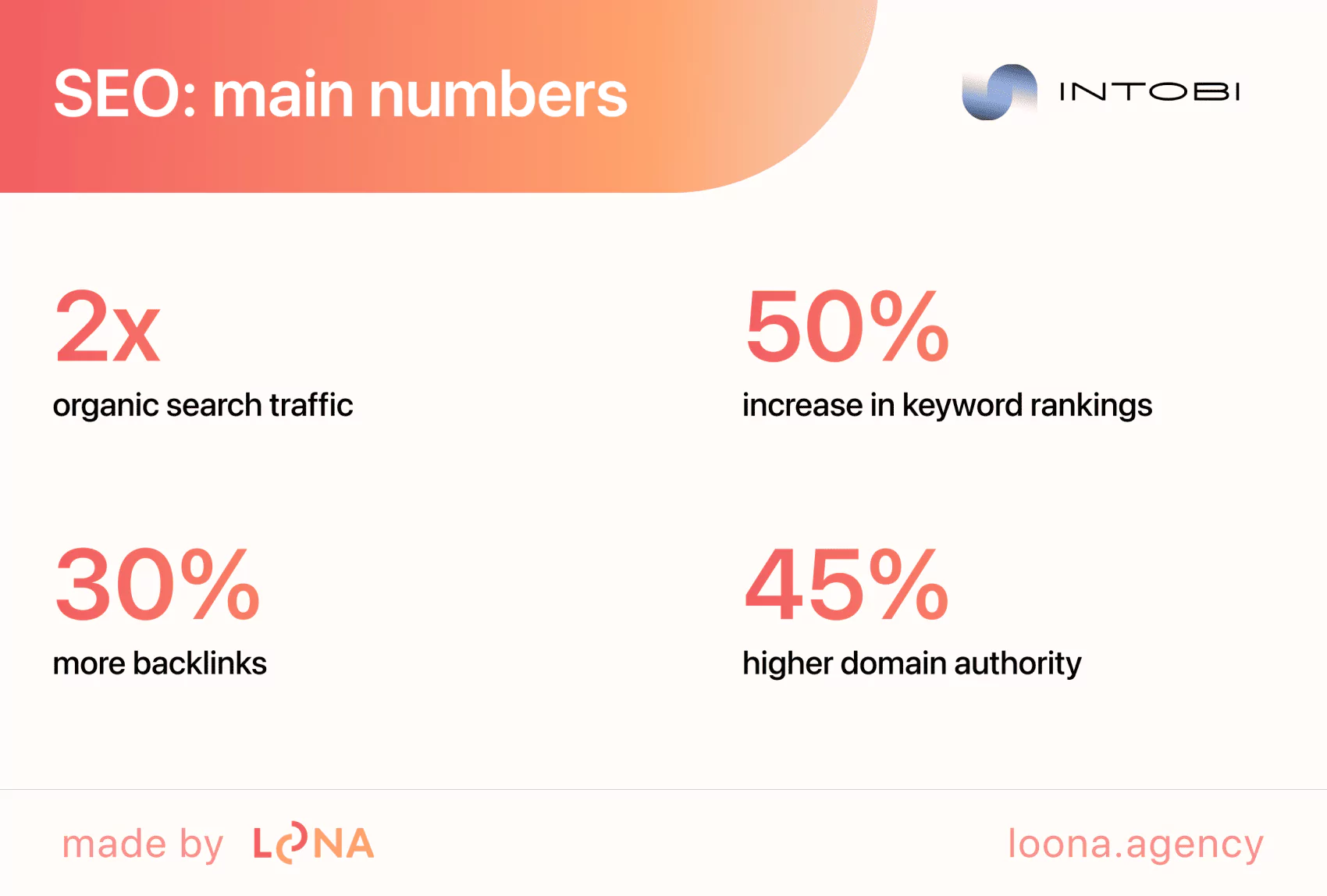
We also focused on ongoing monitoring and conversion-focused design. The website included clear calls to action, user-friendly navigation, fast loading, and page structures that supported both search visibility and lead generation. This approach helped turn organic traffic into more meaningful business opportunities.
Explore our portfolio to see how Loona helps businesses improve organic visibility, technical performance, content quality, and lead generation across different industries.
Conclusion
SEO for financial services works best when it is built around trust, accuracy, intent, and measurable business outcomes. Financial companies need more than keywords and rankings. They need technically reliable websites, expert-reviewed content, transparent authorship, compliance-aware messaging, strong local or national visibility, and conversion paths that help users take the next step with confidence.
If your financial company wants to attract more qualified organic traffic and build stronger authority online, Loona can help you create a finance SEO strategy that aligns content, technical performance, E-E-A-T, local visibility, and lead tracking. Contact us to build a search strategy that supports trust and long-term growth.
FAQ
01 What does SEO mean in investment banking?
In investment banking, SEO means improving a firm’s visibility in search results for relevant advisory, capital markets, M&A, industry insight, and thought leadership queries. Because the buying cycle is relationship-driven and high-value, SEO content should emphasize credibility, expertise, market knowledge, and compliant messaging rather than generic traffic.
02 What does SEO stand for in finance?
SEO stands for search engine optimization. In finance, it means improving a website’s technical structure, content quality, keyword targeting, trust signals, local visibility, and authority so potential clients can find reliable information and relevant financial services through search engines.
03 How much does a finance company pay for SEO?
SEO for financial services can range from around $1,500 per month for smaller local campaigns to $10,000–$25,000+ per month for competitive national or international strategies. The final cost depends on competition, technical needs, content volume, compliance review, backlink strategy, locations, and conversion tracking requirements.
04 Is SEO important for financial advisors?
Yes. SEO helps financial advisors appear for searches such as “financial advisor near me,” “retirement planning advisor,” or “fiduciary advisor for business owners.” To perform well, advisor websites should include clear service pages, local SEO, transparent credentials, educational content, reviews where compliant, and a secure conversion path.
05 What makes financial services SEO different?
Financial services SEO is different because the content often falls into YMYL topics, where accuracy and trust are critical. Finance websites need stronger E-E-A-T signals, expert review, transparent sourcing, secure technical setup, careful claims, and compliance-aware content workflows.
Love what you’re reading? Sign up for our newsletter to get our newest articles, helpful tips, and fresh marketing updates delivered right to you. No spam, just the good stuff.