



Every home improvement contractor wants more leads. But construction SEO does not work the same way in every market: not every service category offers the same search demand, and not every state competes on the same playing field.
At Loona Agency, we work with contractors, roofers, builders, and home service businesses every day. One question keeps coming up: “Where should I focus my SEO budget?” For many businesses, the real question is how to approach SEO for construction companies without wasting money on keywords that look attractive but do not convert. The answer is never generic. It depends on what you do, where you operate, and how crowded the search landscape already is.
So we decided to stop guessing and start measuring. Our SEO team pulled keyword data from Ahrefs, loaded it into Google BigQuery, and built a structured analysis of construction keywords and home improvement keywords covering 4,782 keywords, 6 service categories, and 10 of the most competitive states in the U.S. home improvement market.
The result? A clear, data-backed picture of where the biggest construction SEO opportunities are hiding in 2026—and which niches are still wide open for contractors, builders, and home service companies willing to invest in organic search.
This article breaks down everything we found.
Key takeaways
- We analyzed 4,782 contractor keywords (891,000 monthly searches) across 6 categories and 10 states.
- Average keyword difficulty is just 12.2 — most home-improvement terms are winnable for local sites.
- Specialty services (crawl space, waterproofing, chimney, foundation) are the easiest wins: average KD 5.8.
- Texas and Florida lead on volume; North Carolina, Ohio, and Virginia give the best ROI (lower competition, higher CPC).
- MEP keywords (electrical, plumbing, HVAC) carry the highest value — $18+ CPC.
The big picture: what 891,000 monthly searches tell us
Across all 10 states and 6 categories, here’s what the full dataset looks like:
| Metric | Value |
| Total keywords analyzed | 4,782 |
| Total monthly search volume | 891,000 |
| Average keyword difficulty | 12.2 |
| Average CPC | $9.94 |
| Service categories | 6 |
| States covered | 10 |
The overall average KD of 12.2 is remarkably low. For context, anything under 20 is generally considered achievable for a well-optimized local website with decent authority. This means that a large portion of construction and home improvement search queries remain underserved—especially outside the most saturated markets.
The average CPC of nearly $10 tells a different story: these are commercial keywords. People searching for these terms are ready to hire, get a quote, or schedule work. That combination—low competition, high intent—is exactly what makes construction company SEO and SEO for builders attractive long-term investments.
Category breakdown: where the demand lives
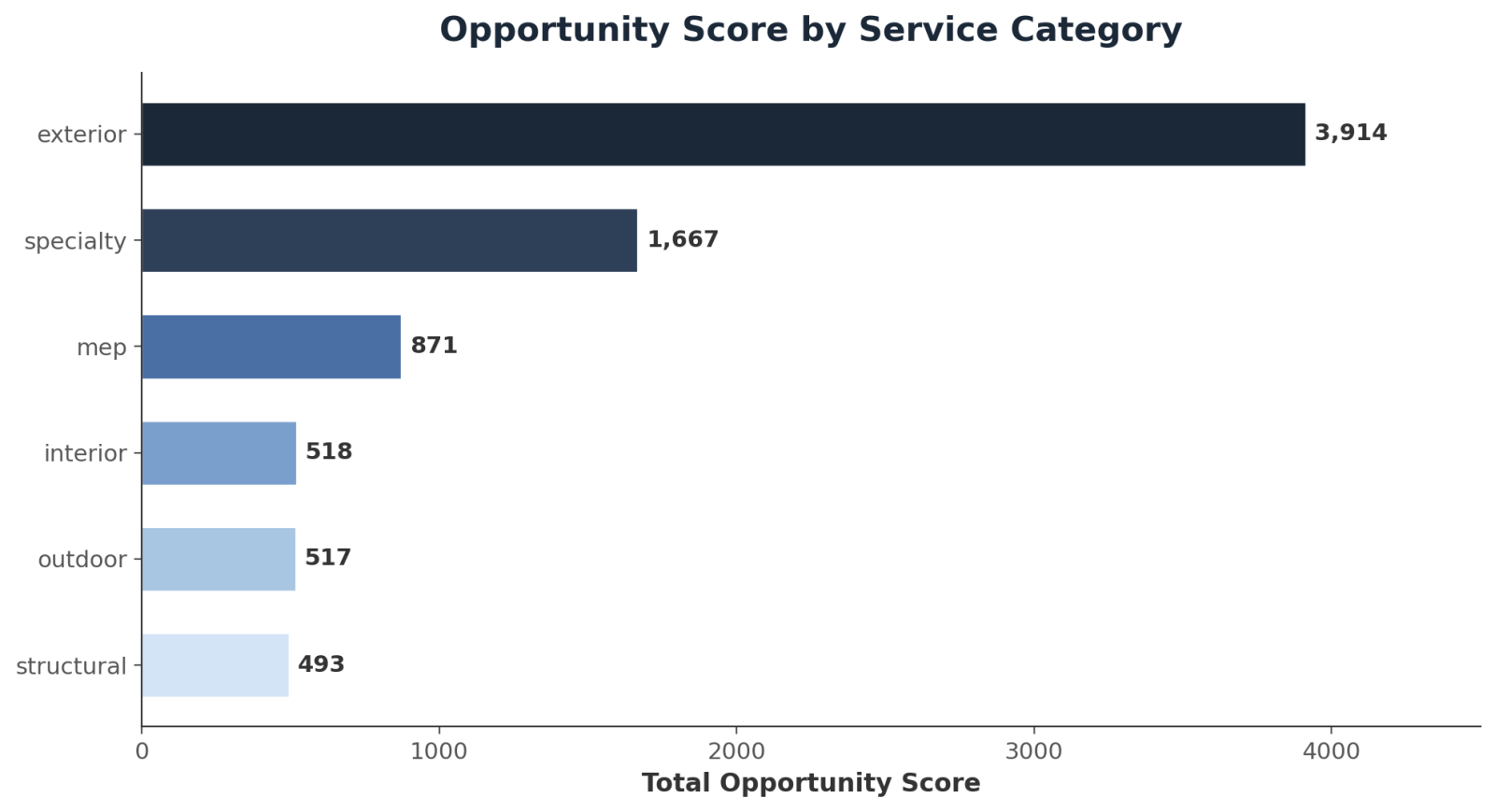
We grouped all 4,782 construction and home improvement keywords into six service categories. Here’s how they rank by total opportunity score:
1. Exterior services — the dominant category
Total opportunity score: 3,914 | Keywords: 2,169 | Search volume: 418,950/mo
Exterior services—including roofing, siding, painting, pressure washing, gutter installation, and related work—account for nearly half of all keyword volume in our dataset. This is the largest, most searched, and most competitive category in home improvement SEO, and it also includes high-intent construction SEO keywords such as keywords for painting contractors.
But “most competitive” is relative. The average KD across exterior keywords is still only 15.8, meaning most of these terms are accessible for contractors who invest in quality content and local SEO.
Top states for exterior services:
| State | Keywords | Search Volume | Opportunity Score |
| Texas | 508 | 105,200 | 917 |
| Florida | 424 | 84,550 | 768 |
| Ohio | 249 | 44,000 | 497 |
| North Carolina | 215 | 40,500 | 397 |
| California | 146 | 40,150 | 314 |
Texas and Florida dominate here, which makes sense given their housing stock size, climate-driven maintenance needs, and population growth. But Ohio and North Carolina present a compelling case: they have strong search volume with even lower competition.
Our follow-up roofing SEO seasonality study goes deeper into the exterior services category, analyzing when demand peaks in each state and how contractors should time their content and budget around seasonal patterns.
2. Specialty services — the hidden goldmine
Total opportunity score: 1,667 | Keywords: 958 | Search volume: 185,850/mo
Specialty services include crawl space encapsulation, basement waterproofing, chimney repair, foundation work, and other niche trades. This is, by far, the most underserved category in our analysis.
The average keyword difficulty for specialty services is just 5.8 — the lowest of any category. Many of these keywords show unusually low organic competition compared with their commercial value. Meanwhile, the average CPC of $8.13 proves these keywords carry strong commercial intent.
Top states for specialty services:
| State | Keywords | Search Volume | Avg KD | Opp. Score |
| Texas | 165 | 36,350 | 5.6 | 344 |
| Florida | 158 | 27,400 | 5.9 | 283 |
| California | 125 | 26,450 | 5.4 | 221 |
| North Carolina | 106 | 20,600 | 3.9 | 193 |
| Georgia | 92 | 18,100 | 4.8 | 190 |
North Carolina stands out with an average KD of just 3.9. If you’re a specialty contractor in the Carolinas and you’re not investing in SEO, you’re leaving qualified leads on the table every single day.
North Carolina also shows +53.7% year-over-year roofing search growth according to our seasonality analysis, making it one of the fastest-expanding roofing SEO markets in the country.
Foundation repair and waterproofing sit right at the center of this opportunity. We broke the numbers down trade by trade — the best states, the highest-intent keywords, and a step-by-step playbook — in our deep dive on SEO for foundation repair and waterproofing companies. If you work in these niches, that’s where the leads are hiding.
3. MEP (Mechanical, Electrical, Plumbing) — low volume, highest value
Total opportunity score: 871 | Keywords: 285 | Search volume: 54,150/mo
MEP has the smallest keyword count and search volume of any category. But it has the highest average CPC at $18.32—nearly double the overall average. This signals intense commercial value behind every search.
The average KD is 18.8, making MEP the most competitive category on a per-keyword basis. But that competition is concentrated: most of it comes from a few high-volume terms in major metros. The long tail of MEP keywords remains wide open.
The CPC in Virginia ($24.83) and Ohio ($25.32) for MEP keywords is striking. Electricians, plumbers, and HVAC contractors in these states face steep Google Ads costs. Organic ranking for the same keywords would effectively replace ad spend dollar-for-dollar.
Top states for MEP:
| State | Avg CPC | Search Volume | Opp. Score |
| Texas | $16.48 | 14,550 | 216 |
| California | $15.13 | 9,600 | 128 |
| Illinois | $22.88 | 5,100 | 104 |
| North Carolina | $23.60 | 4,850 | 96 |
| Virginia | $24.83 | 4,150 | 93 |
4. Indoor services — steady demand, moderate competition
Total opportunity score: 518 | Keywords: 442 | Search volume: 76,650/mo
Interior remodeling, basement finishing, flooring, drywall, and similar indoor services show consistent demand across all 10 states. The average KD of 9.7 and CPC of $6.36 make this a mid-tier category—accessible for most contractors but without the explosive upside of specialty or MEP niches.
Virginia is a sleeper here: with an average KD of just 4.2 and $8.65 CPC, interior service keywords in Virginia are unusually easy to rank for and commercially valuable.
5. Outdoor services — high volume, lower intent
Total opportunity score: 517 | Keywords: 681 | Search volume: 115,400/mo
Outdoor services—landscaping, artificial turf, patio installation, fencing, outdoor lighting—have strong search volume but the lowest average CPC at $4.07. This means high traffic potential but weaker purchase intent compared to other categories.
The strategic play here is content marketing: target informational and comparison keywords to build topical authority, then convert visitors through service pages and calls-to-action. Contractors in Texas (118 score) and Florida (93 score) are best positioned to capitalize.
6. Structural services — niche and premium
Total opportunity score: 493 | Keywords: 247 | Search volume: 40,000/mo
Foundation repair, structural engineering, load-bearing wall removal—these are high-stakes, high-cost services. The average CPC of $12.46 reflects that, and the opportunity is concentrated in a few key states.
Texas dominates with an opportunity score of 184, followed by Ohio (85) and Virginia (68). Virginia once again stands out: with an average KD of just 5.8 and a CPC of $20.47, structural keywords in this state represent one of the single most attractive micro-niches in our entire dataset.
State-by-state rankings: where should you invest?
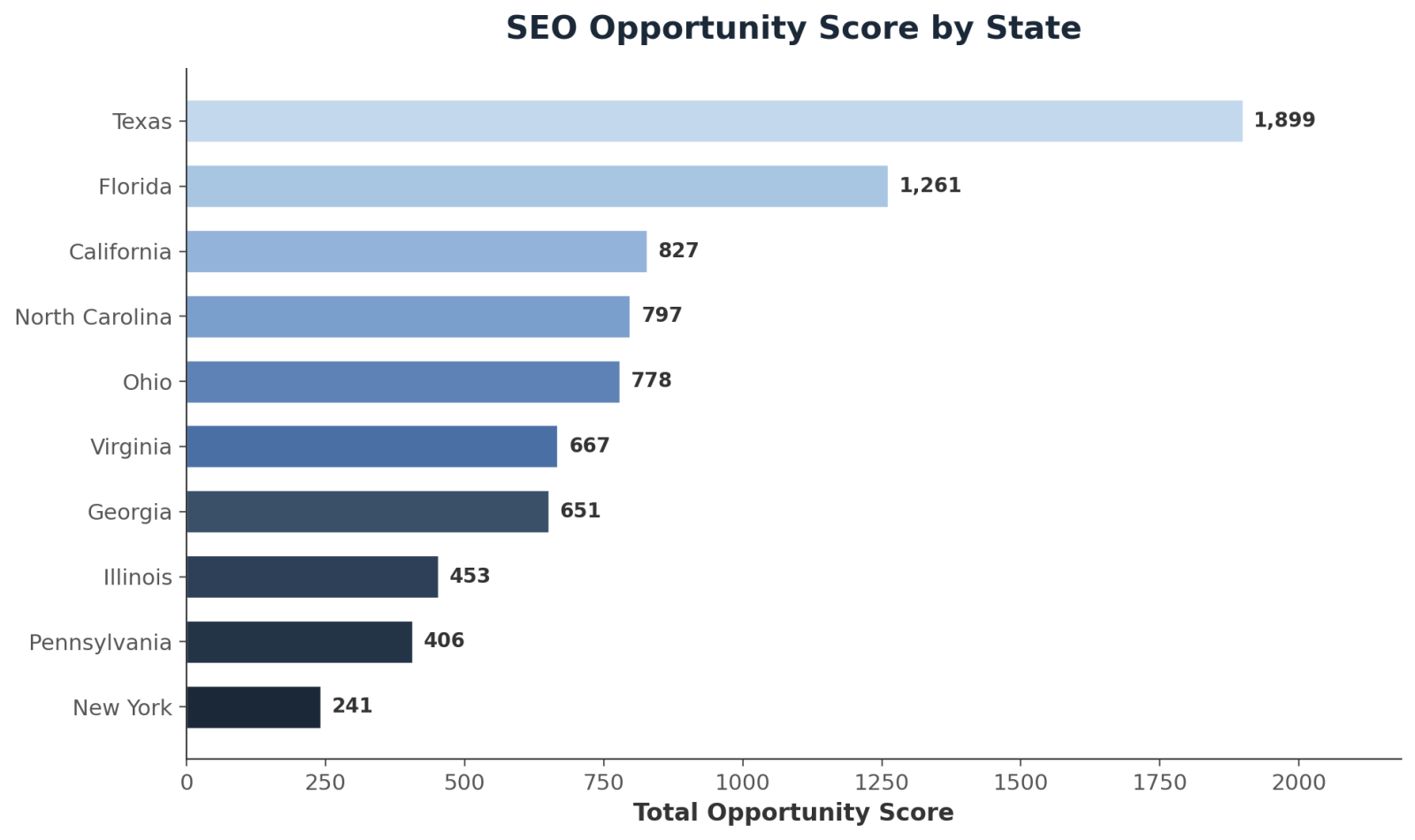
| Rank | State | Keywords | Search Vol. | Avg CPC | Opp. Score |
| 1 | Texas | 1,082 | 215,100 | $9.76 | 1,899 |
| 2 | Florida | 797 | 147,600 | $9.34 | 1,261 |
| 3 | California | 459 | 102,650 | $8.27 | 827 |
| 4 | North Carolina | 464 | 82,600 | $12.32 | 797 |
| 5 | Ohio | 424 | 74,600 | $11.42 | 778 |
| 6 | Virginia | 367 | 58,200 | $13.53 | 667 |
| 7 | Georgia | 420 | 71,500 | $10.97 | 651 |
| 8 | Illinois | 271 | 53,450 | $9.79 | 453 |
| 9 | Pennsylvania | 289 | 52,950 | $7.55 | 406 |
| 10 | New York | 209 | 32,350 | $6.45 | 241 |
Texas: the undisputed leader
Texas leads in every single category. With 1,082 keywords generating 215,100 monthly searches, the state has the largest and most diverse home improvement search market. Its opportunity score of 1,899 is 50% higher than second-place Florida.
The breadth matters. In Texas, you can build an SEO strategy across exterior, specialty, MEP, interior, outdoor, and structural services simultaneously—and find rankable keywords in every bucket.
Florida: volume without walls
Florida ranks second overall but has an interesting quirk: its highest opportunity areas (exterior at 768, specialty at 283) have very low KD scores, while its MEP category (57 score) is more competitive with a KD of 21.4. For Florida contractors, the strategy is clear—dominate the exterior and specialty categories first, then work into harder niches.
The underrated trio: North Carolina, Ohio, and Virginia
These three states consistently punch above their weight.
North Carolina has the lowest average KD (3.9) for specialty services anywhere in the dataset. It also has the fourth-highest total opportunity score despite being a mid-size state.
Ohio has the third-highest exterior opportunity score (497) with a KD of just 11.6—lower than Texas or Florida. The state also stands out for structural services, scoring 85—the second-highest structural opportunity in the dataset.
Virginia offers the highest average CPC ($13.53) of any state in our study. Combined with moderate keyword difficulty, every organic ranking you earn in Virginia displaces expensive paid clicks. Virginia’s MEP keywords deserve special attention: at $24.83 average CPC, Virginia has the second-highest cost-per-click for electrical, plumbing, and HVAC searches among the 10 states we analyzed. An electrician in Northern Virginia who ranks organically saves roughly $25 per visitor that would otherwise come through Google Ads.
New York: surprisingly weak
With the lowest opportunity score (241) and CPC ($6.45), New York is the least attractive state for home improvement SEO. Much of New York’s residential stock is apartments and co-ops, where individual homeowners don’t make repair decisions—building management companies do. Contractors targeting New York may see better returns from PPC and social media, or by focusing on the suburbs where single-family homes dominate.
The full picture: category × state heatmap
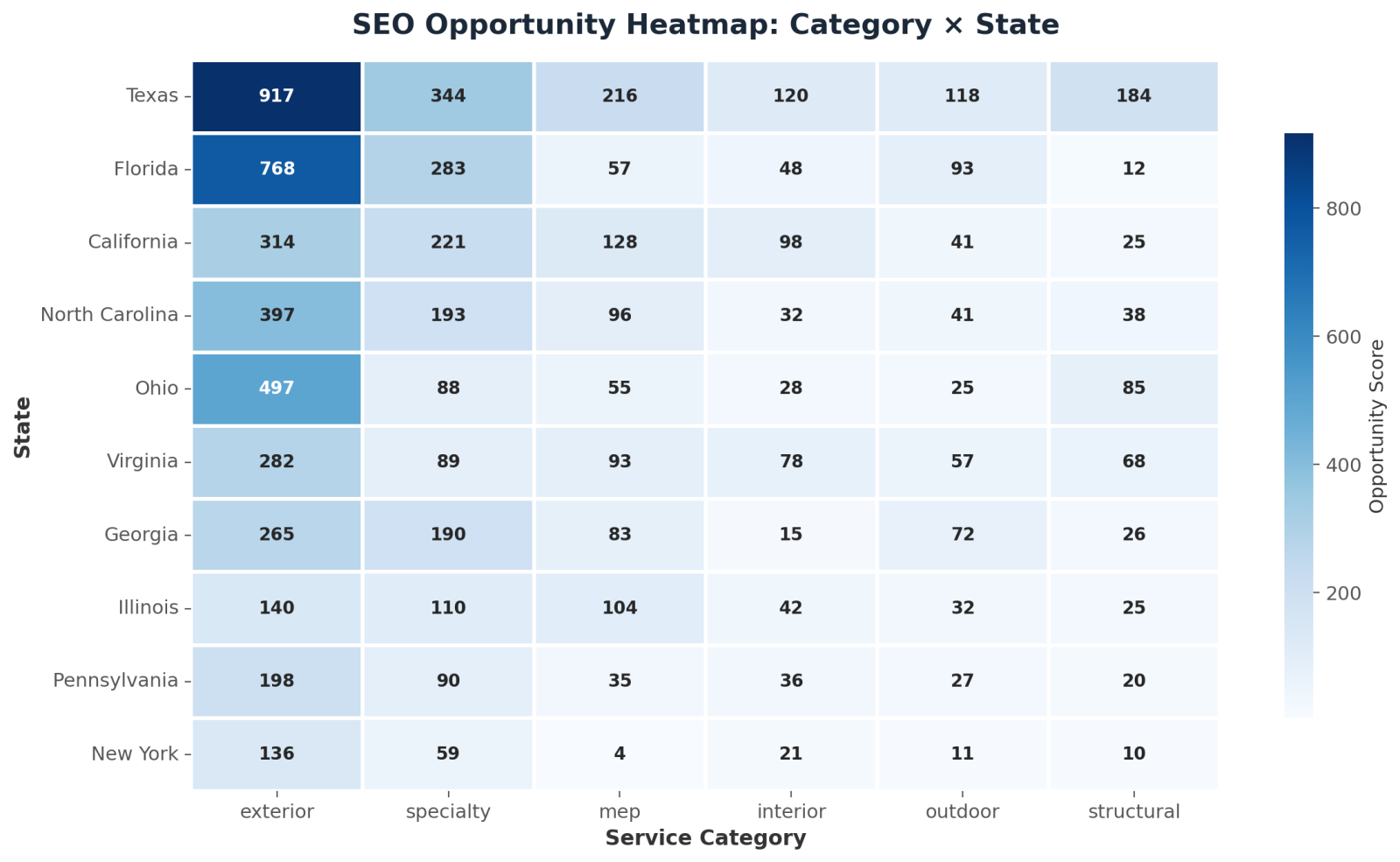
This heatmap tells the complete story at a glance. The darkest concentrations cluster around exterior services in Sun Belt states, but notice the consistent mid-tone shading across specialty services—that’s the hidden opportunity that most contractors are missing entirely.
How to turn an SEO opportunity into a useful service page
A promising keyword is a starting point. Before creating a page, check whether the search matches a service you actually provide, a location you serve, and a project your team wants to take on.
- Choose one service and a real service area. Start with work you can deliver profitably. Avoid creating location pages for areas you do not serve.
- Check the search results. If service pages dominate, improve your relevant service page. If the results answer a question, address it in a useful guide and link to the related service.
- Add evidence from your work. Show a relevant project, explain the scope, and answer the questions prospects ask before requesting an estimate.
- Measure inquiries as well as visibility. Review qualified calls and forms alongside impressions, clicks, and rankings. A higher search volume does not automatically mean better leads.
Need help choosing where to start? Explore our SEO services for construction companies and discuss your service areas and growth priorities with Loona.
Keyword difficulty vs. CPC: the strategic quadrants
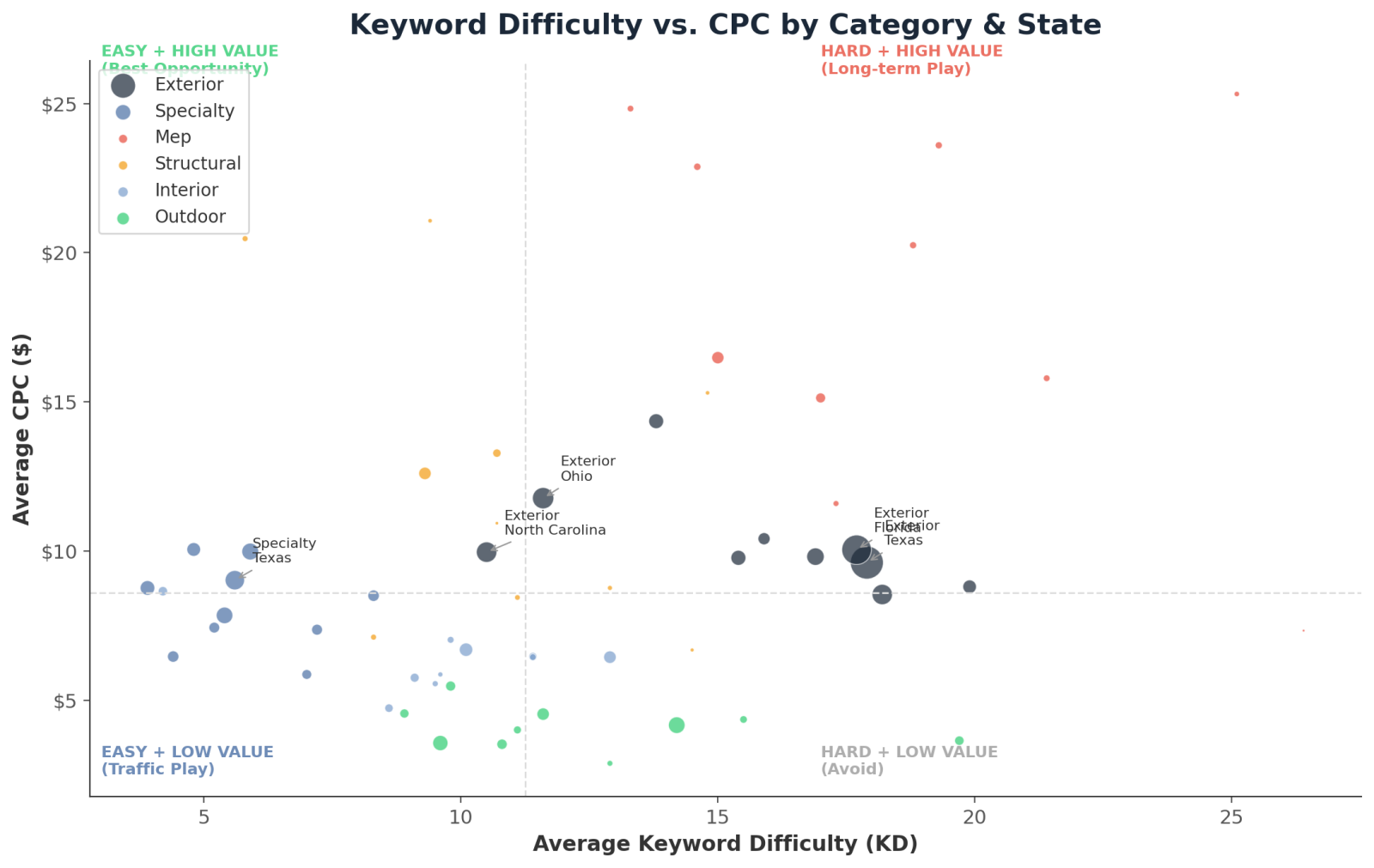
This scatter plot reveals the strategic landscape. The top-left quadrant—low difficulty, high CPC—is where you want to be. Notice how specialty services cluster heavily in that zone, while MEP keywords sit at the top with premium CPC values. Outdoor services occupy the bottom with high volume but lower commercial value.
The easy wins: where to start right now
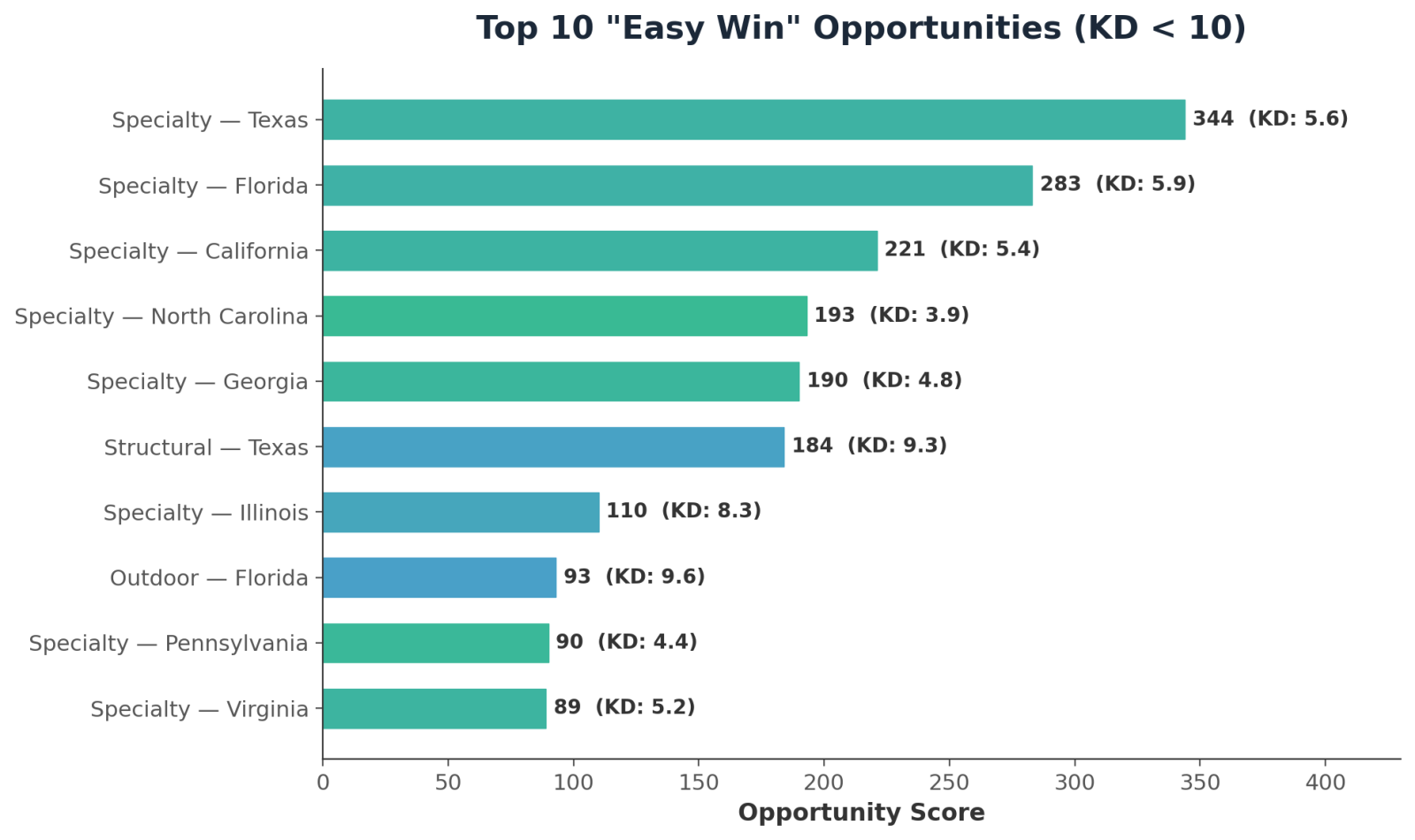
| Category | State | Avg KD | Search Vol. | Opp. Score |
| Specialty | Texas | 5.6 | 36,350 | 344 |
| Specialty | Florida | 5.9 | 27,400 | 283 |
| Specialty | California | 5.4 | 26,450 | 221 |
| Specialty | North Carolina | 3.9 | 20,600 | 193 |
| Specialty | Georgia | 4.8 | 18,100 | 190 |
| Structural | Texas | 9.3 | 14,900 | 184 |
| Specialty | Illinois | 8.3 | 12,600 | 110 |
| Outdoor | Florida | 9.6 | 22,450 | 93 |
| Specialty | Pennsylvania | 4.4 | 12,550 | 90 |
| Specialty | Virginia | 5.2 | 11,150 | 89 |
The pattern is impossible to ignore: specialty services dominate the easy-win list. Eight of the top ten opportunities by KD-to-opportunity ratio are specialty keywords. If you’re a crawl space, chimney, waterproofing, or foundation repair contractor, organic search is your most underutilized growth channel.
The high-value play: MEP keywords worth $20+ per click
For contractors in the MEP space—electricians, plumbers, HVAC technicians—the SEO opportunity is different. It’s not about massive search volume. It’s about the cost you’re currently paying for leads.
| State | Avg CPC | Search Volume | Opp. Score |
| Ohio | $25.32 | 2,800 | 55 |
| Virginia | $24.83 | 4,150 | 93 |
| North Carolina | $23.60 | 4,850 | 96 |
| Illinois | $22.88 | 5,100 | 104 |
| Georgia | $20.25 | 4,800 | 83 |
If you’re an electrician in Ohio paying $25 per click on Google Ads, ranking organically for the same keywords effectively gives you free leads. Scale that over hundreds of monthly searches, and the SEO investment pays for itself within months.
What this means for your SEO strategy
Data without action is just a spreadsheet. Here’s how to translate these findings into real decisions.
If you’re in a high-opportunity state (Texas, Florida, Ohio, NC)
Build a content strategy with two tiers. Pillar pages should target broad, high-volume service terms like “roof repair in Houston” or “bathroom remodel contractor in Dallas.” Supporting content—blog posts, FAQs, and cost guides—should target long-tail SEO keywords for construction and link back to your pillar pages. Use exterior keywords for traffic and specialty keywords for conversions.
If you’re in a high-CPC state (Virginia, North Carolina, Ohio)
Organic SEO is a cost-reduction strategy. In Virginia, where the average CPC is $13.53, replacing 100 paid clicks per month with organic traffic saves $1,353/month—over $16,000/year. And once you rank, that traffic is free every month going forward, while ad spend resets to zero the moment you stop paying.
If you’re a specialty contractor anywhere
Your SEO competition is nearly nonexistent. An average KD of 5.8 means a well-structured website with targeted service pages, a few quality backlinks, and consistent content can reach page one within months—not years. Start by creating dedicated pages for each specialty, then build supporting content (cost guides, process explainers, comparison articles), and earn a handful of quality local backlinks. For many local websites, this can be enough to start competing for page-one visibility.
If you’re in MEP
Focus on local SEO first. Optimize your Google Business Profile, build city-specific landing pages, and earn reviews. The keyword volumes are modest, but the per-click value is enormous.
If you’re in outdoor services
Content marketing is your primary play. Create comparison guides, project inspiration galleries, and cost calculators. Visual content—before-and-after galleries, video walkthroughs—serves double duty across search and social media.
How we built this analysis
This analysis wasn’t a quick spreadsheet exercise. It was a structured research project using enterprise-grade tools and a rigorous methodology.
Data source
We used Ahrefs’ Matching Terms reports to pull keyword data across multiple home improvement and construction verticals. Each export included keyword difficulty (KD), monthly search volume (SV), cost-per-click (CPC), search intent tags, SERP features, and trend data, giving us a clearer view of construction marketing SEO opportunities across states and service categories.
Processing with BigQuery
We loaded everything into Google BigQuery and ran structured queries to:
- Deduplicate and normalize keywords across 20+ export batches
- Tag each keyword with a service category—exterior, interior, specialty, MEP, structural, and outdoor
- Map keywords to U.S. states based on geo-modifiers and local intent signals
- Calculate aggregated metrics for each category-state pair
We built this framework because we believe marketing decisions should be grounded in data, not assumptions. Too many contractors choose their SEO focus based on gut feeling, competitor imitation, or whatever their agency suggests without evidence.
At Loona Agency, we take a different approach. Every strategy we build starts with research like this—specific to your service category, your geography, and your competitive landscape.
What is an “opportunity score” and how is it calculated?
Opportunity Score = (SV / 1,000) × (1 − KD / 100) × (CPC + 1)
The score balances search volume (how many people are searching), keyword difficulty (how hard it is to rank), and CPC (how much commercial value each click carries). Above 200 is strong, above 500 is exceptional, above 800 means SEO could become a primary growth engine.
Final thoughts
The U.S. construction and home improvement search landscape in 2026 is full of opportunity, but that opportunity isn’t evenly distributed. It clusters around specific category-state combinations, and the contractors who find those clusters first will have a significant, durable advantage.
The data points to three core takeaways:
Specialty services are the most underserved category in home improvement SEO. With an average KD under 6, this is the lowest-hanging fruit for any contractor in this space.
Texas and Florida lead in total opportunity, but mid-market states like North Carolina, Ohio, and Virginia offer disproportionately strong ROI due to lower competition and higher CPCs.
MEP keywords carry the highest commercial value per search. Electricians, plumbers, and HVAC contractors paying $20+ per click on Google Ads have the most to gain from an organic SEO investment.
If you’re a construction or home improvement business looking to turn search demand into booked jobs, the data says the window is still open. But it won’t stay open forever. The contractors who move first will be the ones who are hardest to displace.
FAQ
01 What is keyword difficulty (KD) and why does it matter for contractors?
Keyword difficulty is a score from 0 to 100 that estimates how hard it is to rank on Google’s first page for a given search term. A KD under 20 is generally achievable for a local contractor’s website with decent authority and good content. In our dataset, the average KD was just 12.2, meaning most home improvement keywords are still within reach for well-optimized local sites.
02 How much does SEO cost compared to Google Ads for home improvement businesses?
The average CPC across our dataset was $9.94, and MEP keywords averaged $18.32 per click. A contractor paying for 200 clicks per month on Google Ads could be spending $2,000–$3,600/month on paid traffic alone. A comparable SEO investment typically pays for itself within 6–12 months and then delivers essentially free traffic indefinitely.
03 Which U.S. states have the best SEO opportunity for contractors?
Texas leads overall with an opportunity score of 1,899, followed by Florida (1,261) and California (827). However, mid-market states like North Carolina, Ohio, and Virginia offer disproportionately strong ROI due to lower competition and higher CPCs. Virginia has the highest average CPC ($13.53) in our study, meaning every organic ranking displaces expensive paid clicks.
04 How long does it take to see results from SEO as a contractor?
For specialty services with an average KD under 6, a well-structured website can reach page one within 3–6 months. For more competitive categories like exterior services (KD 15.8) or MEP (KD 18.8), expect 6–12 months of sustained effort. Local SEO elements—Google Business Profile optimization, reviews, city-specific landing pages—often show faster results.
05 Is SEO better than Google Ads for home improvement contractors?
SEO and Google Ads work best together, but SEO often delivers better long-term ROI. Paid ads stop producing leads when the budget stops, while organic rankings can continue generating traffic and inquiries over time.
Love what you’re reading? Sign up for our newsletter to get our newest articles, helpful tips, and fresh marketing updates delivered right to you. No spam, just the good stuff.