



Construction buyers rarely choose the first company they find. Homeowners compare contractors, property managers check reviews, and commercial clients look for proof that a team can handle the scope, timeline, permits, budget, and communication. That is why SEO for construction companies is not just about ranking higher — it is about building trust before the first call.
A strong construction SEO strategy helps your company appear when people search for high-intent services such as “general contractor near me,” “home addition contractor in Dallas,” “commercial construction company in Miami,” or “office renovation contractor.” More importantly, it gives potential clients the information they need to decide whether your company is qualified for their project.
In this guide, we break down the practical parts of SEO for contractors: local visibility, keyword research, on-page optimization, technical SEO, content strategy, lead tracking, and common mistakes to avoid. The goal is simple — help your website attract better-fit visitors and turn more of them into qualified project inquiries.
How SEO fuels your construction pipeline
SEO supports the construction pipeline by connecting your website with people who already have a project in mind. These users are not passively browsing. They are comparing contractors, checking service areas, reading reviews, estimating budgets, and deciding who to contact.
For a construction company, organic search can support every stage of that decision. Service pages capture hiring intent, local pages improve city-level visibility, project content demonstrates experience, and educational blog posts answer the questions prospects ask before requesting an estimate.
Here are the main ways SEO helps construction companies generate measurable business value:
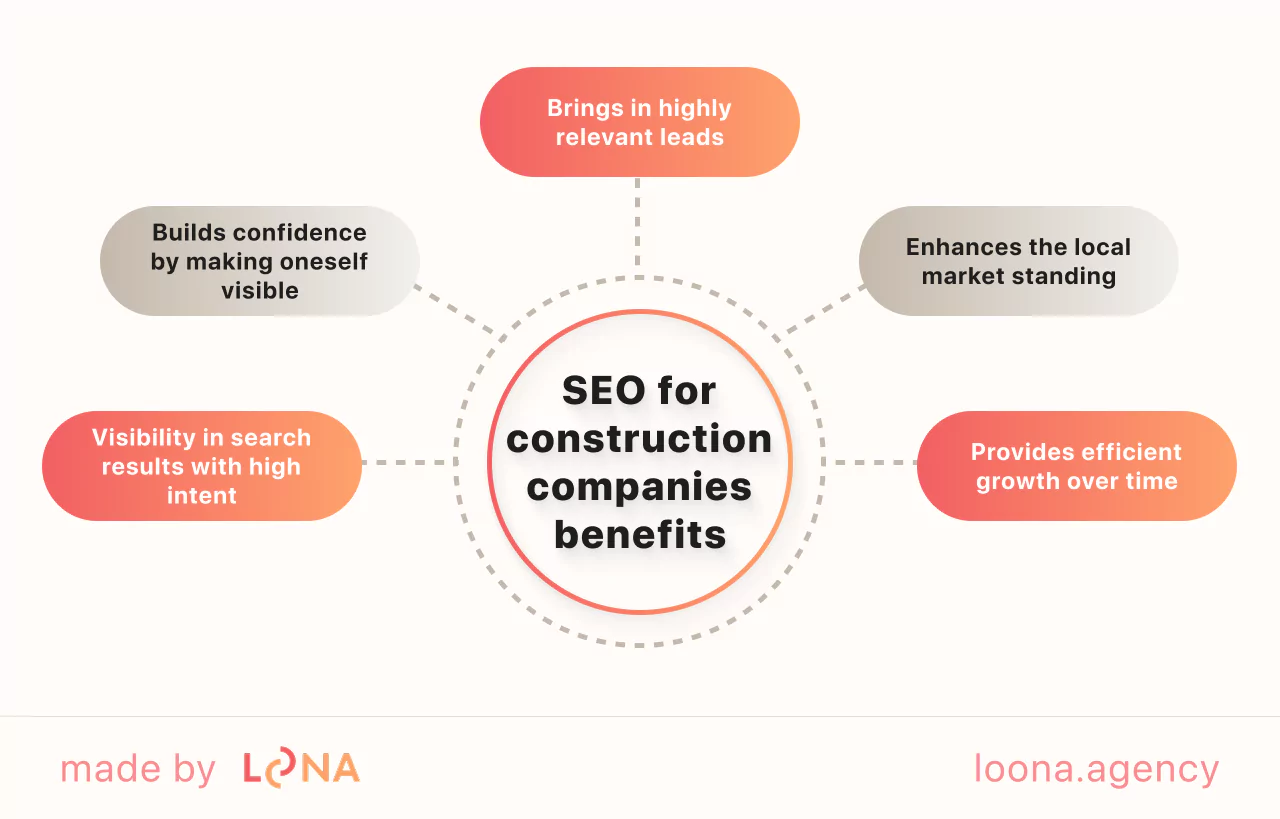
1. Visibility in search results with high intent
Most construction leads start with a specific problem or service need. A prospect may search for “kitchen remodeling contractor,” “commercial build-out contractor,” “roof replacement company,” or “general contractor in my area.” Ranking for these searches helps your company appear at the moment when the user is already close to taking action.
For construction companies, the most valuable keywords are usually not broad terms like “construction.” They are service + location searches that show clear intent to hire.
2. Builds confidence by making oneself visible
Higher visibility can support credibility, but rankings alone are not enough. Construction clients want proof. They look for project photos, clear service descriptions, reviews, case studies, licenses, service areas, and a process that feels professional.
A well-optimized website should answer the questions a real buyer has before contacting a contractor: What types of projects do you handle? Where do you work? What does the process look like? Have you completed similar jobs? When these answers are easy to find, users are more likely to trust the company and submit an inquiry.
3. Brings in highly relevant leads
The goal of SEO is not simply more traffic. It is more qualified traffic. A contractor does not need thousands of visitors who are researching generic construction ideas. The business needs users who match the right service, budget, location, and project type.
That is why construction SEO should focus on intent. A page targeting “commercial renovation contractor in Chicago” may bring fewer visits than a broad blog post, but those visits are usually more valuable because the user has a specific project need.
4. Enhances the local market standing
Most construction companies compete within defined cities, counties, or service areas. Local SEO helps Google and potential clients understand where your company works and which services you provide in each location.
Important local signals include a complete Google Business Profile, consistent business information, local reviews, city-specific service pages, relevant directory listings, and internal links between related service and location pages. When these elements work together, your company has a better chance to appear in both organic results and Google Maps for searches in your target area.
5. Provides efficient growth over time
SEO is a long-term channel. Paid ads can generate leads quickly, but visibility usually stops when the budget stops. SEO takes more time, but optimized service pages, location pages, project pages, and helpful blog content can continue attracting potential clients long after publication.
The strongest results come when SEO is treated as part of a broader construction marketing system. Search visibility, website content, calls to action, lead tracking, and follow-up processes all need to work together. That is what turns rankings into actual booked projects.
Actionable steps: Getting started with construction SEO
You do not need to start construction SEO with complicated technical work. The first step is to build a clear foundation: know which services you want to promote, which locations matter most, and what type of projects bring the best revenue.
A practical SEO plan for a contractor should begin with the pages and search terms that are most likely to generate qualified inquiries. From there, you can improve technical performance, strengthen content, build authority, and measure results.
Below are the core areas every construction company should address.
Understanding your audience
Every effective construction SEO strategy starts with understanding who the company wants to attract. A homeowner planning a bathroom remodel searches differently from a developer looking for a commercial general contractor or a property manager searching for ongoing maintenance support.
Before choosing keywords, define your highest-value customer groups. Consider project size, location, service type, urgency, budget, and decision-making process. This helps you create pages that speak to real buyers instead of writing generic content for everyone.
Finding construction SEO keywords
After defining the audience, identify the search terms they use when they are ready to compare or hire contractors. The best construction SEO keywords usually combine the service, location, and intent.
- Start with core services, such as general contracting, home additions, remodeling, commercial construction, tenant improvements, roofing, or exterior renovation.
- Add location modifiers, such as city, county, neighborhood, or service area.
- Separate hiring-intent keywords from informational keywords. For example, “commercial contractor in Austin” belongs on a service or location page, while “how long does a commercial renovation take” works better as a blog topic.
- Group keywords by service type, project type, and buyer stage so each page has a clear purpose.
Adjusting on-page SEO for construction websites
On-page SEO helps both users and search engines understand what each page is about. For construction websites, this means every important page should clearly explain the service, location, project type, process, and next step.
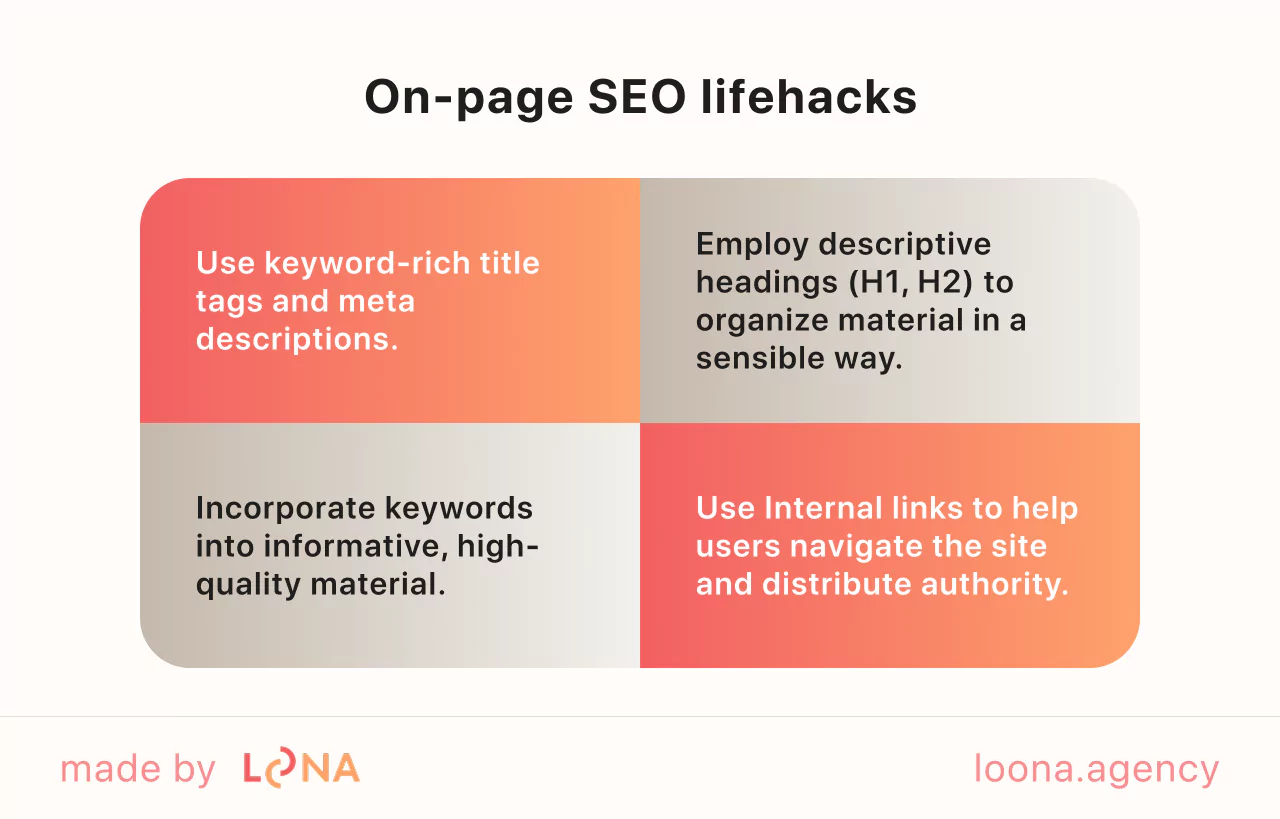
A strong service page should include a clear H1, useful subheadings, natural keyword usage, internal links, descriptive image alt text, FAQs, trust signals, and a visible call to action. Instead of repeating the same keyword too many times, focus on answering the questions a potential client would ask before requesting an estimate.
Fixing technical SEO details
Technical SEO makes it easier for Google to crawl, understand, and index your pages. It also improves the user experience, especially on mobile devices where many prospects compare contractors and call directly from search results.
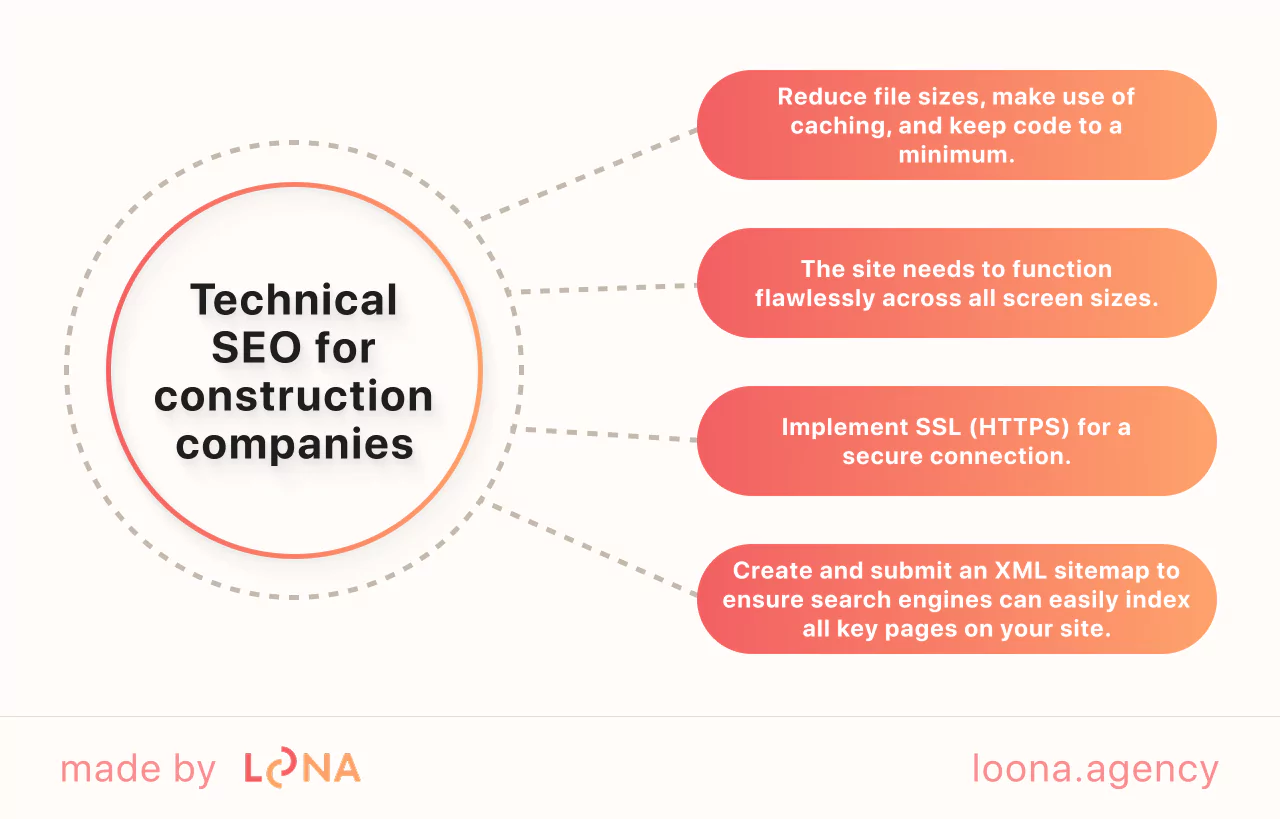
Key technical checks include indexability, canonical tags, XML sitemap status, broken links, mobile usability, page speed, large image files, structured data, and whether important content is visible without rendering issues. For construction sites, image optimization is especially important because project photos can make pages heavy if they are not compressed properly.
Gaining a local construction marketing SEO advantage
Local visibility is one of the most important parts of SEO for contractors. Most construction companies serve specific cities or regions, so your website needs to make that service area clear.
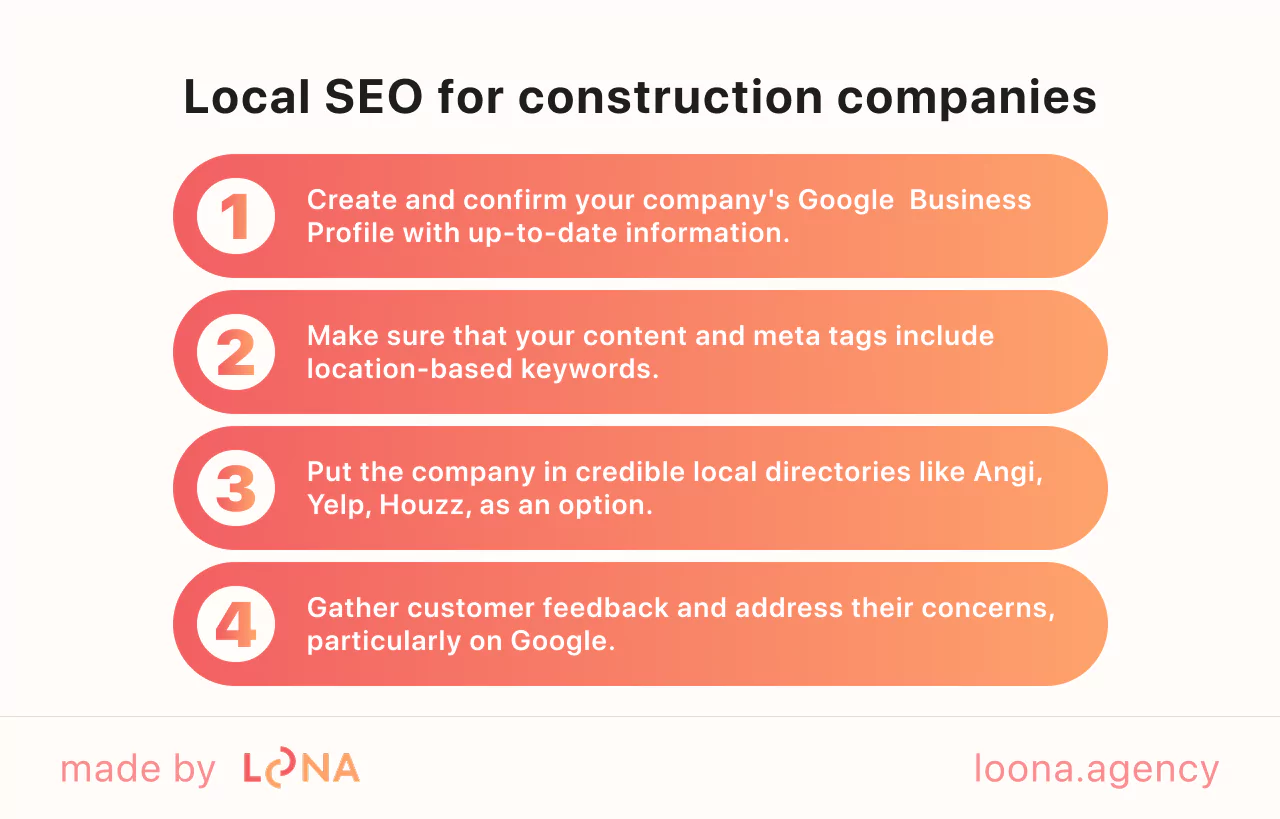
Optimize your Google Business Profile, keep your business name, address, and phone number consistent across directories, add real project photos, collect reviews, and create location-specific pages for priority markets. If you serve several cities, each important location page should include unique local details instead of copy-pasted text.
For companies that need a broader acquisition strategy, SEO should also support the full construction marketing agency approach: local search, content, website conversion, and lead tracking working together.
Earning authority across the web through link-building
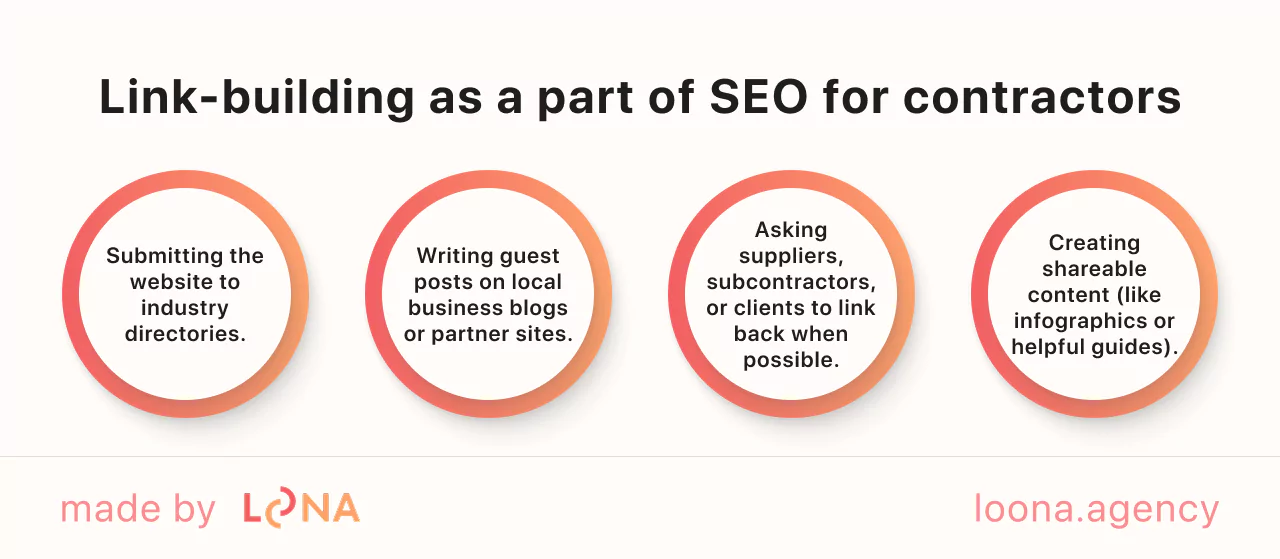
Backlinks can help strengthen authority, but quality matters more than quantity. A construction company should focus on links that make sense for the business: local chambers of commerce, industry associations, supplier partners, community sponsorships, local publications, project features, and reputable directories.
Avoid spammy link packages and irrelevant placements. A single link from a credible local or industry source can be more valuable than dozens of low-quality links from unrelated websites. Link-building should support trust, not just metrics.
Creating & optimizing content
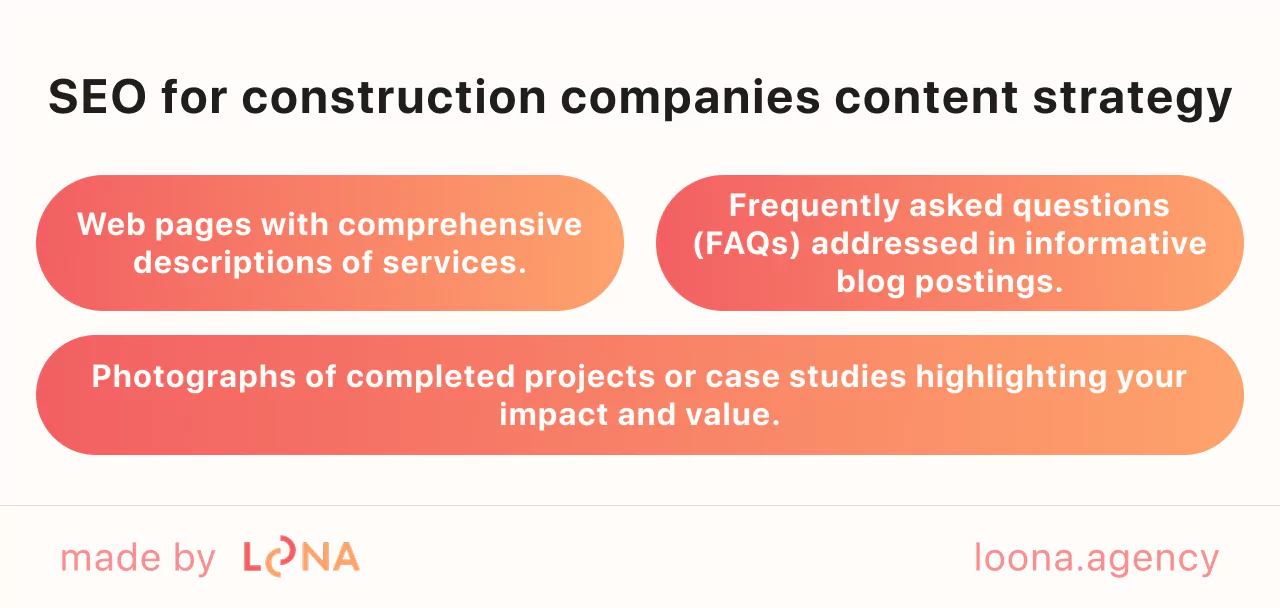
Content is where a construction company can prove real experience. Strong content should not sound like a generic marketing article. It should explain project types, timelines, planning steps, budget factors, permitting considerations, common mistakes, and what clients should know before hiring a contractor.
Google recommends creating helpful, reliable, people-first content that demonstrates expertise and gives users enough information to achieve their goal. This is especially important for construction because buyers are making high-cost decisions and need trustworthy guidance before contacting a company. You can use Google’s guidance on helpful, reliable, people-first content as a quality benchmark.
The best content marketing for construction strategy should turn real client questions into useful service pages, project pages, FAQs, and blog articles. When content is specific, accurate, and connected to the company’s actual services, it becomes a long-term SEO asset.
Measuring your SEO success
Without tracking, SEO becomes guesswork. A construction company should not measure success only by traffic or keyword rankings. The real question is whether organic search is generating qualified calls, estimate requests, consultations, and booked projects.
The best SEO reporting connects visibility to business outcomes. Track which pages bring leads, which services get the most inquiries, which locations perform best, and which keywords are connected to revenue opportunities.
Use the following tools and metrics to understand SEO performance:
Google Analytics
You may see the total number of visitors, the sources (such as organic search), the pages they viewed, and the average time spent on your site. Finding high-performing content and underperforming sites becomes much easier with its guidance.
Google Search Console
Google Search Console shows how your website performs in Google Search. Use it to monitor impressions, clicks, average positions, indexing issues, page experience signals, and the queries that bring users to your site. For construction companies, it is especially useful for finding service and location keywords that are close to ranking higher.
Google Business Profile insights
Google Business Profile insights help measure local visibility. Track calls, website clicks, direction requests, profile views, and the search terms that triggered your listing. These numbers are important because many contractor leads happen directly from local search results before the user visits the website.
Keyword ranking tools
Ranking tools such as Ahrefs, Semrush, or other SEO platforms can show how your priority keywords move over time. Track terms by service and location, not only broad phrases. A ranking increase for “commercial contractor in Tampa” may be more valuable than a higher position for a generic informational keyword.
Lead tracking
Lead tracking connects SEO activity to real business results. Track form submissions, quote requests, phone calls, consultation bookings, and the source of each lead. If possible, connect website analytics with CRM data so you can see which organic pages generate qualified opportunities.
For a complete lead generation for construction strategy, SEO should be measured by lead quality as well as traffic. Monthly reporting should show what improved, what declined, which pages need updates, and which services or locations deserve more focus.
When SEO is measured properly, construction companies can make better marketing decisions and turn search visibility into a predictable source of project inquiries.
Common SEO construction mistakes (beware)
Even experienced construction companies can lose SEO opportunities because of avoidable website issues. In many cases, the problem is not the quality of the service. The problem is that the website does not clearly communicate expertise, location, services, or trust signals.
Here are the most common SEO mistakes contractors should avoid:
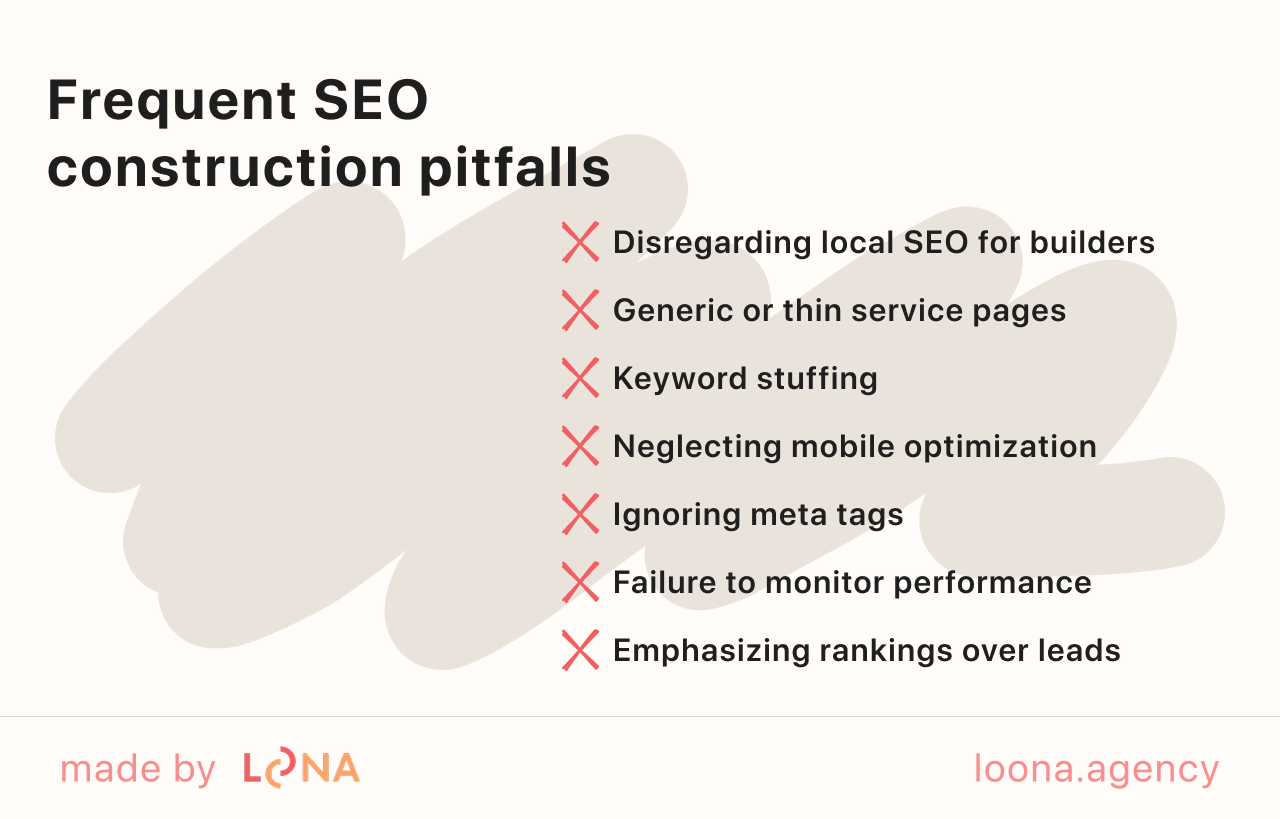
1. Disregarding local SEO for builders
Ignoring local SEO can prevent your company from appearing for the searches most likely to convert. Contractors should optimize Google Business Profile, use consistent business information, collect reviews, and create pages for priority service areas.
2. Generic or thin service pages
A short paragraph with a list of services is usually not enough. Service pages should explain what the service includes, who it is for, what project types you handle, where you work, what the process looks like, and why your company is qualified.
3. Keyword stuffing
Repeating the same keyword unnaturally makes content harder to read and can reduce trust. Use keywords naturally, include related terms, and focus on answering real client questions. A page should sound like it was written for a potential customer, not for a search engine.
4. Neglecting mobile optimization
Many construction prospects search from mobile devices, especially when comparing contractors quickly or calling directly from search results. A slow website, small buttons, difficult forms, or hard-to-read pages can reduce both rankings and conversions.
5. Ignoring meta tags
Title tags and meta descriptions help users understand what a page offers before they click. Each important construction page should have a clear title that includes the service and, when relevant, the location. The meta description should explain the value of the page and encourage the right users to visit.
6. Failure to monitor performance
If performance is not measured, it is hard to improve. Google Analytics, Google Search Console, call tracking, and form tracking help show which pages are working and which need attention. Without this data, SEO decisions are based on assumptions.
7. Emphasizing rankings over leads
Rankings matter, but they are not the final goal. A construction company should focus on the keywords and pages that attract people who are ready to discuss a project. A lower-volume keyword with strong hiring intent can be more valuable than a broad keyword that brings unqualified traffic.
Avoiding these mistakes can make SEO more effective and easier to measure. With the right strategy, a construction website can become a reliable lead-generation channel instead of a passive online brochure.
Next, let’s look at when it makes sense to manage SEO in-house and when a construction company should work with an external team.
Advanced SEO tactics for competitive advantage
Once the SEO foundation is in place, construction companies can use more advanced tactics to compete in crowded local markets. These strategies are most effective when the website already has strong service pages, technical health, local signals, and consistent content.
1. Using programmatic SEO to expand your location
Programmatic SEO can help companies scale location or service pages, but it must be handled carefully. Every page should provide unique value, not just swap city names in the same template. For construction companies, this means adding real service details, local context, project examples, FAQs, and clear calls to action.
2. Integrating first-party data
First-party data makes construction SEO more accurate. Use information from sales calls, estimate requests, CRM notes, form submissions, and customer questions to guide content. If prospects repeatedly ask about timelines, permits, costs, or project phases, those topics should appear on your service pages and blog.
3. Leveraging entity-based SEO & semantic optimization
Modern SEO is not only about exact-match keywords. Search engines also evaluate topics, relationships, and context. A construction website should build topical relevance around services, project types, locations, materials, processes, and customer questions.
Internal links should connect related pages in a logical way. For example, a commercial construction page can link to tenant improvement content, case studies, and location pages. This helps users explore the site and helps search engines understand how the content is connected.
These advanced tactics can create a competitive advantage, but only when they are built on accurate, helpful, and experience-based content.
Outsource vs. in-house SEO construction experts
Construction companies often need to decide whether to manage SEO internally or work with an agency. Both options can work. The right choice depends on your team, budget, timeline, competition, and growth goals.
In-house SEO gives you direct control and access to internal knowledge. However, it requires time, tools, technical experience, content production, and ongoing analysis. An agency can provide a more structured process, faster implementation, and broader expertise across local SEO, content, technical SEO, analytics, and conversion strategy.
Here is a simple comparison:
| Category | In-house SEO | Outsourced SEO (Loona) |
| Expertise | May require months of learning and upskilling | Ready-to-go team with industry-specific experience |
| Tools & technology | Often limited to basic/free tools | Access to advanced SEO tools and platforms |
| Time investment | High—SEO takes hours per week to do well | Managed for you, freeing time for core construction work |
| Speed of results | Slower, especially at the beginning | Faster results with proven strategies and technical audits |
| Cost | Lower on paper, but higher when factoring in time and tools | Fixed monthly fee, often more cost-effective in the long run |
| Scalability | Depends on internal resources | Easily scales as your business grows |
| Consistency | Can fluctuate with internal workload | Ongoing, dedicated focus on SEO and performance tracking |
For construction companies that want consistent execution and measurable growth, working with a specialized SEO partner can be the more efficient option. The value is not only outsourcing tasks. It is getting a strategy that connects rankings, local visibility, content quality, technical performance, and lead generation.
Loona Agency is your SEO for construction company expert
Loona helps construction and home improvement companies build SEO systems that support real business growth. Our work focuses on the areas that matter most for contractors: local visibility, high-intent service pages, helpful content, technical performance, lead tracking, and conversion-focused website improvements.
We approach construction SEO with a practical understanding of how buyers choose contractors. A homeowner, property manager, or commercial decision-maker needs more than a list of services. They need proof of experience, clear communication, trust signals, and an easy path to request a quote.
Our team supports construction companies with SEO audits, keyword research, content planning, on-page optimization, technical fixes, local SEO, link-building guidance, and ongoing reporting. The goal is to improve search visibility while helping the website generate better-quality inquiries.
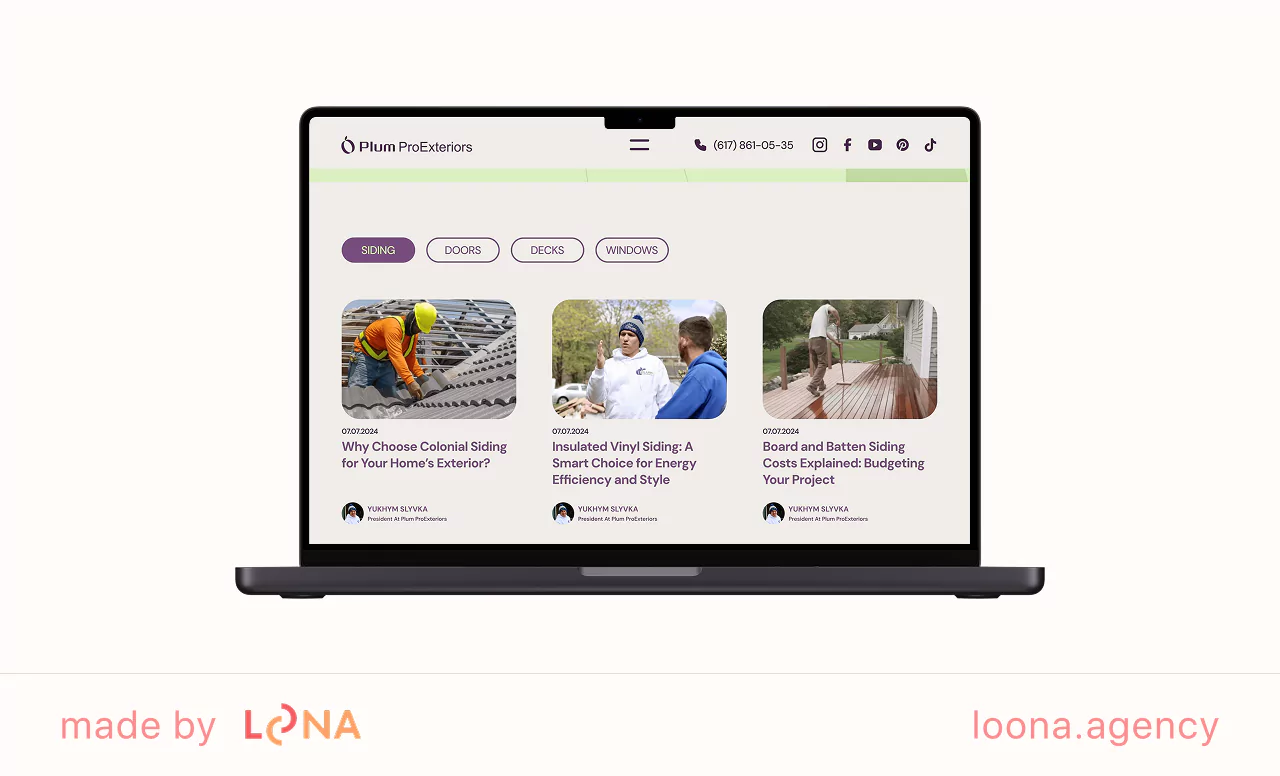
Plum ProExteriors had strong services, but the company was not getting enough visibility in local search and its website did not fully support lead generation. Loona rebuilt the website experience, improved local SEO foundations, strengthened organic visibility, and focused the strategy on qualified traffic from relevant service areas.

Value delivered for Plum ProExteriors
- +200% domain rating increase – Strengthened organic authority through targeted, relevant link-building.
- +900% growth in organic traffic – Increased visibility from users searching for relevant services.
- Google Business Profile optimization – Improved local presence with better profile structure, updates, and local engagement signals.
- Local keyword domination – Achieved top 10 rankings for high-intent, region-specific search terms.
- Geographic coverage expansion – Improved visibility across 90% of priority cities in the service area.
- Content strategy execution – Created SEO-focused blog and local service content to support long-term growth.
- Google Maps positioning – Strengthened map visibility for mobile-first local searches.
- Complete website redesign – Built a modern, user-friendly website experience focused on trust and lead conversion.
If you are looking for SEO for general contractors, Loona can help you build a search strategy that supports visibility, trust, and qualified lead generation. We combine construction-industry understanding with technical SEO, content strategy, local optimization, and performance tracking.
Conclusion
SEO for construction companies works best when it reflects how people actually hire contractors. Prospects want clear services, local relevance, proof of experience, project examples, reviews, and a simple way to request a quote. Search engines also need clear page structure, useful content, technical accessibility, and strong topical signals.
A complete construction SEO strategy should include keyword research, service-page optimization, local SEO, technical improvements, content development, authority-building, and lead tracking. When these pieces work together, your website becomes more than a brochure. It becomes a long-term source of qualified project inquiries.
Loona helps construction companies turn organic search into measurable growth. If your website is not generating enough qualified leads, our team can help identify what is holding it back and build a strategy focused on visibility, trust, and conversions.
FAQ
01 What does SEO stand for in construction?
In construction, SEO stands for search engine optimization. It is the process of improving a contractor’s website and local presence so potential clients can find the company when searching for construction services, project information, or local contractors.
02 What are the 4 Ps of marketing for construction companies?
The 4 Ps are Product, Price, Place, and Promotion. For construction companies, this means clearly presenting your services, explaining value, targeting the right service areas, and promoting the business through channels such as SEO, local search, paid ads, reviews, and content.
03 What’s the cost of SEO for construction?
SEO for construction companies can vary widely depending on the market, competition, website condition, number of services, number of locations, and scope of work. Many professional SEO campaigns start around $800 per month and can exceed $5,000 per month for competitive markets or larger strategies.
04 Is SEO necessary for construction?
Yes. SEO is important for construction companies because many clients search online before contacting a contractor. Strong SEO helps your company appear for relevant services, build trust with helpful content, and convert search traffic into qualified inquiries.
Love what you’re reading? Sign up for our newsletter to get our newest articles, helpful tips, and fresh marketing updates delivered right to you. No spam, just the good stuff.