



Franchise digital marketing is the coordinated system home service brands use to rank and generate leads across every location while protecting the parent brand. For HVAC, plumbing, lawn care, and cleaning franchises, it means running SEO, Google Ads, and content on two levels at once: corporate messaging up top, local execution on the ground. Get the wiring right, and 40 locations each dominate their own city. Get it wrong, and neighboring franchisees bid against each other, duplicate location pages tank rankings, and you’re paying to compete with yourself.
This guide breaks down the exact structure that scales without cannibalizing itself, from geo-fencing to location-level ROI. Let’s start with what franchise digital marketing actually is.
What Is Franchise Digital Marketing?
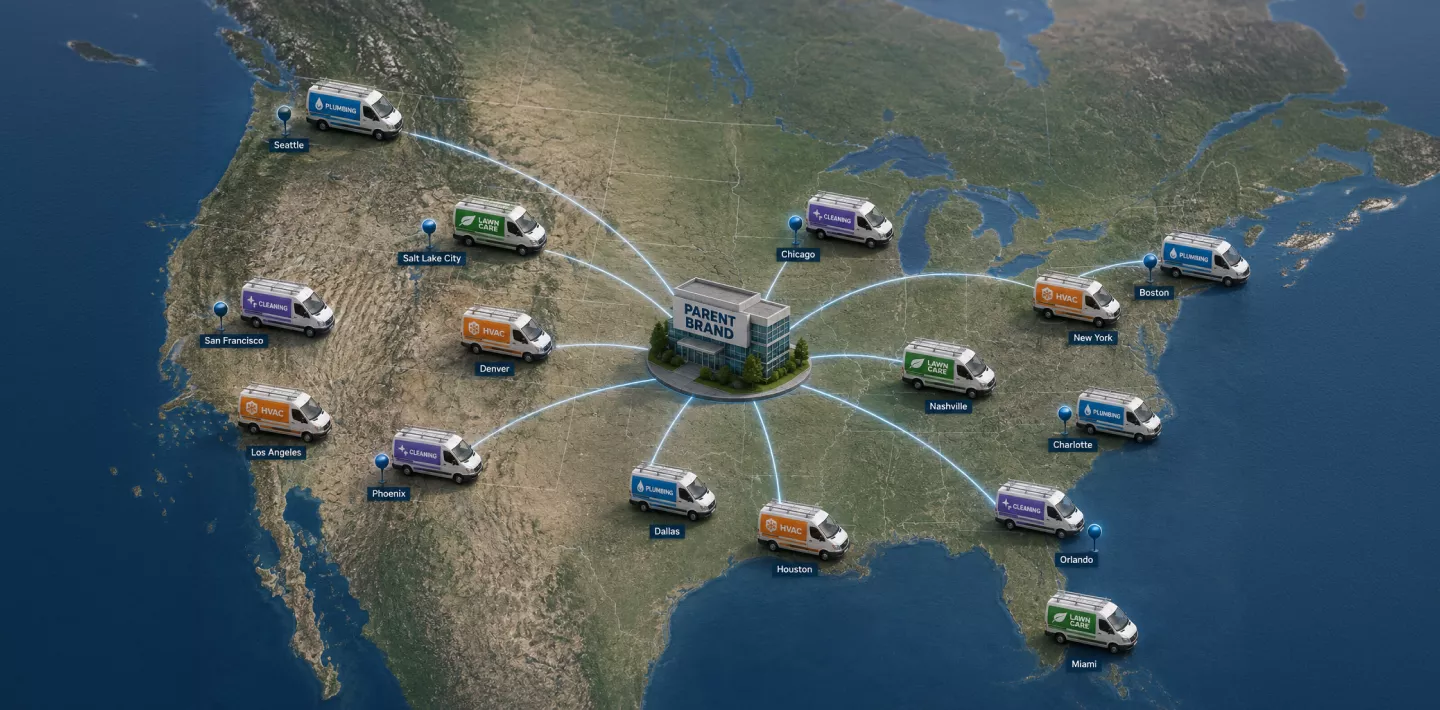
Franchise digital marketing is the coordinated management of SEO, paid ads, and content across two levels at once: the corporate brand and every individual franchisee. Done right, each HVAC or plumbing location ranks in its own city without stepping on the parent brand. Done wrong, you get 40 locations all sounding identical and none of them ranking.
Think of it as two layers working together. The corporate brand strategy layer sets national messaging, brand guidelines, and paid brand campaigns. This is where your logo, review-response tone, and core promise stay locked. It’s the foundation that keeps a lawn care franchise in Dallas recognizable as the same company operating in Denver.
The local franchisee execution layer handles local SEO, geo-targeted local ads, and community content. This is where a cleaning franchisee talks to their specific neighborhood, runs offers for their ZIP codes, and builds reviews tied to their address. The two only work when they’re wired together. Most successful brands run a two-tier model where corporate owns brand messaging and franchisees own market-specific tactics.
So what makes digital franchise marketing different from marketing a single shop? You’re not optimizing one business. You’re running a coordinated SEO, ads, and content system that scales across dozens of markets while protecting a single brand. That’s the balancing act franchise digital marketing solves. That two-tier structure is exactly why home service franchises face a distinct set of marketing challenges that generic playbooks don’t solve.
Why Home Service Franchises Need Multi-Location Marketing
Generic digital marketing for franchise companies assumes every location is a fresh start in an empty market. Home service brands know better. HVAC, plumbing, lawn care, and cleaning franchises share borders, and those borders create problems a one-size playbook typically ignores.
The first is territory overlap and lead cannibalization. When two nearby franchisees bid on the same “emergency plumber near me” search, they inflate each other’s click costs and split leads that should’ve gone to one. Nobody wins except Google. This shows up fast in franchise PPC, where uncoordinated campaigns drive up costs across the whole network.
The second problem is duplicate “find a location” directory pages. Most franchises spin up identical location pages with the same copy swapped by city name. Search engines read that as duplication and strip the ranking potential, pushing franchisees back toward paid ads to compensate.
Then there’s the tension between brand consistency and local relevance. Push too hard on central control, and your Denver location sounds like a robot. Give total freedom, and franchisees create off-brand assets. Inconsistent local marketing correlates with 31% higher acquisition costs, per a 2024 IFA analysis.
Finally, franchisee buy-in matters more than owners expect. One franchisee ignoring a bad review can spill onto the entire network’s reputation. Would you trust a brand where one location botches every complaint?
Your locations aren’t independent businesses. They’re a connected system, and marketing them like isolated shops leaves money on the table. Solving that tension starts with defining who controls what between corporate and the local franchisee.
Corporate Control vs. Local Flexibility
So where’s the line? Lock the things that protect the brand. Free the things that win local trust.
Keep visual identity, review-response tone, and core messaging under corporate control. These stay identical whether a franchisee operates in Phoenix or Portland. That’s what makes your HVAC brand recognizable across state lines.
Then hand franchisees bounded autonomy over what’s genuinely local: landing page copy, community content, and geo-targeted offers. A plumbing franchisee should be able to mention the neighborhood they just served or a seasonal deal their market actually responds to. Neither extreme works. Full centralization makes you sound robotic; a free-for-all fractures the brand. In most cases, you want locked guidelines plus room to breathe. That balance shows up most clearly in how franchise brands approach local search engine optimization.
Local SEO For Multi-Location Franchise Brands
Ranking 30 locations isn’t 30 times harder than ranking one. It’s a different game entirely. Copy-paste directory pages won’t cut it, and neither will one central listing pretending to serve every market.
Start with citation building and consistency across data aggregators. Lock onto a single NAP format as your master reference, then push identical data to Data Axle and Neustar Localeze, plus Bing Places, Apple Maps, and Yelp. A single source of truth stops the drift that happens when different managers handle each location independently. Audit quarterly to catch what slips.
Review generation and response are the other levers, and they’re underused. Review signals carry roughly 16% of local ranking weight in 2026, behind only Google Business Profile and on-page signals. Google rewards active response, so a plumbing franchisee replying to every review isn’t just being polite. They’re feeding a ranking signal.
Volume matters too. Franchises with more than 50 Google reviews earn 45% more clicks than those with fewer than 10. And reviews spill across the network: one bad outlet drags the whole brand’s perception down.
Underneath all of it are unique location landing pages and a fully optimized Google Business Profile for each market. That’s the foundation for search engine optimization. Getting search engine optimization right at scale is exactly what our Boston SEO services for local franchises are built around for digital marketing for local franchise owners. The Google Business Profile is such a critical piece of this puzzle that it deserves its own playbook at scale.
Optimizing Google Business Profile Per Location
Managing 30 Google Business Profile listings by hand isn’t realistic. You need bulk workflows. Update hours, photos, and service areas across every franchisee at once, not one login at a time. Then standardize service categories and profile fields so that an HVAC location in Austin uses the same “HVAC contractor” primary category and the same service list as one in Houston. Mismatched categories confuse Google and split your ranking signals.
Reviews need a standardized response cadence per location, too. Set a rule: every review answered promptly, within a consistent brand-defined window, in an on-brand tone, no exceptions. Consistency across the network is what protects the parent brand’s reputation. Google Business Profile only works if it points to a location page with accurate, consistent NAP data.
Location Pages And NAP Consistency
Every franchise location needs its own landing page. Not a cloned template with the city name swapped out. Real, unique copy about that market’s services, neighborhoods, and team.
NAP format matters just as much. “Brand Name Phoenix” and “Brand Name – Phoenix, AZ” look identical to you, but search engines treat them as two separate businesses. That halves your ranking signals.
So pick one exact format and use it everywhere: the same name, the same address style, and the same local phone number. A plumbing franchisee who mixes a central 800 number with a local line across different listings quietly sabotages their own rankings. Strong local SEO earns organic visibility, but Google Ads is how franchise locations generate on-demand leads.
Google Ads Strategies For Franchise Lead Generation
One shared regional Google Ads account is where franchise lead budgets go to die. Google funnels spend toward high-population markets and starves the smaller ones.
The fix is a location-isolated campaign structure: one campaign per location or a tight cluster of locations. That gives you precise geo-targeting and budget control per franchisee, and it stops two HVAC locations from bidding on the same broad keyword and inflating each other’s CPCs. Pair that with a national brand campaign run by corporate and local lead-gen campaigns managed at the franchisee level.
Call tracking isn’t optional here. Most home service leads come by phone, and speed-to-answer decides whether they convert. Calls answered within 15 seconds convert at 2.1x the rate of those answered after 45 seconds. Track every call by location, tie it to lead quality, and you’ll see which franchisees close and which drop the phone.
Then allocate the budget based on cost per lead and market opportunity, not an equal split. Why give a slow market the same dollars as one converting at half the cost? Feed the locations with lower cost-per-acquisition and stronger population and competition data.
Want this built out correctly across every location? Get a free estimate and start generating more leads for your home service business today. The most important safeguard in that structure is precise geo-fencing between neighboring territories.
Geo-Fenced Campaigns For Local Leads
When two franchisees sit within 15 miles of each other, loose targeting turns them into competitors. Tight geo-fencing fixes that.
Set granular radius or polygon targeting down to about 1km where markets sit close, matched to each location’s catchment area. Layer ZIP exclusions and bid adjustments near borders so the closest location wins the click.
Add negative keywords and territory exclusions for neighboring markets too. A plumbing location shouldn’t chase searches meant for the franchisee next door. This geo discipline keeps Google Ads profitable across a network, and it’s core to how our Portland SEO agency for multi-location brands structures local campaigns.
Content Marketing And Social Media For Franchises
Ask a franchisee to build content from scratch every week, and it won’t happen. They’re running service calls, not writing captions. That’s why scalable content typically lives in a two-part model.

Corporate builds the centralized content library – the hub of approved graphics, copy, and templates.. Franchisees add the spoke, customizing with local imagery, neighborhood mentions, and seasonal offers. A lawn care franchisee drops in a photo of the yard they just finished; the frame and brand voice stay locked.
Govern the cadence with a hub-and-spoke ratio. A 70/30 balance of educational content versus promotional content keeps feeds useful rather than salesy, and corporate ships’ monthly frameworks franchisees adapt to fast. That governance rhythm is what keeps digital marketing for franchise networks consistent without smothering local voices.
Platform choice matters for social media marketing too. Instagram engagement is roughly three times higher than Facebook’s, so allocate your effort to Instagram for reach-per-post, while Facebook still covers broad local visibility. Don’t spread thin across five platforms; pick two and post well.
One local tactic to keep steady: post to Google Business Profile a few times a week. Dormant listings lose the direction requests that active ones earn. For service-specific playbooks, our digital marketing tactics for landscaping businesses break down how local social media marketing converts into booked jobs. With SEO, ads, and content strategy in place, the next decision is who will actually execute them: an in-house team or a specialized agency.
Choosing a Franchise Digital Marketing Agency
Here’s the number that decides most of this: building a four-person in-house team runs $450,000 to $550,000 a year once you factor in salaries, benefits, and overhead, with roughly three months before real output. A franchise digital marketing agency typically lands at a fraction of that monthly cost. So the choice comes down to budget, control, and speed to scale.
An in-house marketing team gives you full control and deep brand knowledge. It fits franchises running steady, long-term programs across every location. The tradeoff is cost and slow scaling.
A franchise digital marketing agency flips that. You get specialized skills, faster scaling across markets, and a franchise digital marketing company that’s already solved geo-fencing and Google Business Profile problems. You hand over some execution control in exchange.
The hybrid model splits the difference: keep brand strategy in-house, outsource technical execution to a digital marketing agency. For most growing home service franchises, that’s the practical middle.
| Factor | In-house team | Franchise agency | Hybrid model |
|---|---|---|---|
| Annual cost | $450K-$550K | Lower, monthly | Mid-range |
| Control | Full | Partial | Strategy retained |
| Speed to scale | Slow | Fast | Moderate |
| Best for | Steady programs | Aggressive growth | Most franchises |
Which one matches your growth plan? Want it scoped out? Get a free estimate and start generating more leads for your home service business today. Whichever model a franchise chooses, the only way to prove it’s working is with clean, location-level reporting.
Measuring ROI Across Every Franchise Location
System-wide averages lie. A network hitting a healthy blended cost per lead can still hide three franchisees bleeding money. A sound franchise digital marketing strategy measures performance at the location level, where the money actually moves.
Start with cost per lead by location. Calculate it per franchisee, not blended:
cost per lead = ad spend ÷ total leads
A plumbing location in Denver paying double what Austin pays needs a fix, and the average would’ve buried that.
Next, track conversion rate by channel. Which source books jobs, and which just burns the budget? Google Ads, local SEO, and social each convert differently per market, so break them out. These are the marketing strategies you keep or cut based on evidence, not gut.
Then tie it to marketing-attributed revenue and ROAS. Leads are nice; booked revenue pays the bills. Attribute closed jobs back to the channel and campaign that drove them so you can prove which multi-location marketing KPIs actually earn.
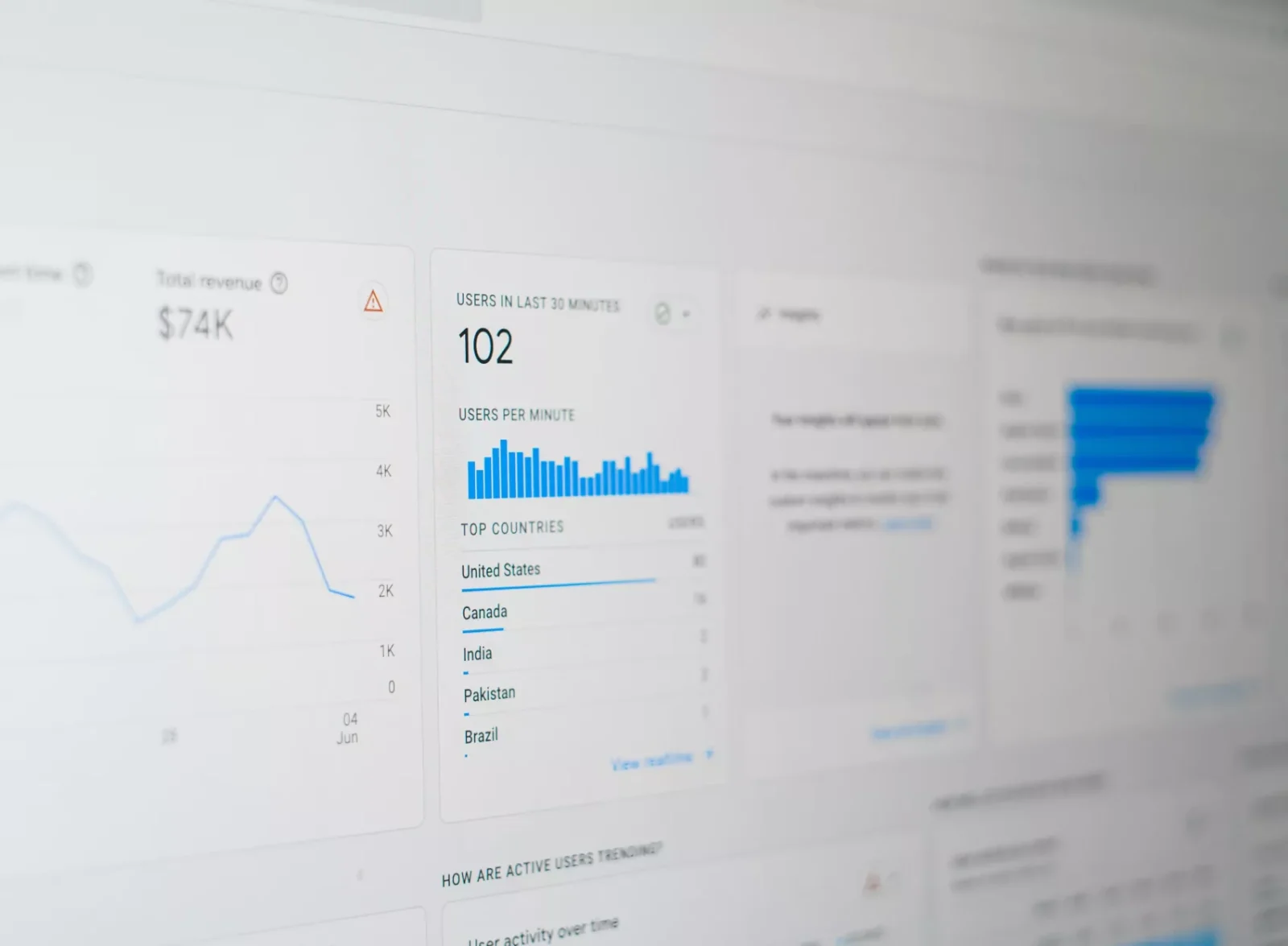
Finally, build location-level dashboards benchmarked against system averages. Show each franchisee where they rank against the network, and you’ll see who’s winning and who needs help. You can also track your franchise’s Google rankings per market to connect visibility gains to lead flow. None of these frameworks matter without a track record, so here’s what industry observers consistently report managing franchise accounts.
What Industry Observers Report Managing Franchise Accounts
The pattern repeats across dozens of home service franchise engagements. The accounts that grow fastest aren’t the ones that pour money into ads first. They’re the ones that fix the plumbing before turning on the tap.
Here’s what that looks like in practice. Reviewers consistently report that neighboring HVAC franchisees bidding on the same emergency searches incur double-click costs and split leads. Fixing geo-fencing alone – tightening the targeting radius and adding territory exclusions – reduces wasted spend before a single new dollar hits the account.
Google Business Profile hygiene is the other early win. Mismatched categories, inconsistent NAP data, and dormant listings quietly bleed rankings. Cleaning those up costs nothing but attention, and it often lifts local visibility faster than paid campaigns do.
Why fix these first? Because pouring an ad budget into a broken structure just scales the waste. You’d be paying to compete with yourself. The sequence that works is boring on purpose: lock the NAP master format, standardize every profile, isolate campaigns by territory, then open the budget. Ad spend performs when the underlying foundation is clean.
Industry reports note that cleaning franchises following that sequence saw cost per lead drop across locations before any budget increase. The lesson holds consistently. Foundation first, spend second, and the numbers follow. That discipline is what separates a franchise network that scales from one that just spends.
Franchise Digital Marketing That Scales Without Cannibalizing Itself
The brands that win aren’t spending more. They’re sequencing smarter: lock the NAP master format, standardize every Google Business Profile, isolate campaigns by territory, then open the budget. Foundation first, spend second.
That order matters because franchise digital marketing lives or dies on structure. Two neighboring HVAC locations bidding on the same “emergency” search don’t grow the network; they burn it. Clean geo-fencing, unique location pages, and location-level ROI tracking turn a scattered set of shops into a connected system that ranks and converts.
Want to see how other home service brands structured this? Our case studies show the before-and-after on cost per lead across real multi-location accounts. If you’d rather dig into tactics first, our marketing blog breaks down local SEO, Google Ads, and content workflows step by step.
Ready to scope your own network? Reach out to the team for a free estimate and start generating more leads for your home service business today.
FAQ
01 How much does franchise digital marketing cost?
Most franchises spend 7-11% of revenue on marketing. Smaller systems under $5M in sales sit at the lower end. Costs scale with the number of locations, ad spend, and whether you execute in-house or through a digital marketing agency.
02 Should each franchise location manage its own marketing?
No. Full local autonomy risks brand inconsistency and duplicate ad spend between neighboring franchisees. A hybrid model with a centralized strategy and local execution controlled by an agency performs better.
03 What’s the difference between franchise marketing and general digital marketing?
Franchise marketing balances one brand voice with dozens of local audiences at once. General digital marketing serves a single business with one target market and no territorial conflicts.
04 How do multi-location franchises rank in local search?
Ranking depends on consistent NAP citations, unique location pages, and a fully optimized Google Business Profile per address. Duplicate "find a location" pages across territories actively hurt rankings rather than help.
05 Can franchisees run their own Google Ads campaigns?
Yes, but without corporate oversight, they risk bidding against neighboring locations. Presence-based targeting and shared negative keyword lists prevent internal competition across Google Ads accounts.
06 What KPIs matter most for franchise marketing performance?
Cost per lead, conversion rate by channel, and marketing-attributed revenue per location are the core KPIs. Standardize these across dashboards so franchisors can benchmark one location against another.
Love what you’re reading? Sign up for our newsletter to get our newest articles, helpful tips, and fresh marketing updates delivered right to you. No spam, just the good stuff.