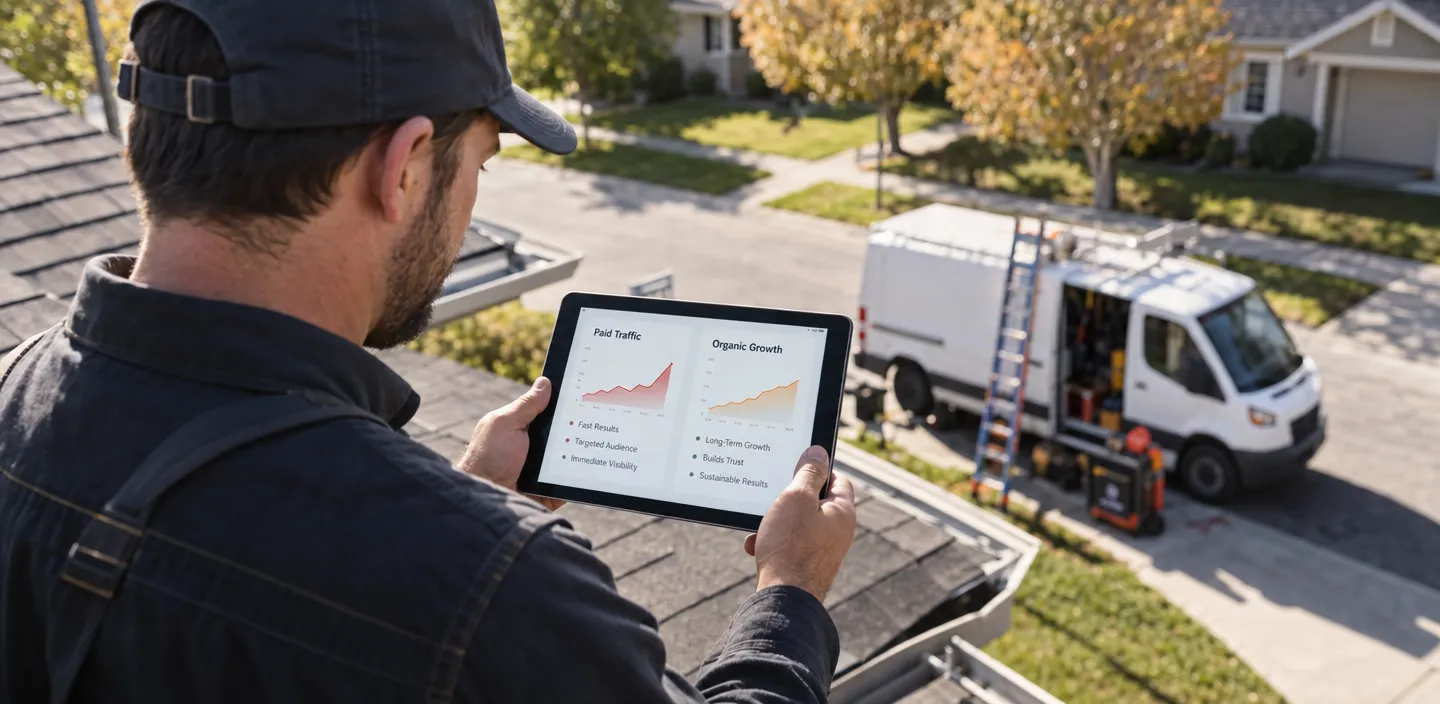




How to drive traffic to your website in 2026? Stack channels that run on different clocks: paid search puts clicks on your site within 24–48 hours, while organic search needs three to twelve months before it carries your pipeline.
That gap is where most home service companies get stuck. They either wait on SEO with no leads coming in, or they rent traffic from ads forever and never build anything that lasts.
And plenty of traffic problems aren’t traffic problems at all. A homeowner searches “AC not blowing cold air Mesa,” lands on a homepage listing eight services, and leaves. The click counted. The phone didn’t ring.
So the real question isn’t how to get more visitors – it’s which channel to run first, given where your site stands today.
The Fastest Ways to Drive Traffic to Your Website Right Now
The honest answer to how to drive traffic to your website is that no single channel does it alone. Each one runs on its own clock, so you stack them.
Organic search (SEO) is the compounding engine, and it’s slow – expect 8–12 weeks for early ranking movement and three to twelve months before it meaningfully feeds your pipeline. Paid search/social ads (PPC) cover that gap, often delivering clicks within 24–48 hours of launch, though traffic stops the day you pause spend.
The rest fill the middle. Social media puts finished jobs in front of nearby homeowners, email to past customers and leads reactivates a list you already own, and referrals, backlinks, and partnerships with realtors or suppliers keep sending people your way without a new ad bill.
| Attribute | Organic search (SEO) | Paid search/social ads | Social + email | Referrals, backlinks, partnerships |
|---|---|---|---|---|
| First traffic | 8–12 weeks | 24–48 hours | Days | Weeks to months |
| Ongoing cost | Content and time | Continuous ad spend | Time and effort | Relationship upkeep |
| Compounds? | Yes | No | Partly | Yes |
So how do you drive traffic to your website this quarter? Run paid for speed, build SEO for durability. The goal is not maximum visitor volume. For home service companies, a smaller number of visitors searching for a specific service in the right location is usually more valuable than a large audience with no buying intent.
Before you pick tactics, you need to know whether your site is brand-new or already established – that changes which of these channels deserves your budget first.
Match Your Traffic Strategy to Your Website’s Maturity
Same goal, different bottleneck.
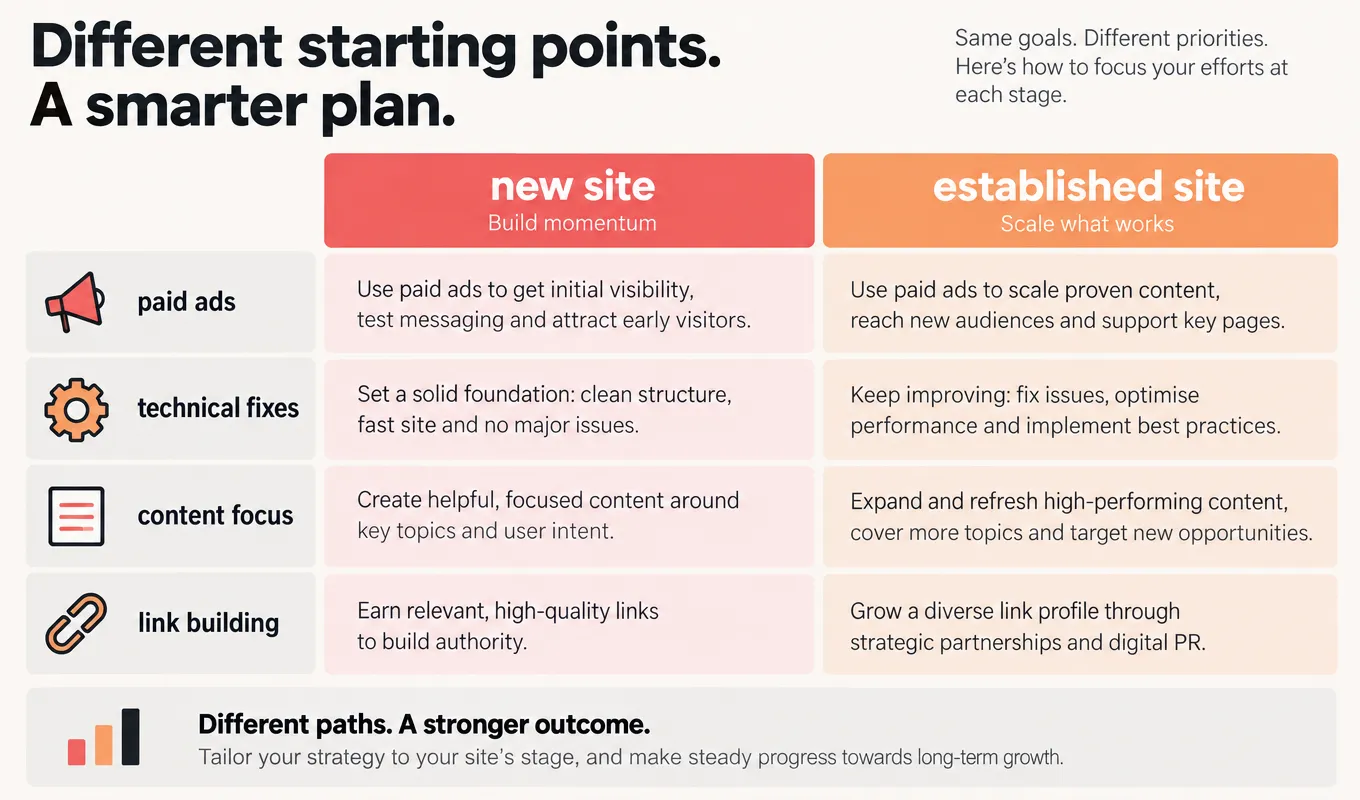
New sites lack history, citations, backlinks; organic results take six to 12 months to show. Lean on paid ads in the meantime – a complete Google Business Profile paired with steady reviews tends to win top-three map results faster than anything else at this stage.
Established multi-location sites face the opposite problem: technical debt, not thin content. In audits, we often find companies investing in new blog posts while their highest-value service pages have weak internal links, outdated titles, or missed search intent. Fixing those pages usually creates a faster path to qualified traffic than publishing more content.
Sequence: fix technical blockers, improve pages, add content, strengthen internal links, build backlinks.
| Priority | New/early-stage site | Established multi-location site |
|---|---|---|
| First 90 days | Paid ads and GBP | Technical fixes and audit |
| Content focus | Core service pages | Refresh existing rankings |
| Link work | Local citations | Earned backlinks |
| Realistic payback | Six to 12 months | Three to six months |
Driving more traffic to your website across locations? Digital marketing for home service companies works when the sequence matches the stage.
Build a Sustainable SEO Foundation for Organic Traffic
Ask how to drive organic traffic to your website and the answer starts under the hood, not in the blog. Crawlability and indexability come first – a leftover noindex tag on your Phoenix AC repair page means nothing else you do matters.
Site architecture is next. Your core service pages should sit one or two clicks from the homepage, not buried four levels deep under a “Resources” menu, which is where storm damage repair pages on roofing sites tend to get lost.
For businesses with multiple related services, collection pages can help organize topics and create stronger pathways between service pages, locations, and supporting content. For example, a contractor offering HVAC repair, installation, and maintenance can use a broader HVAC services page to connect users and search engines with each service.
Next, think about page speed and Core Web Vitals, followed by mobile usability. Homeowners searching for a burst pipe are often on a phone in a flooded basement, and Google evaluates your site through mobile-first indexing regardless. If you have real crawl blockers, fix those before chasing marginal speed gains – shaving milliseconds off a page Google can’t index is wasted work.
Last, map keywords to intent. “Emergency plumber near me” belongs on a service page with a phone number; “how to unclog a drain” belongs on a blog post that links to it. That split is the backbone of any working content marketing strategy example you’ll see.
Search behavior is also changing with AI-powered search experiences. Businesses should continue creating helpful, specific content that answers customer questions clearly, supports topical authority, and connects informational pages with commercial services.
Once the technical foundation and keyword map are in place, the fastest traffic wins usually come from pages you’ve already published – not brand-new ones.
Turn Existing Pages into Your Fastest Traffic Win
Open Google Search Console and sort by impressions. Pages ranking just outside the top results, or pulling many impressions with a low click-through rate, are your shortest path to more traffic – they already rank, but they aren’t earning the click.
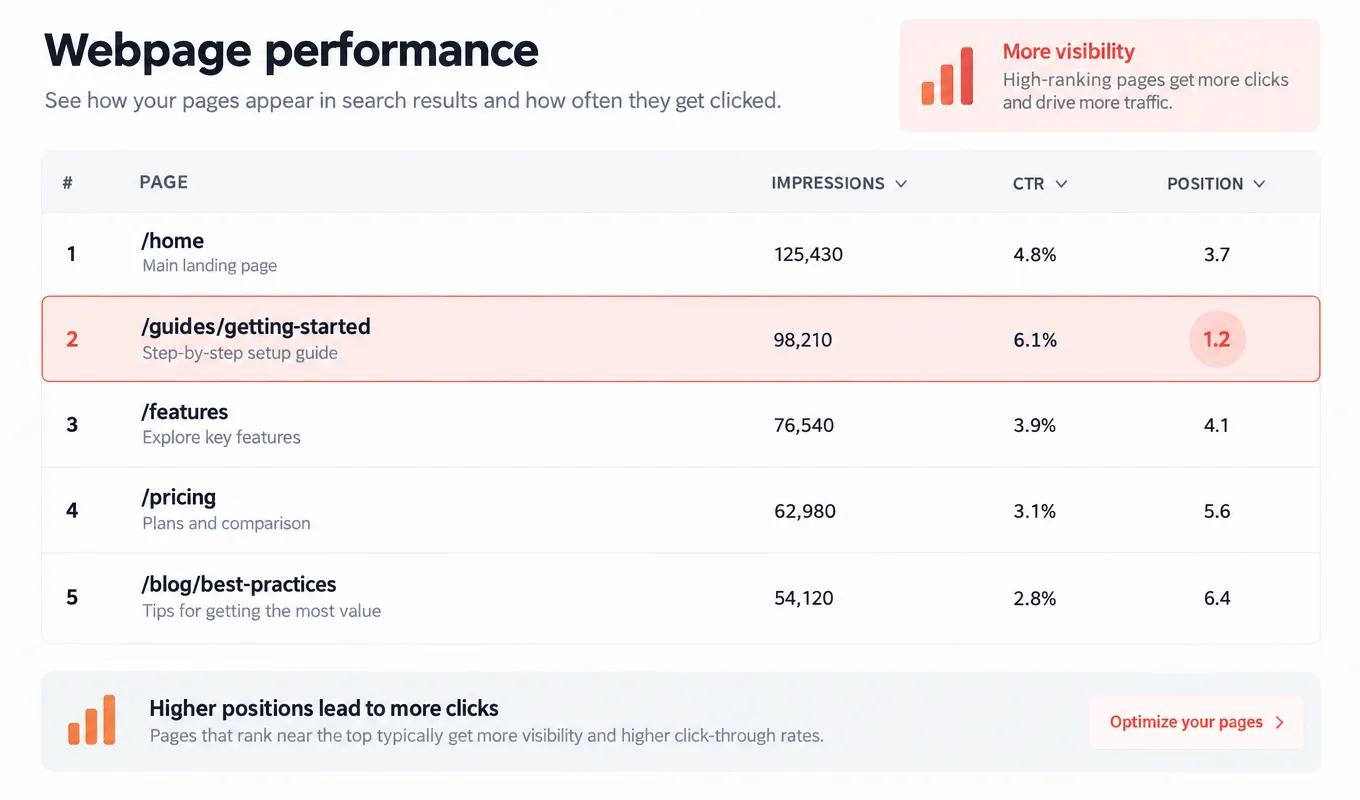
Start with a content refresh: update outdated pricing ranges, add sections competitors cover, cut the filler. Then handle title tag optimization – “Water Heater Repair | Company Name” earns far fewer clicks than a title naming the city and the problem. Meta description optimization is a same-day job; CTR changes usually show up in Search Console within two to four weeks.
Structure matters too. Group refreshed posts into topic clusters anchored by cornerstone service guides, then add internal linking from supporting posts to service pages – “signs your water heater is failing” should point straight at your water heater replacement page. For companies wondering how to drive more traffic to your website, the fastest gains usually come from improving pages that already have search visibility.
For example, an HVAC company might build a main AC repair guide supported by articles about warning signs, maintenance schedules, repair costs, and common failures. Those supporting pages then link back to the main service page.
That’s how to drive quality traffic to your website without publishing a new article. A content marketing audit tells you which pages qualify. Get a free estimate and start generating more leads for your construction business today.
Refreshing and interlinking compounds fastest when those pages also earn backlinks – where many home service sites leave traffic on the table.
Earn Backlinks That Actually Move the Needle
Studies from Backlinko and Ahrefs point in the same direction: pages with more total backlinks and more referring domains tend to rank higher, and referring domain count shows the strongest correlation of the ranking factors examined. Treat that as directional, not proof – but the pattern holds across millions of pages.
Where you point those links matters more than how many you collect. A page sitting at position 11 for “roof replacement Tulsa” needs a handful of quality links to break into the top five. A brand-new page with no visibility needs content work first; links won’t rescue it.
Local digital PR is the strongest earner for home service companies. A cost calculator, an annual energy-bill survey, or a data study on seasonal repair costs in your metro gives a local reporter something to cite. One Boston plumber’s water heater replacement calculator earned a Boston Globe link that still sends hundreds of referral visits a month.
Supplier and manufacturer partnerships are the easier alternative. Certified dealer directories, co-marketing pages, and youth sports or community sponsorships produce links most competitors never bother to ask for. Guest posts on regional trade or home improvement sites fill the gaps.
Anyone promising to show you how to drive massive traffic to your website through bulk link packages is selling you the thing Google discounts.
Backlinks and refreshed pages build authority over time, but social media can put your work in front of local homeowners today.
How to Drive Traffic to Your Website Using Social Media
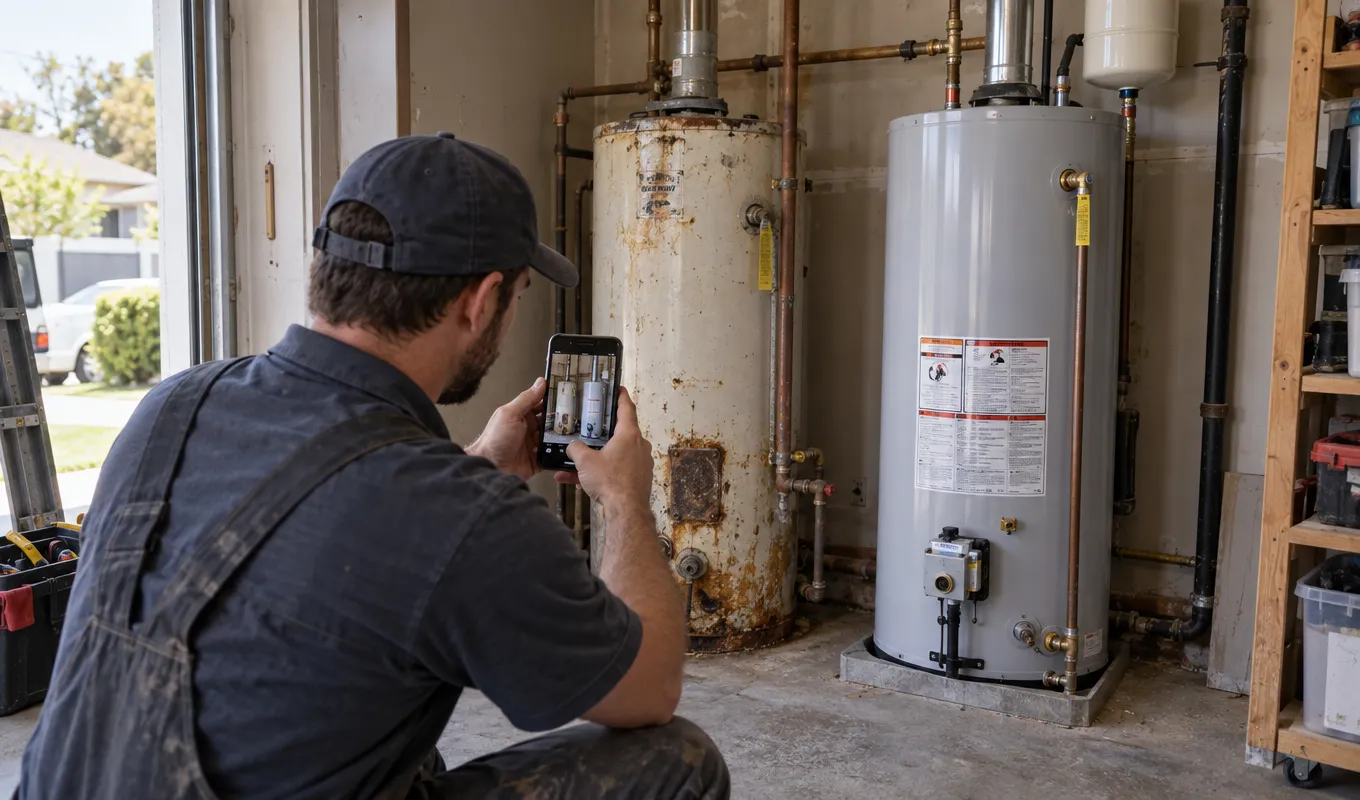
Before/after project photos are the easiest place to start. A cracked, rusted water heater next to a clean new install, or a storm-damaged roof beside a finished replacement – that contrast does the selling for you. Caption it with the neighborhood and a link to the matching service page.
Local community groups come next. Neighborhood Facebook groups and homeowner association pages are where people ask “who do you use for HVAC?” – answer helpfully, link to a relevant guide on your site, and skip the sales pitch.
Short-form video is the workhorse. Reels, TikToks, and Shorts of jobs in progress – a drain camera feed, a furnace swap, a paver patio going down in time-lapse – consistently outperform static posts and talking-head clips across contractor accounts. Keep clips under 30 seconds and shoot actual work footage, not you explaining the work.
The best-performing content is usually proof of work: completed projects, technician walkthroughs, customer stories, and before/after transformations.
Here’s the part most people get wrong when they ask how to drive traffic to your website from social media: Google has said repeatedly that likes, shares, and follower counts aren’t ranking signals. Social is a distribution channel, not a ranking factor. Its job is to put your pages in front of homeowners already vetting nearby contractors, then send them to your site.
Social posts bring one-time visitors – email and referral partnerships are what bring the same customers, and their neighbors, back.
Keep Traffic Coming Back With Email And Partnerships
Every past customer in your CRM is traffic you already paid for once. Email nurture sequences for past customers and leads bring them back without buying a new click.
Keep it simple: a seasonal maintenance reminder in spring and fall, a follow-up 30 days after a job asking for a review, and a quarterly note linking to one useful guide on your site. An HVAC company can email its list of past customers before the first cold snap to book tune-ups from a list that costs nothing to reach. Typical cadence: a modest, consistent number of touches per year.
Referral partner programs with realtors and property managers work on the same logic. Realtors need pre-sale repairs done fast; property managers need a plumber who answers on a Sunday. Build a dedicated landing page for partners, set a clear referral fee or reciprocal arrangement, and visit local real estate offices in person.
Cross-promotion with complementary local businesses is the lighter-lift alternative – a roofer and a gutter installer, a landscaper and a fence company, each linking to the other’s site and mentioning them to clients.
That’s the quiet half of how to drive traffic to your website: audiences you already own.
Email and referrals compound slowly – if you need visitors this week, pair them with free listings and short-term paid traffic.
Free And Paid Tactics to Increase Traffic Fast
The rule is simple: businesses trying to increase website traffic free should start with assets they control. So, if you’re looking for how to get traffic to your website fast or how to drive traffic to your website for free, start with Google Business Profile optimization, local listings, and content improvements before spending on ads.
Match name, address, and phone across local directories and citation listings, then work on Nextdoor and community forums – neighbor recommendations win jobs.
Short-term paid search/social ads cover the gap for a limited window, focused on highest-margin services.
| Attribute | Google Business Profile | Nextdoor + community forums | Short-term paid ads |
|---|---|---|---|
| Setup time | 2–4 hours | 1–2 hours | 1–2 days |
| Cost | Free | Free or low-cost deals | Continuous spend |
| First traffic | 1–2 weeks | Days | 24–48 hours |
| Lasts after stopping | Yes | Partly | No |
Track Whether Your Traffic Is Actually Qualified
Sessions are context, not an outcome. A month where traffic jumps 40% but calls stay flat tells you the extra visitors weren’t homeowners with a problem – they were readers, bots, or people three states away.
Start in Search Console with organic clicks and impressions by page. High impressions and low clicks mean a title problem; rising clicks on your blog but none on service pages means you’re attracting research traffic, not buyers. That’s also the fastest way to spot which pages deserve work when you track your keyword rankings.
Then look at landing-page conversions in GA4 – form submits and calls, split by the page people actually landed on. Two numbers are worth reporting:
landing page conversion rate = conversions ÷ sessions on that page × 100
Finally, assisted conversions. Under last-click attribution, a homeowner who found your Reel, came back through organic search two weeks later, and booked gets credited entirely to organic – social looks like it contributed nothing. GA4’s Conversion Paths report shows the channels that appeared earlier in the path.
Practical next step: build one report with four columns – channel, landing page, conversions, conversion rate – and review it monthly. Raw session volume goes at the bottom, where it belongs.
Once you know which pages and channels actually convert, it’s worth comparing that to what we typically see when we audit home service traffic reports.
What We See When We Audit Traffic Reports for Plumbing, HVAC, and Roofing Sites
Across audits of plumbing, HVAC, and roofing sites, the problem is rarely a traffic shortage. It’s where the traffic lands.
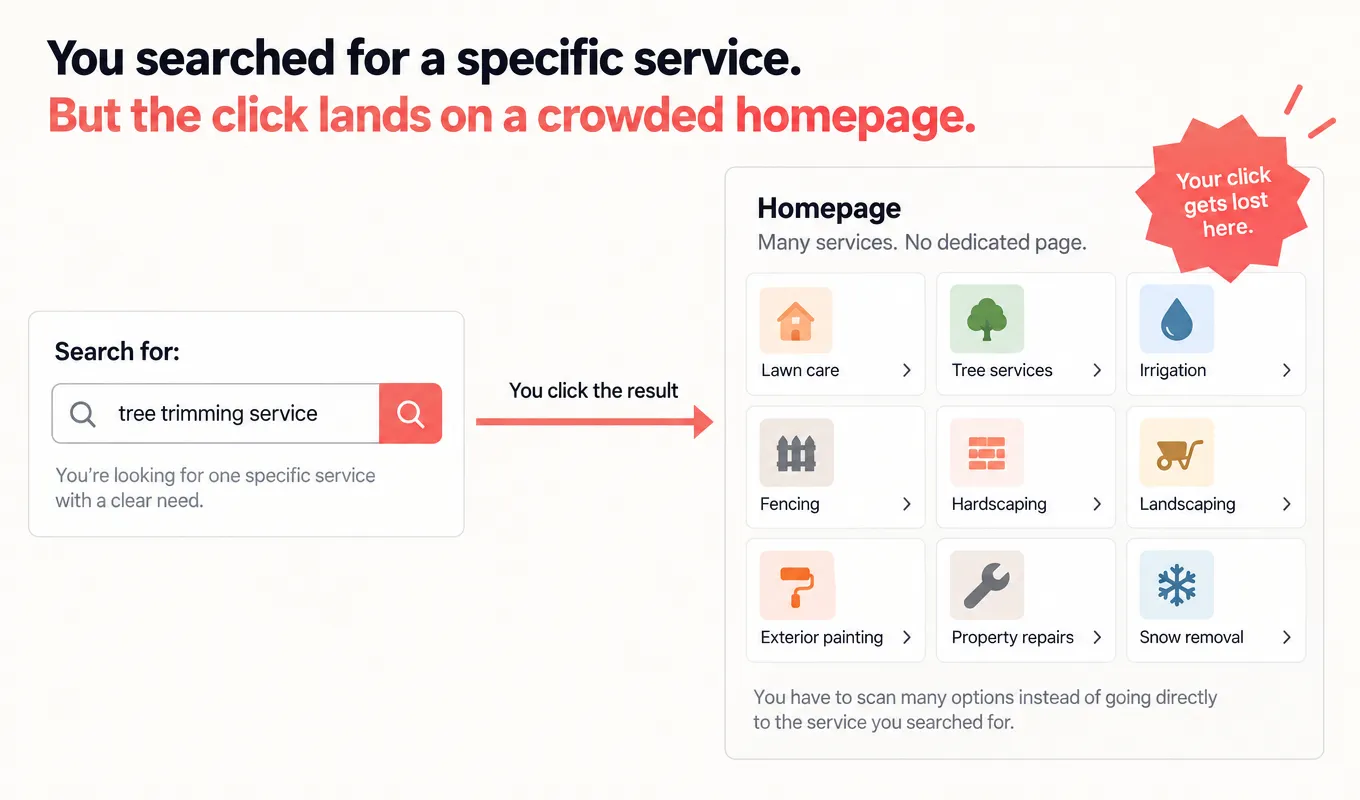
The pattern repeats: the homepage is the top organic landing page by a wide margin, or a thin “Areas We Serve” page with two paragraphs and a city name is absorbing clicks meant for a specific service. Someone searched “AC not blowing cold air Mesa.” They landed on a homepage listing eight services and a hero image, then left. The click counted. The call never happened.
That’s a page-inventory problem, not a ranking problem. If the only page Google can match to a searched service is the homepage, the homepage is what ranks – and it converts poorly because it answers everything and nothing.
The fix is unglamorous. Build one real page per service per market, with pricing ranges, local specifics, and a phone number above the fold. Then point internal links from the homepage and blog posts at those pages so Google stops defaulting to the catch-all.
Anyone asking how to drive traffic to your website should first check which page their existing traffic is already hitting.
FAQ
01 How do you drive traffic to a website without spending money?
Claim and fully complete your Google Business Profile, then get listed in local and industry directories. Post helpfully in neighborhood Facebook groups and Nextdoor, publish content answering real customer questions, and ask past customers for referrals and reviews.
02 How can I get 1,000 website visitors per day?
That volume usually means ranking for hundreds of keywords while running paid and social campaigns at the same time. Most home service businesses don't need it. Fewer, higher-intent visitors on service pages convert better than a big raw number.
03 What is the 80/20 rule in SEO?
A small share of your pages or effort tends to drive most of your results. For home service sites, a handful of core service pages and high-intent keywords drive most conversions. Improve and link to those before spreading effort everywhere.
04 How long does it take to see results from SEO traffic strategies?
Early ranking movement typically shows up in three to six months, with meaningful ROI closer to six to 12 months. Refreshing existing pages moves faster – documented cases show changes within two weeks.
05 How do you know if your website traffic is actually qualified?
Check conversion rate by channel and by landing page, not total sessions. Track assisted conversions separately. The real test: does traffic hitting your service pages produce calls, form fills, or booked estimates?
Love what you’re reading? Sign up for our newsletter to get our newest articles, helpful tips, and fresh marketing updates delivered right to you. No spam, just the good stuff.