



How much does a website cost? In 2026, expect roughly $0–$500 for DIY, $500–$3,000 for a template-based build, $1,000–$10,000 for a freelancer, and $5,000–$30,000+ for a custom agency website. But costs vary enormously by route, with most home service businesses paying a moderate mid-market amount for a professional build.
Expect a wide range depending on route, with most home service businesses landing in the moderate mid-market tier for a professional build. That spread isn’t vague pricing – it’s four different products. A DIY builder page, a pre-built theme, a freelancer project, and a custom agency build all get called “a website,” and they perform nothing alike once a homeowner with a leaking roof lands on their phone at 9 pm.
Pricing research consistently shows professionally built sites convert better and load faster than DIY equivalents, which is why cost belongs next to booked jobs on the P&L, not in the overhead column.
Here’s what each route actually costs in 2026, and what it returns.

How Much Does a Website Cost in 2026?
The spread is that wide because “website” can mean anything from a free drag-and-drop page to a custom build engineered to book estimates. Industry pricing surveys put the average small business website at $3,000 to $10,000, which tracks with what roofers, HVAC companies, and remodelers actually pay.
Four routes account for nearly every quote you’ll get, and understanding the differences makes website pricing much easier to compare.
| DIY builder | Template/theme | Freelancer | Agency | |
|---|---|---|---|---|
| Typical cost | $0–$500 | $500–$3,000 | $1,000–$10,000 | $5,000–$30,000+ |
| Build time | Days | 1–3 weeks | 3–8 weeks | 6–12 weeks |
| Design | Preset templates | Pre-built theme | Semi-custom | Fully custom |
| Best for | Brand-new operators | Tight budgets | Clear, small scope | Consistent job volume |
| Lead-gen strength | Weak | Moderate | Varies by hire | Strongest |
When someone asks how much does a website cost, the better question is what the site needs to produce. A $500 page that never generates a call is expensive. A $12,000 build that adds four booked jobs a month pays for itself in a quarter.
So how much does it cost to create a website that actually works for a contractor? Depends entirely on the route you take. Those numbers are a starting point – the route you choose changes everything about what you get for your money.
Website Cost by Build Route
Four build routes drive every quote. The gap isn’t price – it’s load speed, conversion, and who fixes your broken form.
Here, DIY means you build the site yourself in a hosted platform like Wix or Squarespace; template/theme means a freelancer or professional sets up and customizes a pre-built design for you.
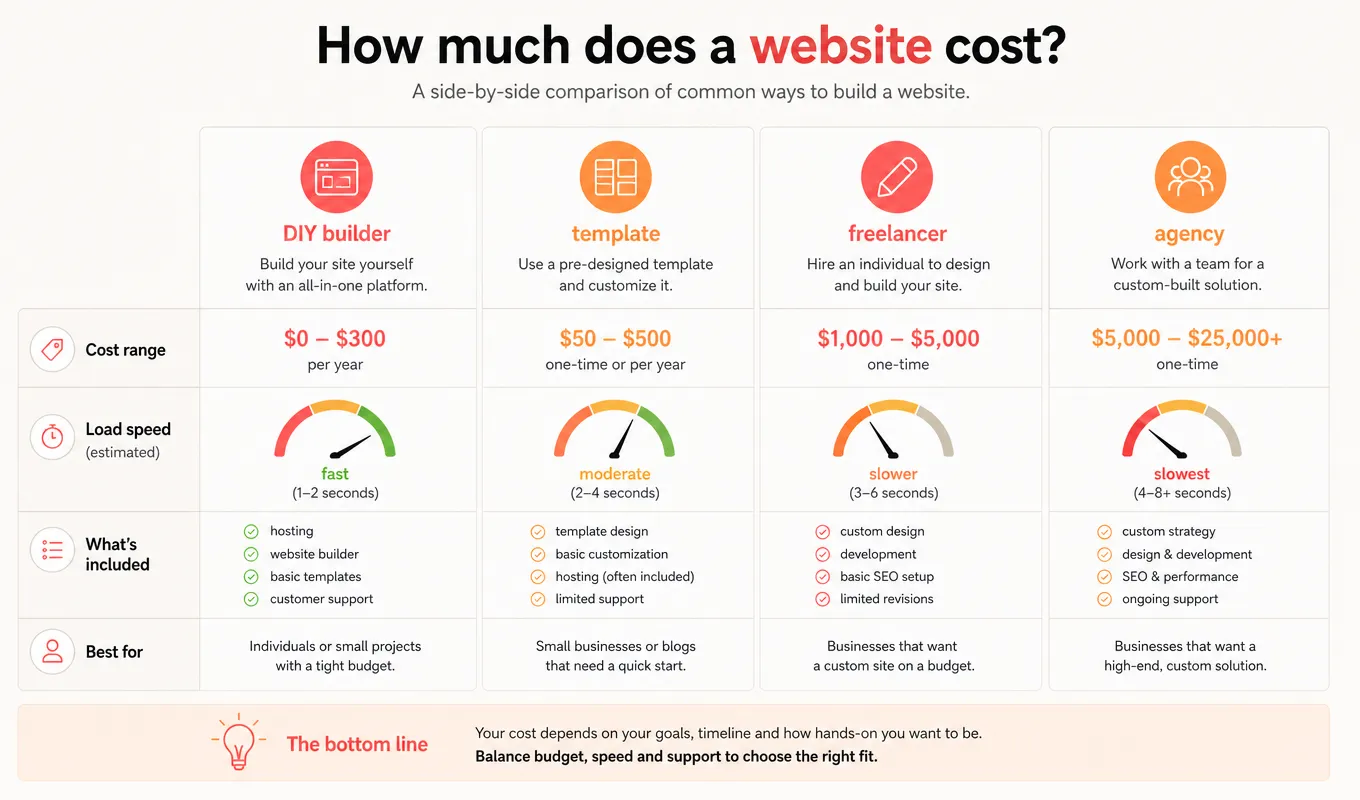
| Attribute | DIY builder | Template/theme | Freelancer | Agency |
|---|---|---|---|---|
| Who does the work | You | You or a setup pro | One generalist | Full specialist team |
| Your time required | High | Moderate | Low | Low |
| Ongoing cost | Monthly subscription | Theme renewals | Hourly as needed | Retainer optional |
| Typical load speed | Slowest | Middling | Middling | Fastest |
| Common failure point | Weak lead capture | Bloated plugins | Nobody left to fix it | Scope creep |
DIY costs nothing upfront but eats nights. Themes look pro fast, yet unused scripts slow page load enough to cost calls.
US freelancers bill $50–$150 hourly – while a small multi-page site typically runs into the low thousands of dollars.
Agencies flip it: how much does it cost to build a website matters less than what it books. How much does a website cost, or how much does a professional website cost? Your close rate answers.
DIY Website Builders – Wix, Squarespace, GoDaddy
Wix runs a monthly subscription. Squarespace does too, and GoDaddy sits in the same bracket – call it a few hundred dollars a year, all in. So how much does it cost to make a website yourself? Almost nothing, if you don’t count your evenings.
The problem shows up later. Preset templates rarely give you a prominent estimate-request form, service-area pages built for local search, or the mobile load speed a homeowner needs at 9pm with a leaking roof. You can patch some of that with a solid DIY SEO guide for small businesses.
One missed job a month erases the savings.
If DIY feels limiting, freelancers and agencies offer more horsepower – at a price.
Freelancers vs. Agencies – What Each Delivers
| Attribute | Freelancer | Agency (Loona benchmark) |
|---|---|---|
| Typical project price | $1,000–$10,000 | $5,000–$30,000+ |
| Turnaround | 3–8 weeks | 6–12 weeks |
| Team | One generalist | Designers, devs, copywriters |
| Built for | Launching a site | Booking estimates |
| After launch | Ad hoc availability | Ongoing support |
Ask a freelancer how much does it cost to have a website built, and you’ll get a lower number, faster. Real value when your scope is small and clear.
Agencies charge more because the deliverable differs: custom, conversion-focused WordPress builds where the estimate form, service pages, and mobile speed are engineered around booked jobs. Either route, the final price hinges on a few specific cost drivers.
What Affects the Cost of a Website
Page count is the first lever. A five-page brochure site prices very differently from a 25-page build carrying a separate page for every service and every city in your radius. Each page needs layout, copy, and internal linking – that’s real hours.
Design is the second. Template-based sites typically run $0–$300 for the theme, or $750–$3,000 for professional setup, while custom builds start near $4,000 and climb past $15,000 as complexity grows.
Functionality is where contractor budgets move fastest. Booking calendars and contact forms come as plugins costing free to $200 a year each. Custom estimate forms add $300–$800, an online booking system $500–$2,000, and a CRM or payment integration $500–$5,000 depending on how much data has to sync.
Copywriting runs $100–$300 per page, or $50–$150 an hour – the same discipline behind good ecommerce content marketing tips applies to a service page that has to sell a roof replacement.
Photography lands at $500–$2,500 for a half-day shoot. Stock adds $450–$1,500 for a ten-page site, but real crew-and-jobsite photos tend to convert better than a stock family smiling at a thermostat.
So when you ask how much does it cost to design a website, or more broadly how much does a website cost, those five inputs explain nearly every quote gap. Beyond the build itself, most owners forget there’s a second, ongoing bill waiting after launch.
One-time Build Costs vs. Recurring Costs
The quote you sign covers the build. It doesn’t keep the site online. Every contractor site carries a second bill – domain, hosting, security patches, plugin updates – that runs for as long as the phone needs to ring.
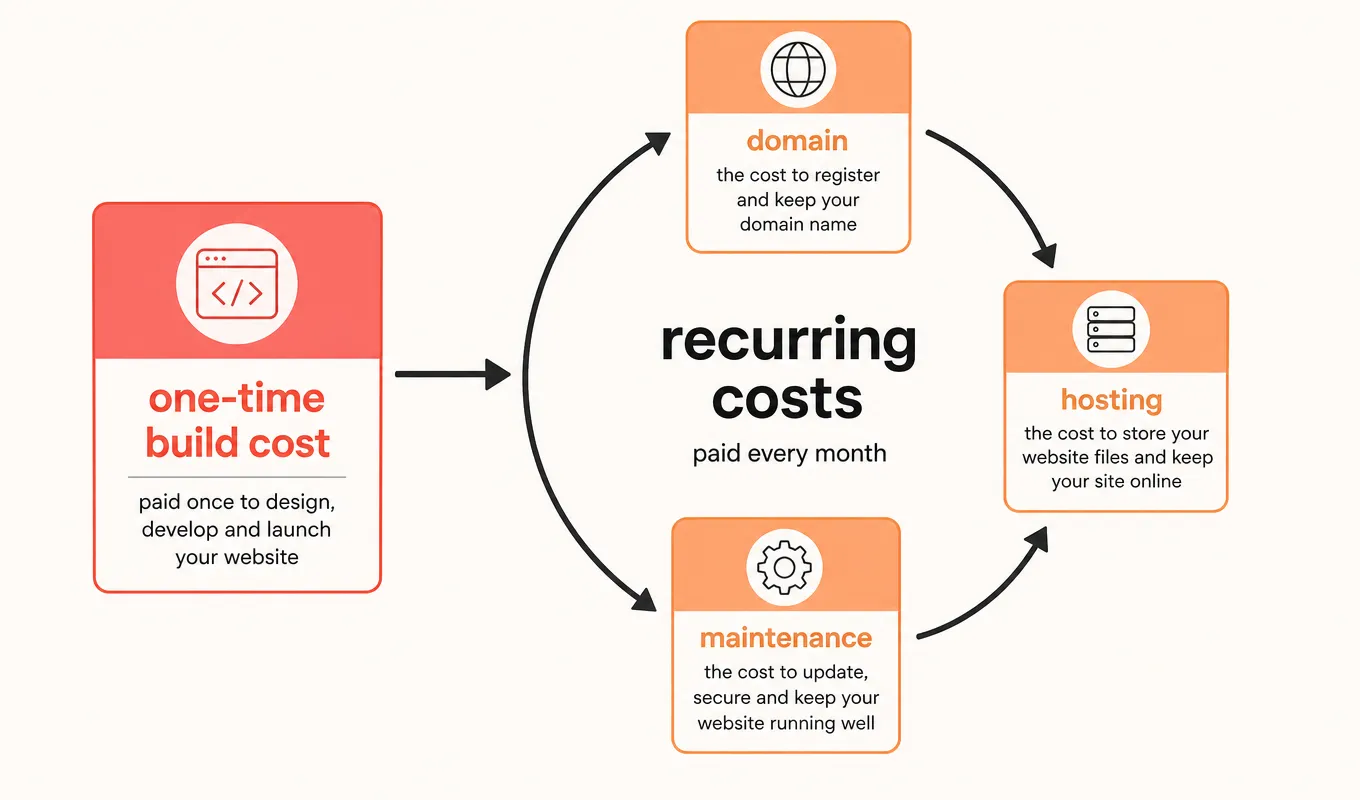
| Attribute | One-time build cost | Recurring costs |
|---|---|---|
| What it covers | Design, development, copy | Domain, hosting, maintenance |
| Billing | Once, or in milestones | Monthly and annual |
| Typical range | $500–$30,000+ | $35–$500 per month |
| Who handles it | Builder or agency | You, freelancer, or agency |
| Skip it and | No site launches | Site breaks or goes down |
Professional maintenance for a small- to mid-size business averages $100 to $300 monthly in 2026, with most owners paying $100–$200.
So how much does a website cost per month once it’s live? Budget $35–$500 depending on who manages it. Self-managed sits at the low end. Agency-managed care sits at the top, and buys you someone watching uptime at 6 am.
Here’s the math that matters:
true first-year cost = build cost + (monthly recurring × 12)
A $5,000 build at $150 a month is really $6,800 in year one. Price it that way from the start.
Let’s break down exactly what those recurring line items cost, starting with domain and hosting.
Domain And Hosting Costs
Plan on $10–$60 a year for domain registration. When owners ask how much does a website domain cost, they price the first year and miss the renewal – which usually runs higher than the intro rate.
So, how much does it cost to host a website? Shared hosting handles most contractor sites at about $2–$15 monthly, while VPS or higher-performance hosting typically costs more. That’s fine for a brochure-style site with steady local traffic. VPS or higher-performance hosting runs $20–$100+ monthly, and it’s worth it once you’re carrying big project galleries, booking software, or storm-season traffic spikes from ads.
Domain and hosting are just the baseline – maintenance is where most owners underestimate their annual spend.
Ongoing Maintenance And Updates
Budget $35–$500 a month, or roughly $420–$6,000 a year. Where you land depends on who’s holding the wrench.
DIY maintenance stays under $100 monthly – hosting, an SSL certificate, a few plugin licenses, and you run the updates. Freelancers bill hourly as needed, which works until your contact form quietly breaks on a Friday. Agency plans are at the top of the range and cover security patches, plugin and core updates, backups, and uptime monitoring.
So how much does it cost to maintain a website? Enough to belong in your annual budget, not your surprise column. Here’s what those numbers look like for roofers, HVAC companies, and remodelers.
Website Costs for Home Service Businesses
Costs vary widely for home service sites, driven by service-area pages, galleries, and estimate forms.
| Attribute | Roofing | HVAC | Remodeling | General contractors |
|---|---|---|---|---|
| Typical build range | $2,500–$12,000 | $1,500–$15,000 | $2,500–$30,000 | $2,000–$10,000 |
| Biggest cost driver | Storm-area pages | Service-area volume | Project galleries | Trade breadth |
| Gallery needs | Heavy | Light | Heaviest | Moderate |
| Estimate flow | Fast quote form | Emergency call button | Multi-step consult form | Project inquiry form |
| Monthly maintenance | $35–$500/month | $35–$500/month | $35–$500/month | $35–$500/month |
HVAC coverage runs widest – twenty city pages cost more than five. Remodelers pay most for galleries; contractors sit mid-range unless multi-trade.
Roofing: fewer pages; storm-season estimate forms must work instantly. A lead-generating contractor site with project galleries: $2,500–$6,000.
First, check your Google rankings: coverage matters, but only when every page serves a real search or conversion need. So how much does a website cost, and how much does a small business website cost in your trade?
Average Website Cost For a Small Business
$2,000 to $10,000. That’s the working range for a professionally built, mobile-ready small business site.
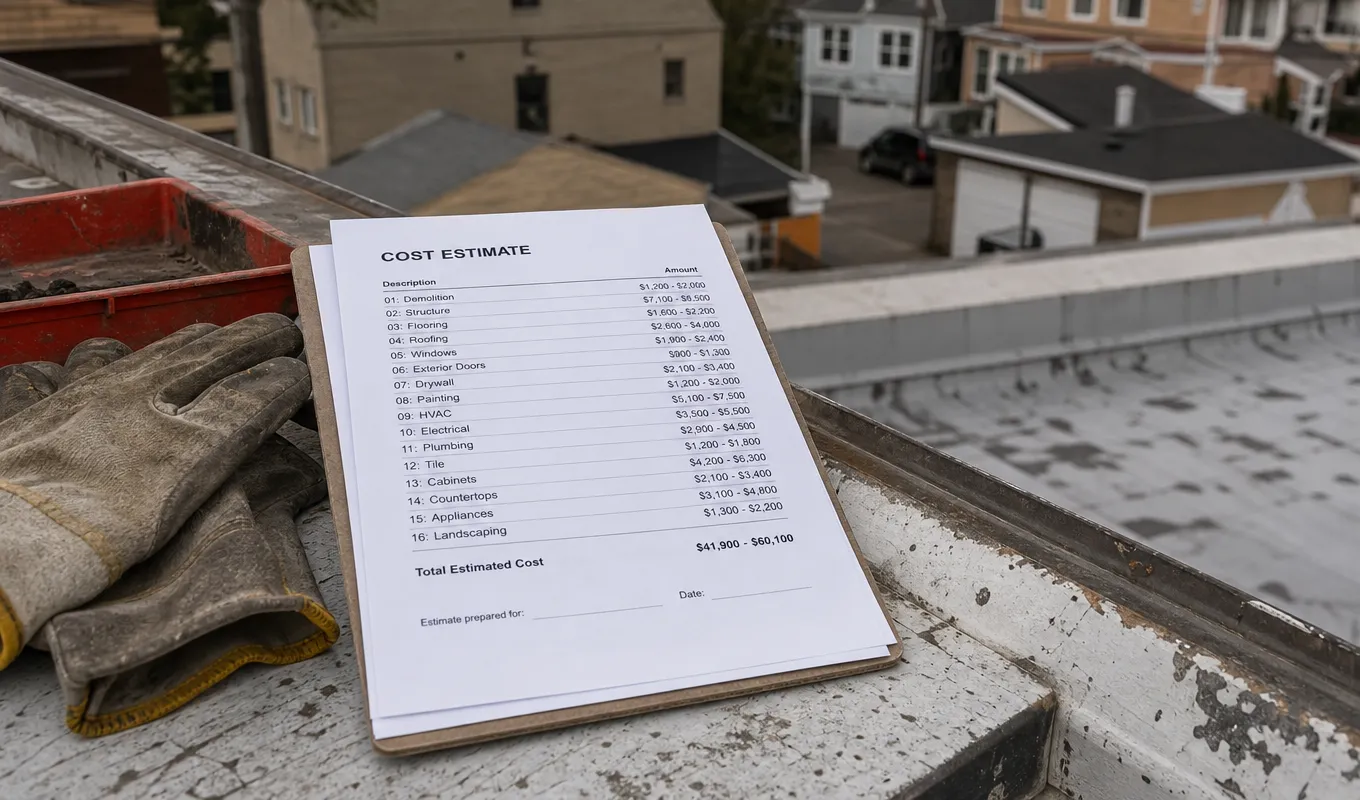
The three named benchmarks worth anchoring to:
Freelancer average sits around $2,000. That buys a clean multi-page site from one person, usually semi-custom and built on a theme. Fine scope for a two-truck operation.
Agency averages run $5,000–$30,000+, while the average cost of website design for small business owners who need more pages, custom features, and stronger branding generally lands in the professional mid-market range ($2,000–$10,000).
The overall small-business benchmark tends to fall in the middle of the typical range. Not a coincidence – that’s where page count, custom design, copywriting, and a working estimate all fit in one budget without cutting the part that generates calls.
Averages hide the variables, though. A five-page HVAC site in a single city and a 30-page remodeling site with a full project gallery both count as “small business websites,” and they’re not remotely the same job. So when you ask how much does a website cost for your company, the average is a sanity check, not a quote.
Use it this way: if a bid comes in at $900, ask what got cut. If it comes in at $25,000, ask what revenue that extra scope is supposed to produce.
If you want a number specific to your project instead of an industry average, a cost calculator can narrow things down fast.
Estimate Your Website Budget with a Cost Calculator
Before you request a single quote, run your project through a website cost calculator. Most tools ask three inputs, and those three inputs explain almost every price gap you’ll see in bids.
Page count comes first, usually as a slider from 1 to 50 pages. Be honest here. If you’re a roofer serving eight towns with six services, you’re not building a five-page site – you’re building closer to 20 once service and city pages are counted.
Design complexity is the second input. A pre-built theme, a semi-custom layout, and a fully custom build sit at three different price tiers, and the calculator will spread your estimate by thousands based on that one choice.
Features and integrations come third: estimate forms, booking calendars, project galleries, CRM sync. Each one adds hours. The rough math behind any website cost calculator looks like this:
estimate = (pages × per-page rate) + design tier + feature add-ons
Treat the output as a budget bracket, not a quote. It tells you whether you’re shopping in the $3,000 range or the $15,000 range – useful context when someone asks how much does a website cost for your specific project.
A number on a calculator is useful, but the real question is whether spending more actually pays off in booked jobs.
Is a Higher Website Cost Worth It?
It’s worth it when the extra money buys conversion, not decoration. A prettier homepage doesn’t book jobs. An estimate form above the fold, a tap-to-call button that works on a cracked phone screen, and pages that load before a homeowner bounces – that’s what higher budgets should be paying for.

At Loona, we’ve delivered 100+ digital projects, with website design and conversion-focused WordPress development among our core services. The construction benchmarks below come from that hands-on work.
In one recent construction rebuild, our 2026 project data showed a 32% estimate-form start rate, 63% form completion, and 59% mobile task completion. Those aren’t design awards. They’re the numbers that decide how many calls hit your phone.
Industry benchmarks back the pattern: home service sites convert only a small slice of visitors into leads, and phone leads close at several times the rate of form-only leads. Speed compounds it – contractors who respond within minutes instead of an hour book dramatically more of the leads they already paid for.
Run the math before you decide:
payback months = build cost ÷ (extra monthly leads × close rate × average job value)
Two extra booked roofs a month cover most builds within a quarter. Not sure where your current site leaks? Start with a content marketing audit.
Get a free estimate and start generating more leads for your construction business today. Whether you’re spending $2,000 or $20,000, a few smart decisions determine whether that budget turns into leads.
How to Get the Most Value for Your Website Budget
Two mistakes drain contractor website budgets, and they pull in opposite directions.
The first is overspending on features nobody uses. Custom animations, a live chat widget no one staffs, a blog module that sits empty for two years, a client portal for a business that books by phone. Every unused feature costs money upfront and adds weight that slows the pages homeowners actually visit. Before approving any add-on, ask what it does for booked estimates. If the answer takes more than a sentence, cut it.
The second is underspending on mobile speed and hosting reliability. Skipping mobile optimization or parking a lead-generating site on the cheapest available hosting is where owners lose real jobs. A homeowner with a failed AC in July doesn’t wait five seconds for your page to load – they hit the next result. Common budget traps on both ends come down to the same thing: spending without a clear brief.
Allocate toward conversion first. Mobile load speed, a visible estimate-request form, a tap-to-call button, then design polish with whatever’s left.
If you want that order enforced by people who build for booked jobs, our website design and UI/UX services and verified Clutch reviews show what it looks like in practice. Here’s what actually shows up when we rebuild sites for contractors and home service companies.
What We’ve Learned From Rebuilding Contractor & Home Service Websites
Across roofing, HVAC, and remodeling rebuilds, the same two problems show up again and again. Neither one is design.

Problem one is estimate-form placement. On most sites that get replaced, the form sits at the bottom of the page or hides behind a “Contact” tab in the menu. Homeowners don’t hunt for it. Move that form above the fold on the homepage and repeat it on every service page, and start rates tend to climb before a single word of copy changes.
Problem two is mobile load speed. Old builds carry stacked plugins, uncompressed jobsite photos, and a slider nobody scrolls. A roof leak at 9 pm gets searched on a phone, on a weak signal, and slow pages lose that call to the next result.
Loona’s 2026 build data on a construction rebuild bears it out: a 32% estimate-form start rate and 59% mobile task completion came from flow and speed work, not a prettier layout.
Page count matters far less than owners assume. Twenty thin service pages convert worse than six pages with a working form. For deeper breakdowns, browse more website and marketing guides.
Wrapping Up on Website Cost
Costs vary enormously by route, with most home service businesses landing on a moderate mid-market spend for a professional build. The route you pick – DIY, template, freelancer, or agency – sets the bracket. Page count, design, functionality, copy, and photography are the biggest variables in the cost of building a website.
Add recurring costs before you sign anything. A build plus $100–$300 a month in maintenance is the real first-year figure, and owners who skip that math get surprised in month three.
Then judge the spend by what it books. Two extra booked jobs a month cover most builds inside a quarter, which is why an estimate form above the fold beats a prettier homepage nearly every time. Want to see how those decisions play out on real contractor builds? The construction and home service case studies show the flow and speed work behind the numbers.
For more breakdowns on website cost, SEO, and lead generation, our marketing guides go deeper on each piece.
Ready to find out how much does a website cost for your specific project? Reach out for a quote – get a free estimate and start generating more leads for your construction business today.
FAQ
01 Can I build a website for free?
Yes – free builder plans or open-source platforms with a free theme cost nothing upfront, though you'll still pay for a domain and often hosting. Expect builder branding, limited features, and weaker SEO structure. For a lead-generating service business, a small paid plan is worth it.
02 Is $1,000 enough for a small business website?
It covers a basic template site or a bare-bones freelancer project. At that budget, expect limited pages, stock imagery, and minimal copywriting – no custom design or advanced functionality. Workable as a starting point, but plan to reinvest once lead volume grows.
03 How much does a 10-page website cost?
Typically $2,000–$10,000, depending on design complexity and functionality. More pages mean more design, copywriting, and development hours. Service-area pages, project galleries, and estimate forms push a 10-page contractor site toward the higher end.
04 Do websites come with monthly fees?
Most do, even when the build was a flat fee – hosting alone is recurring. DIY builders bundle hosting into plans of roughly $17–$50 monthly. Professionally built sites often bill maintenance, security monitoring, and support monthly.
05 How much does website maintenance cost per year?
Small business sites usually run $600–$6,000 a year. That covers security updates, backups, plugin updates, and technical support. Sites with booking systems or CRM integrations sit toward the top of that range.
06 How much does a website domain cost?
A standard domain runs $10–$60 per year to register and renew. Premium or highly competitive names cost significantly more. Renewal pricing is often higher than the intro rate, so check the renewal cost before you commit.
Love what you’re reading? Sign up for our newsletter to get our newest articles, helpful tips, and fresh marketing updates delivered right to you. No spam, just the good stuff.