


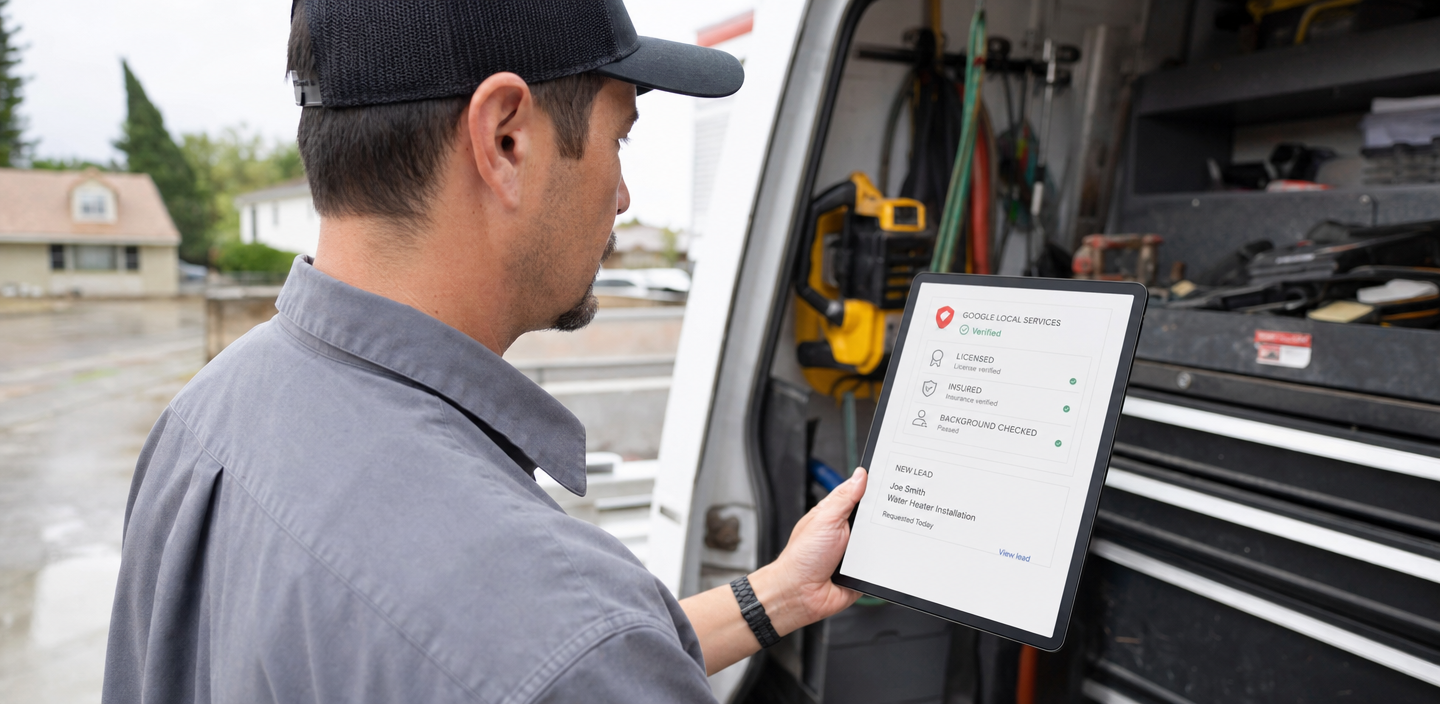
Local service ads are Google’s pay-per-lead format for home service businesses. You’re charged when a homeowner calls, texts, or books, not when someone clicks. They sit above the map pack and every organic result, and the businesses that appear there have passed license, insurance, and background verification.
Cost per lead varies widely by trade and market, with home service categories generally cheaper than legal or high-value healthcare leads.
Placement isn’t bought outright, either. Proximity, review rating, response time, and bid all feed the auction. Loona Agency runs this lifecycle daily for plumbing, HVAC, and roofing clients, and the pattern is consistent: intake discipline beats bid increases.
Here’s what the format actually is, and how it differs from a standard search ad.
What Are Local Service Ads?
Local service ads are Google’s pay-per-lead format built for local service businesses – plumbers, roofers, HVAC techs, electricians, remodelers. The billing model matters most to your budget: you’re not charged for impressions or clicks. You pay when a real customer calls, texts, or books through the ad.
So what separates them from a standard search ad? Trust verification. As of October 2025, Google consolidated its trust badges into a single Google Verified badge with a blue checkmark, retiring the money-back program.
Here’s how the old system maps to the new one, since older terms still appear across the web, including in Google’s own help docs.
| Old badge | Who used it | Old benefit | Current status |
| Google Guaranteed | Home services (plumbers, HVAC, etc.) | Satisfaction guarantee up to $2,000 | Retired – now “Google Verified” |
| Google Screened | Law firms, real estate agents | Same vetting, no financial guarantee | Retired – now “Google Verified” |
Picture a Tampa homeowner searching “emergency water heater repair.” The local service ads unit sits at the top with a Verified badge, star rating, and call button. Tap it with a genuine new job inquiry, and that’s a billable lead.
Next: how pay-per-lead mechanics and ranking play out daily.
How Local Service Ads Work
Local service ads sit at the very top of the results page – above paid search ads, above the map pack, above every organic listing. That’s the highest-visibility spot available in local search.
Billing is the part that trips people up. You’re charged for valid leads – phone calls, text messages, voicemails, booking requests – not clicks. Google’s help documentation notes that leads judged invalid at initial contact aren’t charged, and charged leads can be reassessed and credited later.
Your weekly budget is the volume dial.
Quick math: At a $25 cost per lead, a $500 weekly budget lands you around 20 leads.
Placement inside the LSA unit comes down to four things:
- proximity to the searcher
- review rating and volume
- responsiveness
- your bid.
Verification (license, insurance, background checks) is what gets you in the door in the first place – it’s a gate, not a ranking factor.
Example: An Orlando HVAC company two zip codes closer with a 4.9 rating and fast pickups outranks a bigger competitor bidding more. Placement rewards operations, not just spend.
Want Google local service ads management handled end-to-end? Get a FREE estimate and start generating more leads for your construction business today.
Local Service Ads Cost and Budgeting
Cost per lead varies widely by trade and market, with home service categories generally cheaper than legal or high-value healthcare leads.
Typical cost per lead by trade (mid-size US markets)
| Trade | Cost per lead |
| Plumbing / HVAC | $25 – $80 |
| Roofing | $35 – $100 |
| Electrical | $35 – $85 |
Dense metros push those figures higher; rural service areas run cheaper. Cost also moves with competitor count, lead type, and how well your office handles intake.
Budget math: monthly max = weekly budget × average weeks per month
Your weekly budget is a target spend, not a hard ceiling – some weeks run hot, some run light, but the platform won’t exceed your monthly max.
Where to start:
- Launch around $300/week (roughly 10 leads/week)
- Hold it there for two weeks before adjusting
- This is enough to gauge answer rate and close rate without burning cash on guesswork
How to scale: Increase in steps of about 20% per week until lead volume matches crew capacity. Jumping from $300 to $1,500 overnight floods you with calls you can’t service.
Cost alone doesn’t tell the full story – here’s how LSAs stack up against traditional Google Ads.
Local Service Ads vs Google Ads (PPC)
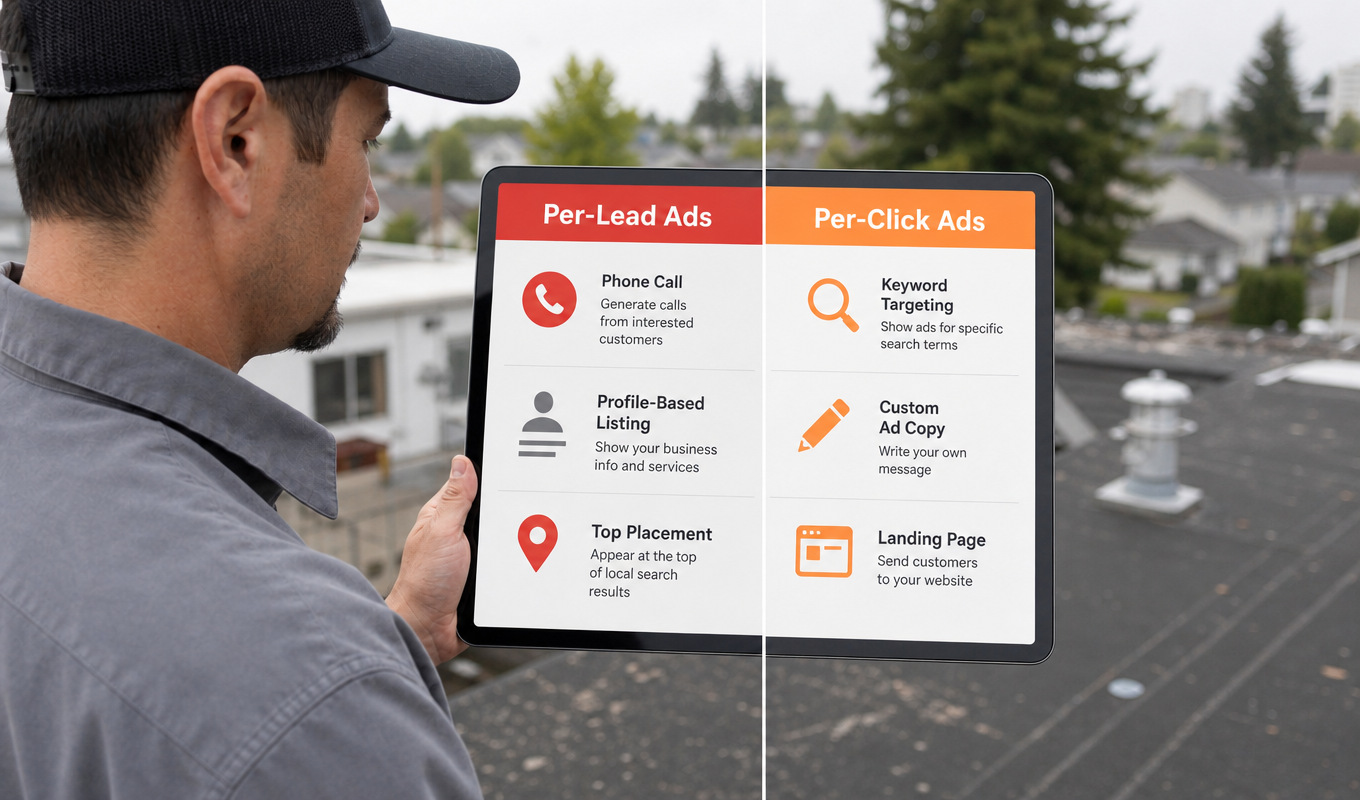
Billing first: LSAs charge per lead, PPC per click.
Control second: LSAs give no keyword, copy, or landing page control; Google builds from your profile, reviews, and verification. PPC gives all three plus negative keywords.
| Attribute | Local service ads | Google Ads (PPC) |
|---|---|---|
| Billing | Per valid lead | Per click |
| Keyword control | None | Full |
| Ad copy control | None | Full |
| Landing page | Google profile | Your page |
| Placement | Always top of page | Above, below, partners |
| Bidding | Auto or max per lead | Manual or automated |
LSAs run on local high-intent searches; PPC reaches earlier shoppers. So which wins? Neither, really – judge cost per booked job, then check qualification.
Eligible Categories and How to Sign Up
The Home category is where most readers land: plumbing, HVAC, roofing, electrical, and general contracting. These are the highest-intent categories on the platform, and the ones Google built the program around before expanding further.
Beyond home services, local service ads categories now span more than 70 business types across roughly eight groups, including business, health, education, care, wellness, beauty, and automotive. Eligibility still depends on your specific trade and your location – check before you plan a budget.
Sign-up runs through verification. You’ll need:
- applicable state or local licenses
- proof of general liability insurance
- background checks on the business
- background checks on the owner
- background checks: field technicians (required in some verticals)
- a public, verified Google Business Profile linked to your LSA account
Google’s screening partners handle identity and criminal history research, plus civil litigation checks on the business. Background checks come at no cost to you.
One requirement people miss: your LSA account must be linked to a public, verified Google Business Profile. A Charlotte roofing company with expired insurance or an unclaimed profile stalls at this step for weeks.
Getting approved is only the starting line – winning consistently takes ongoing work on a handful of specific factors.
How to Win at Local Service Ads
Google’s guidance points to five levers that drive placement and cost per lead:
- Rating — your average review score
- Review count — total volume of reviews
- Response time — how fast you answer calls/messages
- Photos — profile completeness
- Verification checks — license, insurance, background status
Of these, response time has the most outsized effect: target 1-5 minutes on calls and messages, near-perfect answer rate. Missed calls sink rankings faster than low bids do. Enable messaging and booking to catch after-hours inquiries.
Then tighten spend: trim service areas to ZIPs your trucks actually cover, switch off unwanted job types, set hours to when someone answers.
Bad leads happen. The manual dispute button is gone, replaced by automated credits. But “Rate this lead” still works: mark one dissatisfied, get the old dispute reasons, sometimes credits.
Review leads weekly and track your rankings alongside your LSA leads to see cause and effect. Want this managed? Get a free estimate and generate more leads for your construction business today.
What We’ve Seen Work Managing LSAs for Home Service Clients
Across Loona Agency’s local service ads management for plumbing, HVAC, and roofing companies, one pattern repeats: response speed moves cost-per-lead further than any bid adjustment. A higher bid buys placement. Answering in under two minutes buys placement and a booked job.
Example: A two-truck plumbing operation was sending after-hours calls to voicemail. Routing those overnight calls to a live answering service – no budget change at all – typically lifts answer rate, which Google rewards with better placement and lower lead costs. Past results, not a promise. But it’s the cheapest fix available.
The second habit is a weekly dispute and credit review cadence. Every Monday (15 minutes):
- Open each charged lead
- Rate the bad ones
- Note which zip codes and job types produced them
Over a quarter, that discipline reshapes where your money goes.
What rarely helps? Fiddling with bids weekly while leads ring out unanswered. Fix intake first, then adjust spend.
Local service ads close the bottom of your funnel. Pairing them with content marketing strategies for growing service businesses is how you stop renting every lead you get.
The Bottom Line on Local Service Ads
Local service ads work when your operations back them up. You pay per lead, you sit above everything else on the page, and placement rewards proximity, reviews, responsiveness, and bid – in roughly that order of practical impact.
So where should you start? Pass verification, get your Google Business Profile clean and claimed, launch at around $300 weekly, answer every call inside five minutes, and review charged leads each Monday.
A Denver HVAC company that does those five things consistently will outperform a competitor bidding twice as much with a voicemail box.
Don’t treat this channel as set-and-forget. Lead quality drifts, competitors enter your zip codes, and review velocity fades – all of which show up in your cost per booked job before they show up anywhere else.
If you want to see what disciplined LSA management looks like in practice, browse our construction marketing case studies. More tactical breakdowns for contractors live on our marketing blog.
Ready to stop guessing? Talk to our team – get a free estimate and start generating more leads for your construction business today.
FAQ
01 What are Local Service Ads?
They're Google's pay-per-lead ads for local service businesses, shown above regular search results and the map pack. Each one carries a verification badge – historically Google Guaranteed or Google Screened – earned through license, insurance, and background checks.
02 How much do Local Service Ads cost?
You pay per lead, not per click, and rates vary by trade and market. Home service lead costs vary by trade, with plumbing and HVAC typically cheaper than roofing or electrical work. Dense metros cost more than rural areas.
03 How are Local Service Ads different from Google Ads (PPC)?
LSAs charge you only for valid leads; Google Ads charges per click whether it converts or not. With LSAs, Google controls keywords, copy, and placement. With PPC, you control all three – including negative keywords and landing pages.
04 How do I see my Local Service Ads performance?
Everything lives in the Local Services Ads dashboard or mobile app: lead volume, cost per lead, response time, review activity, and credited leads. Check it weekly so you catch charge patterns and slow answer times early.
05 How do I cancel Google Local Service Ads?
You can pause your budget or set it to zero inside the LSA dashboard at any time – no cancellation needed. For full account closure, handle it through the same dashboard or contact Google Local Services support directly.
Love what you’re reading? Sign up for our newsletter to get our newest articles, helpful tips, and fresh marketing updates delivered right to you. No spam, just the good stuff.