



Roofing leads in 2026 cost anywhere from about $25 to $550 each. The price depends mostly on whether the inquiry goes to several competing roofers or only to you. 99 Calls, a lead vendor, puts 2026 roofing lead pricing at roughly $25–$200 per shared lead and $40–$550 per exclusive lead. It also notes that close rate determines the real cost per job.
That matters more than the sticker price. A cheap lead you lose to other bidders can cost more per signed contract than an expensive one you close. Most published pricing comes from vendors, so this guide compares sources side by side, shows cost per sold job under stated assumptions, and explains when to buy leads and when to build your own pipeline.
Let’s start with what counts as a lead and which types vendors offer.
What Are Roofing Leads? Types Explained
Roofing leads are homeowner inquiries for inspections, repairs, or replacements, submitted through calls, forms, or messages. Their value depends on intent, freshness, and whether other contractors receive the same inquiry. 99 Calls, a lead vendor, puts 2026 lead pricing at roughly $25–$200 per shared lead and $40–$550 per exclusive lead. Because most data on contractor roofing leads comes from vendors, it’s best read as directional.
| Attribute | Shared roofing leads | Exclusive roofing leads | Aged leads | Pay-per-call leads |
|---|---|---|---|---|
| Who gets it | Several competing roofers | One roofer | Many past buyers | One roofer, live call |
| Vendor price | About $25–$200 | About $40–$550 | Lowest tier | Billed per call |
| Main risk | Losing on speed | Hidden resale | Stale, cold data | Missed calls still billed |
Shared leads reward whoever calls first, so the conversation tends to become a price comparison. Exclusive leads remove that bidding war, at a higher price. Aged leads are old inquiries resold cheaply. Pay-per-call pays off only if someone answers every ring. Owned channels, built from these roofing marketing ideas, come later in this guide.
Storm and insurance-driven leads spike after hail and wind. If you’re wondering how to get roofing leads from insurance companies, know that carriers don’t sell them. Real referrals come from adjusters, agents, and restoration firms.
This guide covers residential roofing leads. Commercial roofing leads follow longer sales cycles. With the lead types clear, the next question is what each source actually charges.
Roofing Lead Cost by Source in 2026
Prices vary by source.
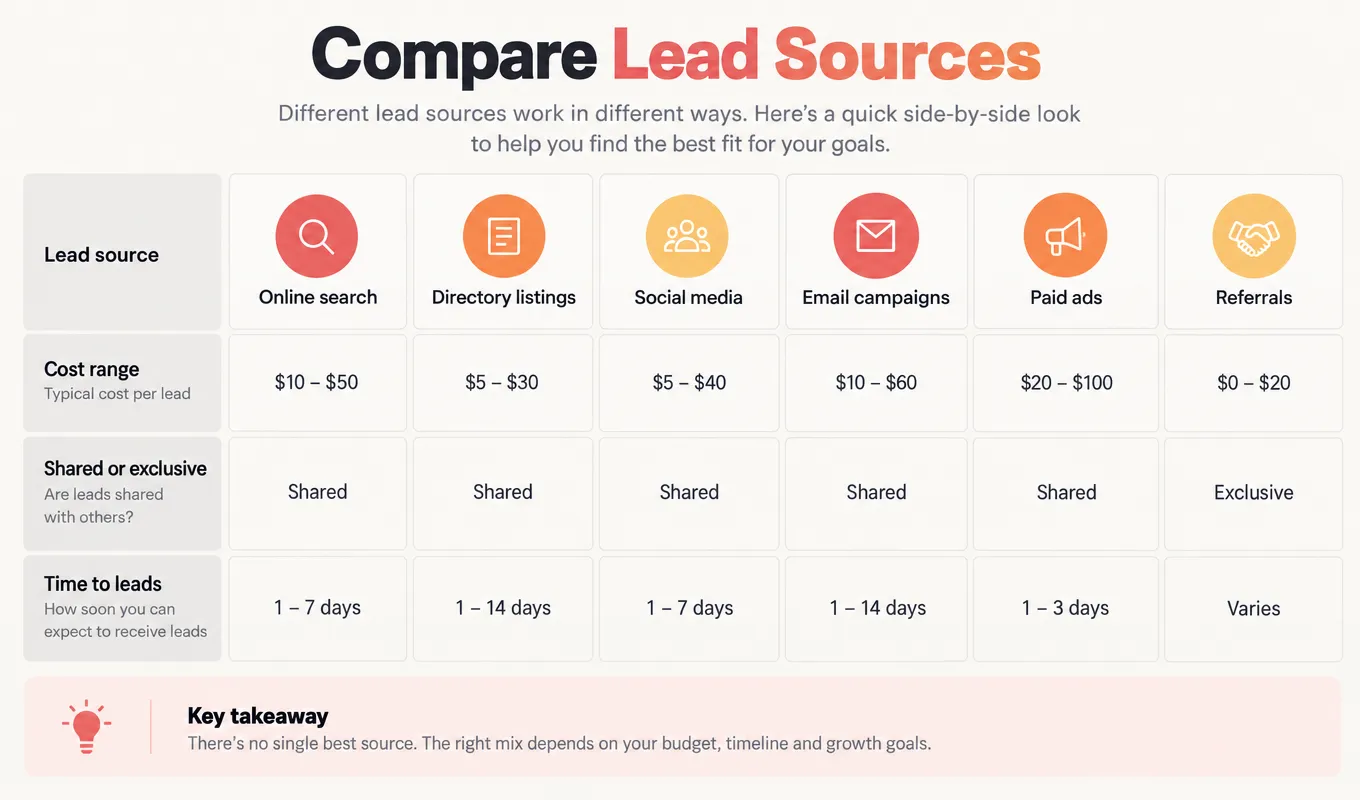
| Attribute | Angi/HomeAdvisor | Thumbtack | Google Local Services Ads | Google Ads (search) | SEO after ramp | Exclusive vendor leads |
|---|---|---|---|---|---|---|
| Cost per lead | $45–$110 | $40–$95 | About $71 | $124–$300 | $25–$100 | $40–$550 |
| Who gets it | Shared, 3–5 roofers | Shared, 3–5 roofers | You only | You only | You only | One roofer |
| Billing basis | Per lead | Per lead | Per lead | Per click | Monthly retainer | Per lead or call |
| Time to leads | Days | Days | Weeks | Days to weeks | Months | Days |
One vendor quotes Angi shared leads at $200–$300.
99 Calls reports that roofing LSA leads averaged $151.07.
For per-click ads, see roofing PPC cost.
The simplest way to judge leads for roofing is this: cost per sold job = cost per lead ÷ close rate
Shared vs Exclusive Roofing Leads: Cost Per Sold Job
Angi’s cost guide puts the average professional roof replacement at $9,607, so use $9,600 as your benchmark. The real question isn’t what a lead costs. It’s how much of that $9,600 job you spend to win it.
marketing cost share = cost per sold job ÷ average job value × 100
The scenarios below rest on assumed prices and close rates, not measured results. Swap in your own numbers.
| Attribute | Shared lead scenario | Exclusive lead scenario |
|---|---|---|
| Cost per lead | $75 (assumed) | $150 (assumed) |
| Close rate | 15% (assumed) | 35% (assumed) |
| Cost per sold job | About $500 | About $429 |
| Share of $9,600 job | About 5.2% | About 4.5% |
Shared inquiries look cheaper upfront. But you’re competing with several roofers on price and speed, so fewer of them turn into signed contracts.
That gap isn’t guaranteed. One vendor’s illustrative cost model shows a $60 shared lead closed at 10% costing $600 per sold job, against $625 for a $250 exclusive lead closed at 40%. Most published models come from vendors that sell exclusive leads, so read them as directional.
Exclusive roofing leads win only when the vendor delivers real exclusivity and real intent. Poor vendor quality erases the close-rate advantage. Track cost per sold job by source before you scale any of them.
If you decide to buy, here’s how the main sources compare.
Where to Buy Roofing Leads: Pros, Cons, Red Flags
When you buy roofing leads, you’re renting volume. They’re fast, and they disappear when payments stop. Use it for slow weeks, new territories, or storm surges. Roofing leads for sale come in three types.
| Attribute | Shared marketplaces | Exclusive lead vendors | Pay-per-call providers |
|---|---|---|---|
| Who gets the lead | Several competing roofers | One roofer, if honored | One roofer, live |
| Main advantage | Fast, steady volume | No bidding war | High-intent phone calls |
| Main drawback | Price and speed fights | Quality varies by vendor | Missed calls still billed |
| Best fit | Fast responders, tight margins | Steady sales teams | Phones staffed all day |
Shared marketplaces suit fast responders, while exclusive vendors need clear contract terms. When comparing roofing leads pay-per-lead pricing, check billing rules, lead quality, and credits for invalid inquiries. Pay-per-call services work best when someone can answer every ring.
Watch for vague lead sources, no credit for bad data, and overlapping “exclusive” territories. Vendor comparison data is directional.
Loona’s view: judge sources on cost per sold job. Start with the biggest marketplaces.
Angi, HomeAdvisor, And Thumbtack
Angi/HomeAdvisor and Thumbtack sell leads for roofing companies per inquiry, and volume shows up within days. The catch is competition. Hero’s 2026 roundup notes that each marketplace lead goes to 3–5 contractors at once.
| Attribute | Angi/HomeAdvisor | Thumbtack |
|---|---|---|
| Billing | Per lead | Per lead |
| Who gets it | Competing roofers | Competing roofers |
| Main risk | Contract terms | Price shoppers |
The first roofer to call usually sets the price. These roofing sales leads pay off only if you answer within minutes and track close rates. Before signing, read this Angi leads review.
Exclusive vendors and pay-per-call providers promise something different.
Exclusive Vendors and Pay-Per-Call
Exclusive lead vendors such as 99 Calls, Service Direct, and 33 Mile Radius promise one lead to one roofer. 99 Calls’ vendor data puts exclusive roofing leads at $40–$550.
| Attribute | Exclusive lead vendors | Pay-per-call providers |
|---|---|---|
| Billing unit | Per lead | Per qualifying call |
| Lead format | Form or call | Live phone call |
| Main risk | Quiet resale | Unanswered calls billed |
| Best fit | Steady sales follow-up | Fully staffed phones |
Pay-per-call providers bill per live call, and intent is high.
Quality varies by provider, so compare roofing contractor leads based on homeowner intent, contact accuracy, and cost per signed job. Question any guaranteed roofing leads claim until the contract defines it.
Whichever source you choose, watch for these warning signs.
Red Flags When Buying Leads
Bad lead deals usually show their warning signs before you sign.
| Attribute | Resold “exclusive” leads and overlapping territories | No credit or return policy for bad leads | Vague sources, long contracts, prepay pressure, undefined “qualified” guarantees |
|---|---|---|---|
| What you see | Competitors quoting same homeowners | Wrong numbers billed in full | Rep dodges sourcing questions |
| Cost to you | Shared-lead close rates | Paying for dead data | Locked into weak leads |
| What to ask | Exclusivity clause in writing | Written return window | Source, term, “qualified” definition |
If a vendor won’t put answers in writing, assume the inquiries are shared. The alternative to buying is building your own pipeline.
How to Generate Your Own Roofing Leads
Buying rents volume. Owned channels start slower, then get cheaper. How to get roofing leads depends on your budget, market, and ability to follow up with homeowners.
| Attribute | Owned (SEO, GBP, referrals) | Paid (LSA, Google Ads) | Marketplaces |
|---|---|---|---|
| Time to first leads | Months | Weeks | Days |
| Cost per lead trend | Falls over time | Tracks your spend | Stays or rises |
| Who owns pipeline | You | You | The platform |
| Role in mix | Compounding base | On-demand volume | Slow-week filler |
Combine all three so no single source decides your season. That’s how to generate roofing leads.
Loona’s roofing clients get qualified LSA and Google Ads inquiries in 2–3 weeks. SEO compounds over about 90 days and reaches the lowest cost per lead. Run paid first.
So what’s the best way to get roofing leads? Paid now, owned later, marketplaces as backup. For channel ideas beyond search, see these roofing marketing ideas.
Local Services Ads and Google Ads
Local Services Ads charge per lead, not per click. Your listing appears above regular ads with a Google Guaranteed badge, and you pay when a homeowner calls or messages. Setup is simple, so Google Local Services Ads lets you get started fast.
Google Search Ads bill per click and give you more control. You choose keywords, budgets, and landing pages, which lets you target leads for roofing jobs such as replacement or storm repair.
SearchLight Digital’s February 2026 benchmark, drawn mostly from HVAC and plumbing, found $233 per paying customer from LSAs versus $472 from Google Ads. Read it as directional for roofing leads. Paid channels stop when the budget does, which is why SEO matters.
SEO & Google Business Profile
If you’re researching how to generate roofing leads through organic search, expect a gradual ramp. Technical fixes, service pages, and local content can take months to produce steady inquiries. After that ramp, Hero’s 2026 roundup puts SEO-sourced inquiries at $25–$100 each, the lowest long-term cost of any source.
Your Google Business Profile carries much of the local weight. Keep categories, service areas, and photos up to date, and ask every customer for a review. Map-pack calls often arrive before your site ranks.
Owned rankings keep producing when ad budgets pause, as the Plum ProExteriors case study shows.
If you’d rather skip the in-house build, compare roofing SEO services. Not every channel needs ad spend, though.
Referrals & Free Roofing Leads
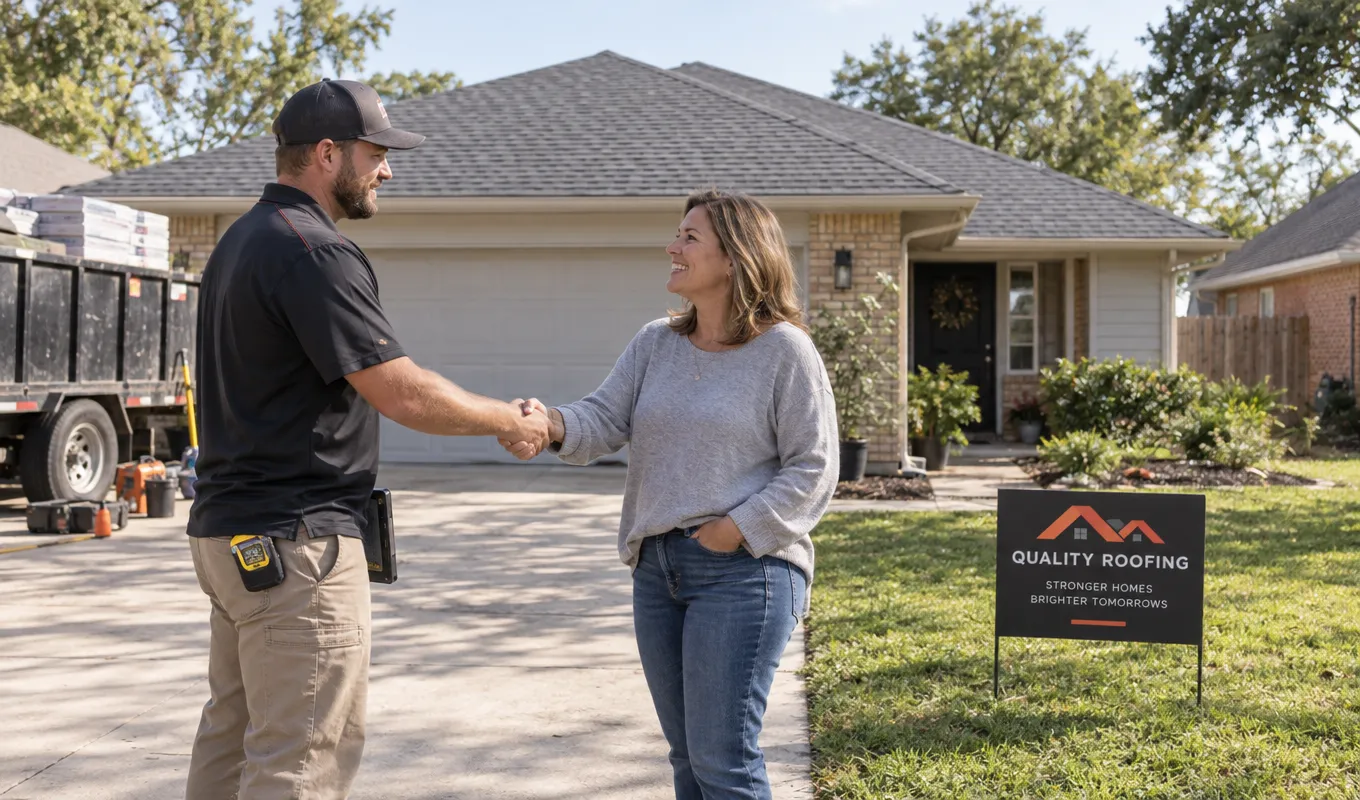
Free roofing leads cost time, not ad spend. Referrals come first: a happy customer’s neighbor already trusts you, so ask at the final walkthrough. Reviews keep that trust visible, and a steady stream of fresh ones lifts your Google Business Profile in the map pack. If you’re exploring how to get roofing leads from insurance companies, focus on legitimate referral relationships rather than expecting carriers to sell inquiries. Networking with insurance agents, restoration firms, realtors, and home inspectors can help build those connections.
Yard signs work on the street where you just installed.
None of these scale on demand. You can’t buy more referrals in a slow month, so treat them as a base layer under your paid and SEO channels. Whatever the source, leads only pay off if you work them fast.
How to Work Leads So They Turn Into Jobs
Two habits decide whether inquiries become signed contracts: how fast you respond, and whether you know which source each job came from.
Five-minute Response
Roofr’s Roofing by the Numbers 2025 report found that leads contacted within 5 minutes convert about 9x better than leads contacted after 30 minutes. On a shared lead, that window is everything, because three to five roofers get the same inquiry.
Set up an automated text that confirms the request within a minute. Then have a person call before the five-minute mark. Send after-hours leads to an answering service, not voicemail.
CRM & Source Tracking
The same Roofr report found that only 28% of roofers use a CRM to track leads. Without one, you can’t see which source produces sold jobs. Tag every lead with its source at entry, then review the numbers monthly:
close rate by source = sold jobs from source ÷ leads from source × 100
Cut the sources that lose on cost per sold job, even if their lead price looks low. Your sales manager should own this review each month.
Want leads that go only to you? Get a free estimate and start generating more leads for your construction business today.
Before signing with any vendor, run it through a vetting checklist.
How to Vet a Roofing Lead Vendor
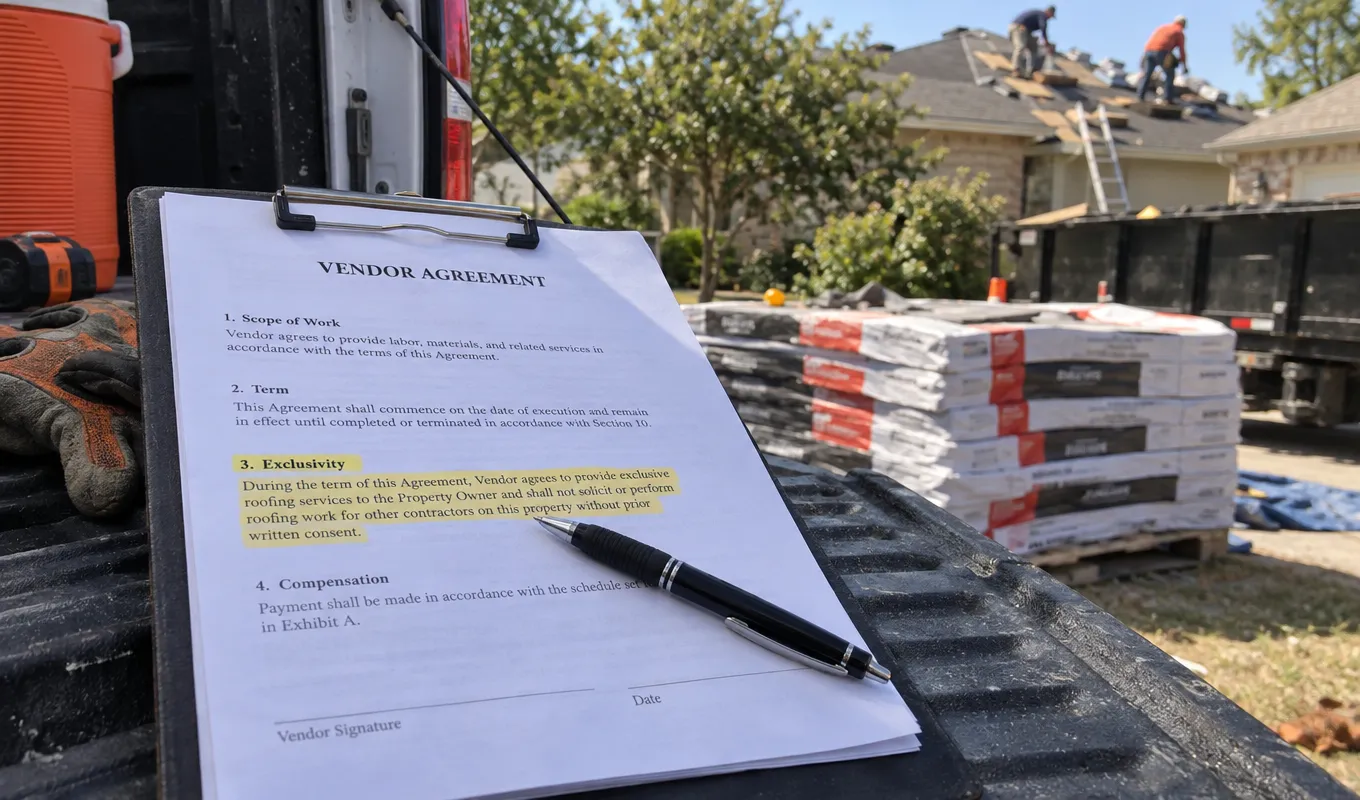
The best roofing leads come from verified homeowners with genuine project intent, but price alone won’t reveal quality. Before choosing a vendor, get four answers in writing. Sales calls aren’t contracts.
| Attribute | Written exclusivity clause | Credit policy, term, cancellation, billing unit | Territory and zip-code protection | Source transparency and data ownership |
|---|---|---|---|---|
| What to ask | Which sentence defines “exclusive” | Credit window and contract length | Roofers allowed per zip code | Traffic source and ad account owner |
| Good answer | Never resold, in writing | Written credits, month-to-month | Capped count, named zips | You own pages and data |
| Red flag | Exclusive only for a short window | Credits only, auto-renewal | Overlapping roofers in your ZIPs | “Proprietary network,” no details |
“Exclusive” can mean never resold, exclusive within a radius, or exclusive for a limited window. Ask the rep to point to the clause. If they can’t, assume the leads are shared.
Next, pin down the billing unit and what counts as a billable, creditable lead.
Territory protection is a separate check. A vendor can sell each lead only once and still place several roofers in your zip codes.
Finally, ask who keeps the tracking data when you leave. Leads you paid for shouldn’t vanish when you leave the vendor. Here’s what we see across roofing budgets in practice.
What We See in Roofing Lead Budgets
Most published guides for roofers put marketing spend somewhere between the high single digits and low double digits as a share of revenue. Treat that as a sanity check, not a plan. Roofing revenue swings after a storm year, so a fixed percentage can overfund a quiet season or starve a busy one.
monthly marketing budget = target annual revenue × marketing % ÷ 12
The bigger question is what that budget buys. Loona’s view, drawn from 50+ roofing clients, is that budgets heavy on purchased shared roofing leads usually shift toward owned channels once cost per sold job is tracked by source. Marketplace spend shrinks to slow-week filler. LSA and Google Ads carry near-term volume, and SEO takes a growing share each quarter.
That shift isn’t the only path. American Building Development went SEO-first, with product-specific long-tail pages and technical fixes, and grew organic traffic within months instead of buying more contractor roofing leads. This approach fits companies with patience and a clear service niche.
To keep the budget honest, give one person ownership of the review. Your sales manager should pull last year’s spend by source, calculate cost per sold job for each, and move next quarter’s dollars toward the two cheapest sources. If you’d rather not build that in-house, compare roofing lead generation services.
Build a Roofing Lead Mix You Control
Roofing leads aren’t equal, and price per lead tells you little. Shared marketplace leads arrive fast but put you up against several roofers on price and speed. Exclusive leads cost more upfront and often close better, but only if the vendor puts exclusivity in writing.
The real priority is cost per sold job by source. Run LSA and Google Ads for near-term volume. Build SEO and your Google Business Profile as the compounding base. Keep marketplaces as slow-week filler.
None of this works without a five-minute response and a CRM that tags every lead’s source. Your sales manager should own the monthly review and shift budget toward the two sources with the lowest cost per sold job.
Want proof before you commit? These roofing case studies show how owned channels replaced rented volume for contractors like Plum ProExteriors. For deeper channel guides, browse the Loona marketing blog.
Ready to own your pipeline instead of renting it? Get a free estimate and start generating more leads for your construction business today.
FAQ
01 How much do roofing leads cost?
99 Calls' vendor data puts shared roofing leads at about $25–$200 and exclusive leads at $40–$550. Ranges differ by source, so don't rely on one average. Judge every source by cost per sold job, not cost per lead.
02 Are exclusive roofing leads worth it?
Often, yes. Higher close rates can give exclusive leads a lower cost per sold job than shared ones. That holds only if the vendor proves true exclusivity in writing and the leads show real intent.
03 What is the best way to get roofing leads?
Mix your channels. Run LSA and Google Ads for leads within weeks, and build SEO for the lowest long-term cost per lead. Buy shared marketplace leads only as a short-term supplement.
04 Can you get free roofing leads?
Referrals, reviews, your Google Business Profile and local networking cost time rather than ad spend. None of them scale on demand, so no truly free source can cover a slow month.
05 How do you get roofing leads from insurance companies?
Insurers don't sell leads. Work storm-damaged neighborhoods after hail and wind, and build relationships with adjusters and agents who refer homeowners. Strong local visibility after storms brings in the rest.
06 How fast should you respond to a roofing lead?
Respond within 5 minutes. Roofr reports those leads convert about 9x better than leads contacted after 30 minutes. Call first, then send a text if the homeowner doesn't pick up.
Love what you’re reading? Sign up for our newsletter to get our newest articles, helpful tips, and fresh marketing updates delivered right to you. No spam, just the good stuff.