




Most contractors should set their contractor marketing budget at 5–12% of revenue. Companies protecting an established pipeline can often stay toward the lower end, while businesses entering new markets or growing aggressively may need to go higher.
The percentage is only half the answer. A $2M roofer and a $2M remodeler can spend the same amount and get very different results, because cost per lead, close rate, and seasonality vary by trade. Published benchmarks also disagree, so use them as starting points to check against your own numbers, not as rules.
This guide covers budgets by revenue tier, a worked cost-per-lead check, a channel split, seasonal weighting, and a one-page ROI scorecard you can run monthly.
First, the core question: how much of your revenue should go to marketing at all?
Contractor Marketing Budget: How Much to Spend
Most contractors should set their contractor marketing budget at 5–12% of revenue. That range comes from Loona’s benchmarks for US roofing, remodeling, and construction companies.
Two outside reference points fall inside that band. The commonly cited SBA guideline is 7–8% of gross revenue for businesses under $5M, and Gartner’s 2025 cross-industry average is 7.7%. Think of the SBA figure as a maintenance level: it keeps the phones ringing, but it probably won’t fund growth.
Contractors in growth mode in competitive markets go to 10–15%. Below 5% usually means you’re coasting on referrals. Above 15%, audit ROI before adding more spend. A roofing contractor marketing budget percentage near the top of the range suits a crowded storm market better than a quiet rural one.
The bigger mistake is the starting number, not the percentage. Contractor marketing budget planning begins with next year’s target revenue. It doesn’t begin with last year’s sales or whatever cash is left at month-end.
annual budget = target revenue × marketing %
monthly budget = annual budget ÷ 12
A $1.5M target at 8% gives $120,000 a year, or $10,000 a month before seasonal adjustments. That’s a contractor marketing budget built for the revenue you’re aiming at. The right percentage shifts with company size, so here’s the breakdown by revenue tier.
Marketing Budget by Revenue Tier
Smaller contractors spend a bigger share because they’re building lead flow from scratch. As repeat work and reviews grow, the percentage drops.
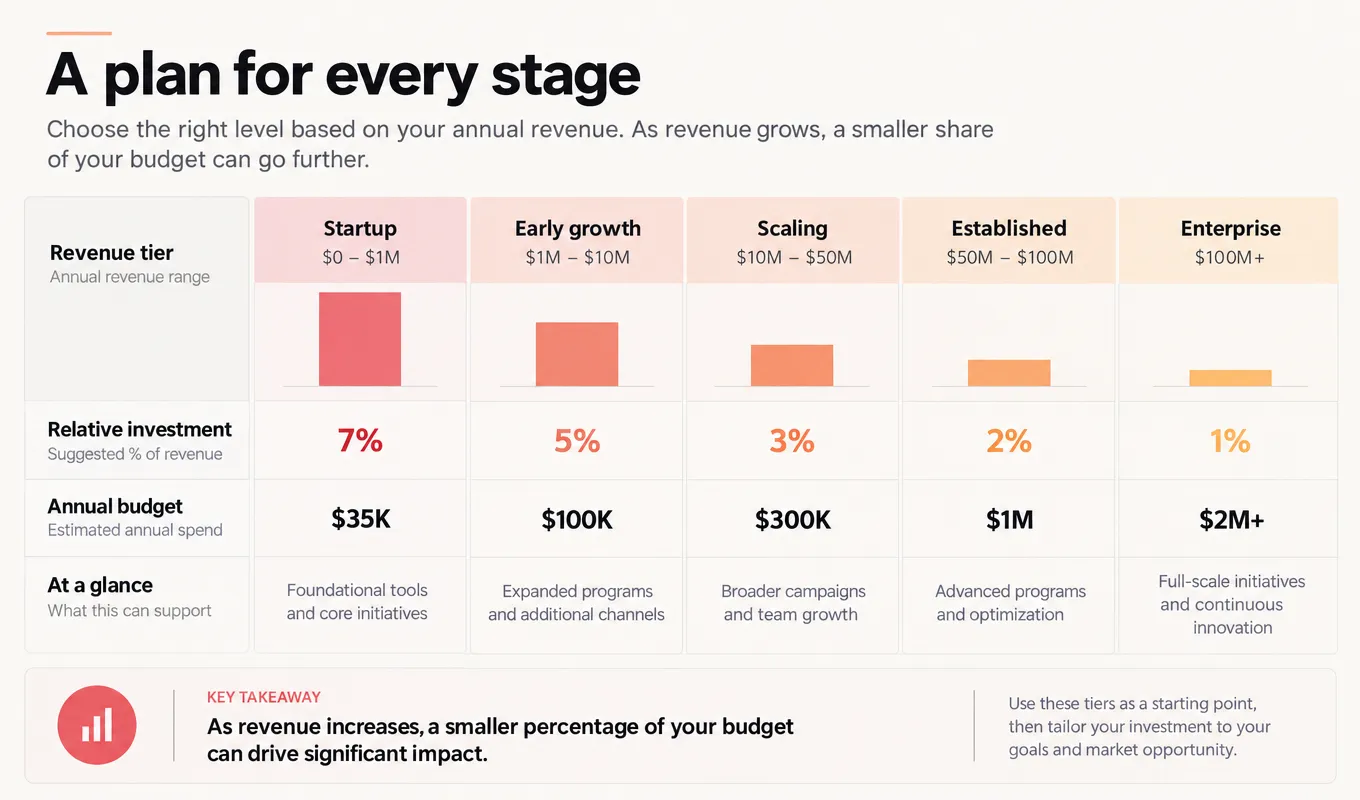
Loona’s tier benchmarks, priced at sample revenue:
| Revenue tier | Marketing % | Sample revenue | Annual budget |
|---|---|---|---|
| Under $500K | 10–15% | $400K | $40K-$60K |
| $500K-$1M | 8–12% | $750K | $60K-$90K |
| $1M-$3M | 8–10% | $2M | $160K-$200K |
| $3M-$10M | 6–8% | $5M | $300K-$400K |
| $10M+ | 5–7% | $15M | $750K-$1.05M |
Treat these tiers as starting points, not fixed rules. A contractor with strong organic rankings and repeat customers may need a smaller percentage than a similarly sized company entering a new market or relying heavily on paid leads.
A $400K roofer has few reviews and little repeat work, so nearly every job is bought. The average marketing budget roofing contractor owners set follows that curve, and it tends to run higher in storm markets.
Take a $2M remodeler. At 8–10%, that remodeling contractor marketing budget is $160,000–$200,000 a year. Sources disagree on remodelers, so calibrate with your own cost per booked job. Cutting too deep backfires. A remodeler spending only a small share of revenue on marketing often runs a thin pipeline of just a couple of months.
Next, turn a revenue goal into a cost per lead you can hold ads to.
Worked Example: From Revenue Goal to Cost Per Lead
Take a roofing company targeting $2M next year at 8%. That’s a contractor marketing budget of $160,000, about $13,300 a month.
Assume a $12,000 average job, 30% gross margin, and a 30% close rate, meaning the share of leads that sign. Cost per lead is what one call or form costs you.
max cost per lead = (average job value × margin × close rate) ÷ 3
cost per acquisition = cost per lead ÷ close rate
That gives 12,000 × 0.30 × 0.30 ÷ 3 = $360 per lead. Dividing by 3 protects a 3:1 ROI, or $3 of gross profit per $1 spent.
Now check that ceiling against LocaliQ’s 2025 benchmarks from 3,211 campaigns:
| Metric | Your cap | LocaliQ roofing | LocaliQ HVAC/plumbing |
|---|---|---|---|
| Cost per lead | $360 | ~$228 | ~$128–129 |
| Cost per job (30% close) | $1,200 | ~$760 | ~$427–430 |
At $228 per lead, 167 jobs need about 560 leads and $127,000. That fits inside $160,000. That leaves roughly $33,000 for management fees, SEO, website work, reviews, software, or other marketing costs. If those additional expenses push the total above the annual budget, the company must either improve conversion, reduce lead costs, or revise the revenue target.
Read these roofing contractor marketing budget statistics as benchmarks, not guarantees. HVAC and plumbing figures differ by source, so calibrate with your own tracked cost per job.
Lead type moves the number too. The roofing PPC cost-per-lead guide breaks out storm, repair, and replacement leads. Once you know what a lead is worth, the question becomes which channels get the money.
How to Split Your Budget Across Channels
Weak rankings? Put paid lead generation first: 50–60% of your marketing budget for contractors into Google Ads and Google Local Services Ads.
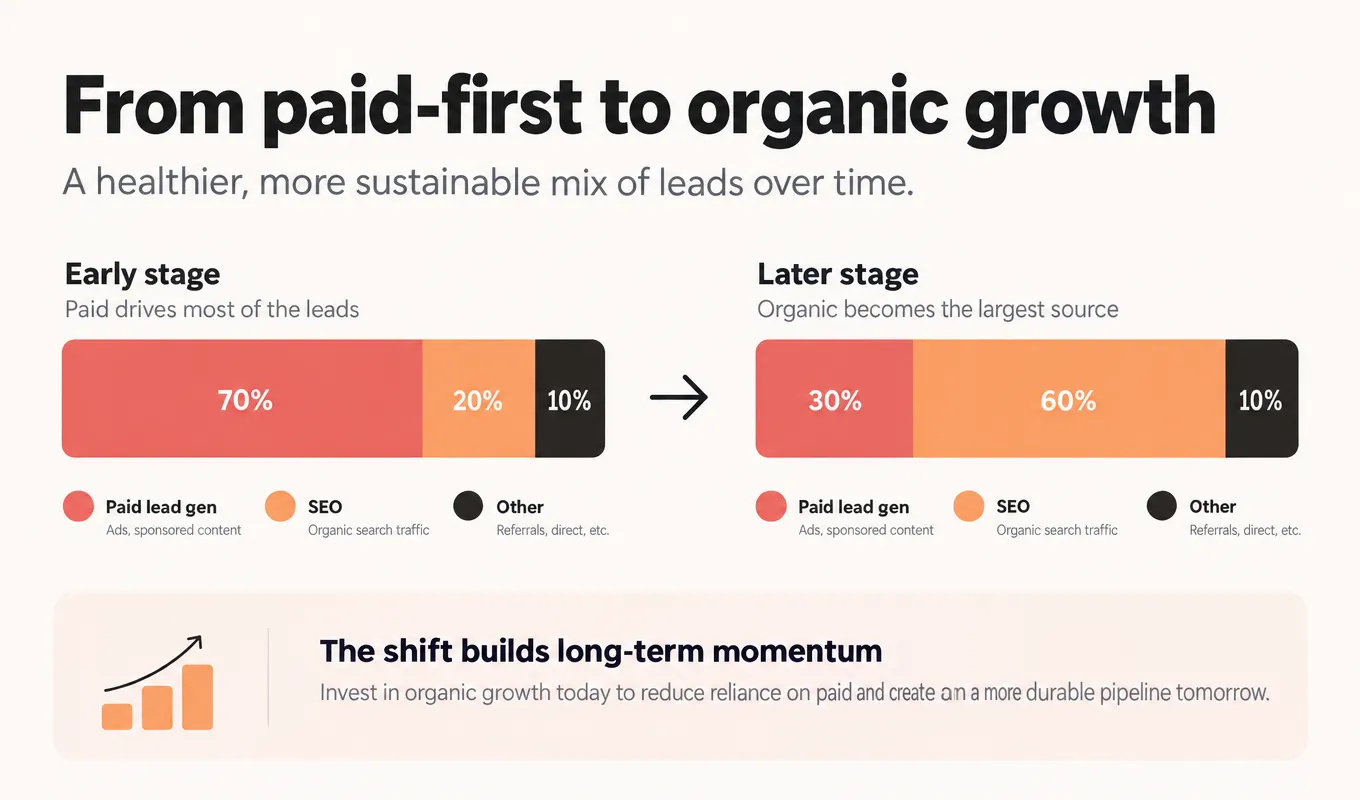
Website/SEO/GBP gets 15–20%. Tools take the rest.
| Channel | Paid-first start | Organic growing | Roofing/remodeling mix |
|---|---|---|---|
| Paid lead gen | 50–60% | Shrinking share | 25% |
| Website/SEO/GBP | 15–20% | Growing share | 35% |
| Reviews and tools | Small share | Steady share | 15% GBP/reviews |
| Best for | Weak organic presence | Rising map rankings | Project-based trades |
Don’t treat the percentages as permanent. The right mix should change as organic visibility, close rates, capacity, and acquisition costs change.
Why paid first? SEO needs 3-6 months. Once organic calls appear, shift toward local SEO services.
Homeowners research big jobs longer. One contractor budget framework suggests 35% SEO and 25% ads for roofing and remodeling. Use that roofing contractor marketing budget allocation once you’re ranked. Check local SEO costs first.
Adjust Spend for Seasonality
Annual ÷ 12 is a starting point, not a schedule. Roofing and exterior demand peaks in warm months and spikes after hail or wind storms.
monthly budget = annual budget ÷ 12 × seasonal weight
Raise the weights a few weeks before peak season, since ads and roofing SEO seasonality both need lead time.
Hold a storm reserve so you can boost roofing lead generation within days of a storm. Trim winter spend, but don’t go dark.
GCs who do mostly interior work can run lead generation for construction closer to flat. However you weight the months, you need numbers to prove the spend is working.
How to Measure Marketing ROI
Untracked budget is a guess. Without channel-level cost per lead and close rate, owners cut whatever looks expensive, which is usually backward.
Give every channel its own tracking number and tag every form, so each booked job traces back to Google Ads, LSA, SEO, or referrals.
Judge cost per booked job, not per lead. A $50 lead closing at 5% costs $1,000 per job. A $150 lead closing at 30% costs $500, half as much.
cost per booked job = channel spend ÷ booked jobs
ROI = gross profit from jobs ÷ marketing spend
Track it on one page each month: spend, leads, booked jobs, revenue, CPL, cost per job, and ROI per channel.
Target a 3:1 gross-profit return multiple as a starting benchmark. Below 2:1, investigate the channel before adding spend. For roofing contractor marketing budget ROI, compare cost per booked job and gross profit—not lead volume alone. Tie your contractor marketing budget to those economics.
Give each channel enough time to gather meaningful data before judging it, and allow SEO several months. Agency fees count too, so here’s what they cost.
Where Agency Fees Fit in Your Budget
An agency’s management fee is a line item inside your marketing budget, not an extra on top of it. Ad spend goes to Google or Meta. The fee pays for the people running the account.

List both as separate rows. In the $13,300-a-month roofing example, every dollar of fee comes out of that total, so ad spend and lead volume shrink to match. Any contractor marketing budget guide that blends the two hides your real cost per lead.
Judge the fee the way you judge a channel:
true cost per lead = (ad spend + agency fee) ÷ leads
If that number stays under your max cost per lead and the account clears 3:1, the fee earns its keep. Below 2:1, renegotiate or move the work.
Before signing, confirm whether the quote includes ad spend, since many agencies quote only the fee. Ask, too, whether the fee is flat or a percentage of spend. Percentage pricing pays the agency more as your spend increases.
Loona’s Google Ads management reports cost per lead and cost per job by campaign. Get a free estimate and start generating more leads for your construction business today. Finally, here’s what this looks like across contractor budgets.
What We See in Contractor Marketing Budgets
Across the roofing, remodeling, and HVAC budgets Loona has reviewed, the same patterns appear repeatedly. These are practitioner observations rather than a controlled industry dataset, but they point to one recurring issue: many businesses don’t track cost per booked job.
Roofers tend to overspend in the wrong months. They run a flat budget all year, pay for slow winter clicks, and have nothing left when a hailstorm hits. More money rarely fixes that. Moving existing money into the weeks that matter does.
Remodelers usually underspend. Many lean on referrals until the pipeline thins, then panic-buy shared leads that close poorly. A steady paid baseline plus patient SEO investment smooths that cycle.
HVAC owners often spread the budget across too many channels. The result is several half-funded platforms, none of which produces enough data to judge. Cutting back to a few tracked channels makes the numbers readable.
Once owners tracked calls and forms by source, the conversation changed. Channels that looked expensive per lead often turned out to be the cheapest per job, and cheap lead sources quickly lost their appeal.
Before you raise or cut your contractor’s marketing budget, run the scorecard for a full month. Then move money based on cost per job, not gut feel.
Set Your Budget From the Revenue You Want
A contractor marketing budget works when it starts from target revenue, sits inside Loona’s 5–12% benchmark range, and answers to cost per booked job. Smaller or growth-mode companies run higher. Larger firms with steady referrals run lower.
The sequence is simple. Set the annual number, weight the months for seasonality, cap cost per lead with the formula, and fund paid leads first while SEO builds. Then let tracking decide where the next dollar goes.
Below 2:1 ROI, move the money. At 3:1 or better, scale.
Want to see how other roofing, remodeling, and construction companies set their numbers? Browse real contractor results to compare spend against booked jobs.
For deeper guides on PPC costs, local SEO, and seasonal planning, the contractor marketing blog covers each channel step by step.
Ready to put real numbers behind your plan? Get a free estimate and start generating more leads for your construction business today. Talk to the Loona team to map your budget to next year’s revenue goal.
FAQ
01 What percentage of revenue should a contractor spend on marketing?
Most contractors spend 5–12% of revenue, per Loona benchmarks. The SBA guideline is 7–8% for businesses under $5M. Growth-mode companies in competitive markets go to 10–15%.
02 Is spending 10% of revenue on marketing too much for a contractor?
Not for most companies under $3M or in growth mode. Above 15%, run an ROI audit. Judge spend by cost per booked job and a 3:1 ROI target, not by the percentage alone.
03 How much should a roofing contractor budget for marketing?
Typically 8–12% of target revenue for companies under $3M, falling as you grow. A $2M target at 8% is $160,000 a year. Weight spend toward peak season and the weeks after storms.
04 How do I know if my contractor marketing budget is working?
Track cost per lead, cost per booked job and ROI by channel with call and form tracking. Aim for 3:1 or better. Under 2:1, reallocate. Give each channel more than 30 days, and give SEO several months.
Love what you’re reading? Sign up for our newsletter to get our newest articles, helpful tips, and fresh marketing updates delivered right to you. No spam, just the good stuff.