



How much do Facebook ads cost? For a roofing, HVAC, or remodeling company in 2026, plan on $1–$3 per click, $10–$15 per 1,000 impressions, and a working monthly budget of $500-$3,000+. Published benchmarks back that up: lead-generation campaigns average $1.92 per click across advertisers, and home services sit at the higher end because local trades bid hard for a small pool of homeowners.
There’s no single price, and anyone quoting one is guessing. Meta runs an auction, so your objective, audience size, ad relevance, and season set the bill – not a rate card. There’s no fixed Facebook ads pricing sheet because every campaign runs through that same auction.
What follows breaks the cost into numbers you can actually budget against, starting with where prices sit today.
How Much Do Facebook Ads Cost Right Now
Plan on $1–$3 per click and $10–$15 per 1,000 impressions if you’re a roofing, HVAC, or remodeling company advertising on Facebook in 2026. Monthly budgets that actually produce results range from $500 for basic testing to $5,000+ once you’re scaling lead generation across multiple service areas. So how expensive are Facebook ads, really? The cost of Facebook ads shifts week to week with your audience and season, which is why a single quoted number is never the full answer.
Independent benchmarks land in the same neighborhood. The Home & Home Improvement category averages a $2.23 CPC on lead campaigns and a $41.26 cost per lead, compared with an all-industry average of $27.66. Home services sits above the platform average because local, high-ticket trades bid hard against each other for a small pool of homeowners.
So when someone asks how much do Facebook ads cost, the honest answer is that it depends on which number you’re asking about – and what you’re asking Meta to deliver.
Treat these figures as planning anchors, not quotes. A roofer in a hail-prone metro during storm season pays more than a remodeler in a quiet suburb in February. Your objective, audience size, and creative quality move the price as much as your industry does.
Those headline numbers only tell part of the story once you separate what you pay per click, per impression, and per lead.
Facebook Ads Cost Per Click, Per 1,000 Impressions, And Per Lead
Meta doesn’t have one price. It has three, and which one applies depends on the objective you select in Ads Manager. Getting these straight is the difference between a campaign that looks cheap and one that actually books jobs.
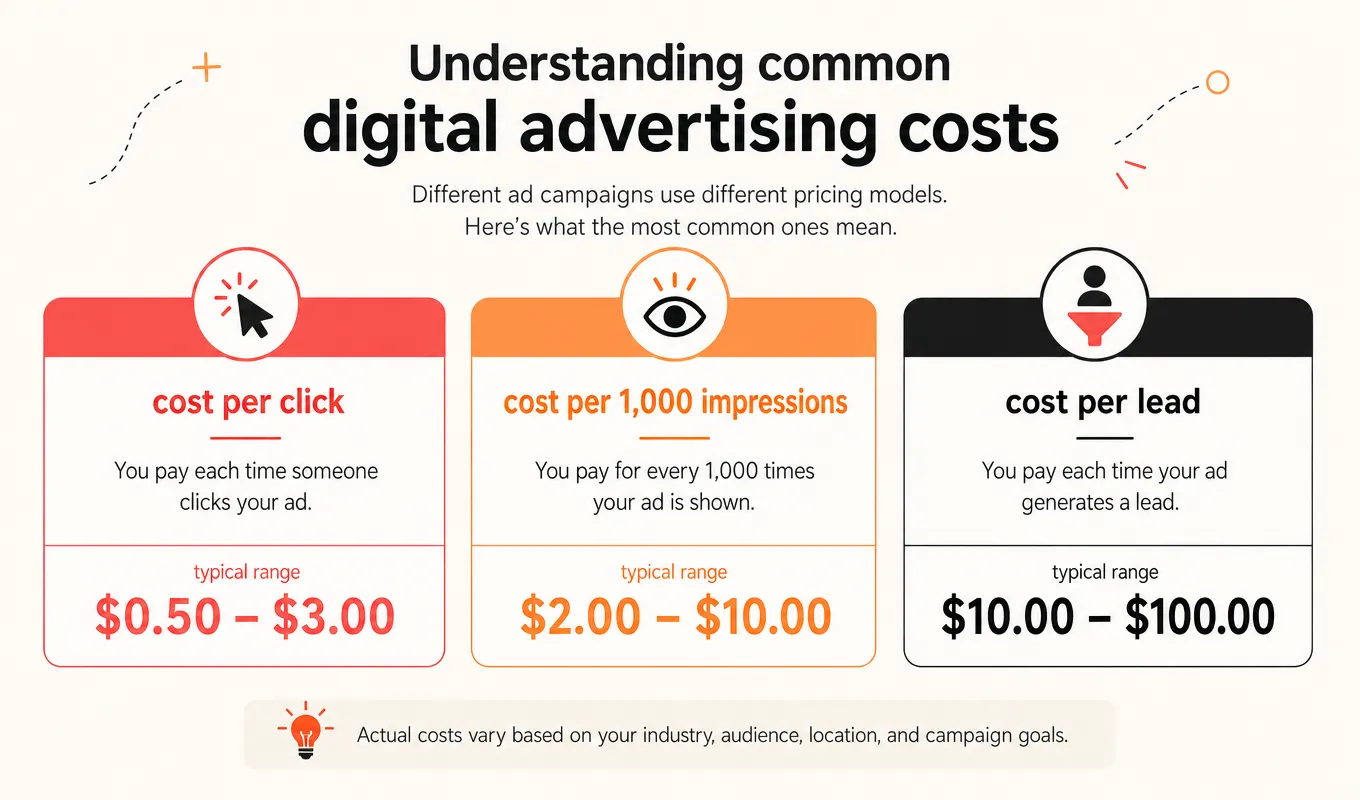
Start with CPC (cost per click). Facebook ads cost per click averages roughly $0.70 for traffic campaigns and $1.92 for lead generation campaigns in 2026 – the same click, priced differently because you’ve asked Meta to find a different kind of person. Traffic campaigns look like a bargain until you notice most of those clicks bounce.
Next is CPM (cost per 1,000 impressions). Platform-wide, CPMs range from about $8 to $14 depending on the vertical and placement. You’ll see this number on awareness and reach campaigns, where Meta charges for eyeballs rather than actions. It’s a useful diagnostic – a climbing CPM on the same audience usually means your creative has gone stale, not that the market changed.
Then CPL (cost per lead), the one that matters. The math is simple:
cost per lead = total ad spend ÷ leads generated
Across all industries, Facebook lead ads average around $27.66 per lead. That’s your baseline, not your forecast.
For home-service advertisers specifically, these blended averages run higher than the all-industry figures.
Average CPC and CPM for Home Service Ads
Roofing, HVAC, remodeling, and general contractor campaigns almost always land in the upper half of Meta’s benchmark range. That’s not bad luck – it’s auction math. You’re bidding against every other contractor targeting the same few zip codes, and the homeowner who needs a new roof is worth thousands, so nobody backs off.
Roofing tends to run hottest, especially after storms. HVAC spikes twice a year with the weather. Remodeling and general contractors sit slightly lower but still above the platform average, since their audiences are just as narrow.
Expect Facebook ad cost per click in these trades to be at or above $2, with CPMs following suit.
Clicks are only half the equation – what matters to a contractor is how much each booked lead ultimately costs.
Cost Per Lead for Roofing, HVAC, And Remodeling Campaigns
Well-run home-service campaigns typically land between $10 and $60 per lead, based on what Loona sees across managed roofing, HVAC, and remodeling accounts. Roofing sits at the top of that range in storm season, when every contractor in the metro is bidding on the same damaged neighborhoods. HVAC swings with the thermometer – cheapest in shoulder months, priciest during the first heat wave.
Remodeling usually falls in the mid-range but has a longer sales cycle, so a $45 lead can take weeks to close.
Judge campaigns on this number, not CPC. A $4 click that never books is more expensive than a $60 lead that signs a roof replacement.
None of these per-click or per-lead figures mean much until you translate them into an actual monthly budget.
How Much Do Facebook Ads Cost Per Month, Week, And Day
Budget $500 to $3,000+ per month, and pick your tier based on what stage you’re at rather than what you can scrape together.
$500/month is the basic testing tier. It buys you two or three audiences and a handful of creatives – enough to learn which message pulls, not enough to fill a calendar. Treat it as tuition.
An early scaling tier with a moderate monthly budget can generate a meaningful number of leads per month, depending on CPL, and provide Meta with enough conversion volume to exit the learning phase and optimize effectively. Most single-crew roofers and HVAC shops live here.
$3,000+/month is full-scale lead generation. Multiple service areas, separate campaigns per trade, retargeting running alongside cold prospecting. This is where Facebook ads’ cost per month starts to buy predictable volume instead of a trickle.
Daily and weekly numbers are just that monthly figure divided out:
daily budget = monthly budget ÷ 30
So how much do Facebook ads cost per day? A $500 monthly budget averages about $17/day. A $3,000 monthly budget averages about $100/day. Your Facebook ads cost per day is just the planning unit – Meta still bills against the auction, not a flat daily rate. Weekly totals scale the same way – a $500 monthly budget works out to roughly $117 per week, and $3,000 lands around $700 per week.
Daily and weekly budgets scale down from the monthly figure, with a modest daily spend covering testing and a larger daily spend supporting early scaling. Push past that, and you’re running serious volume – useful to know if you’re planning spend around storm response or a seasonal push rather than the calendar month.
One rule worth holding: lead generation objectives need at least $20–$50/day to produce enough conversions for Meta to learn from. Below that, the algorithm never gets its footing, and your cost per lead stays high no matter how good the creative is.
Facebook advertising costs depend on the auction, your audience, your objective, and market competitiveness.
What Determines Your Facebook Ad Cost
Two roofers targeting the same county in the same week can pay noticeably different amounts per click, and a several-fold spread is normal. Facebook advertising costs aren’t set by a rate card – they’re set live, auction by auction.
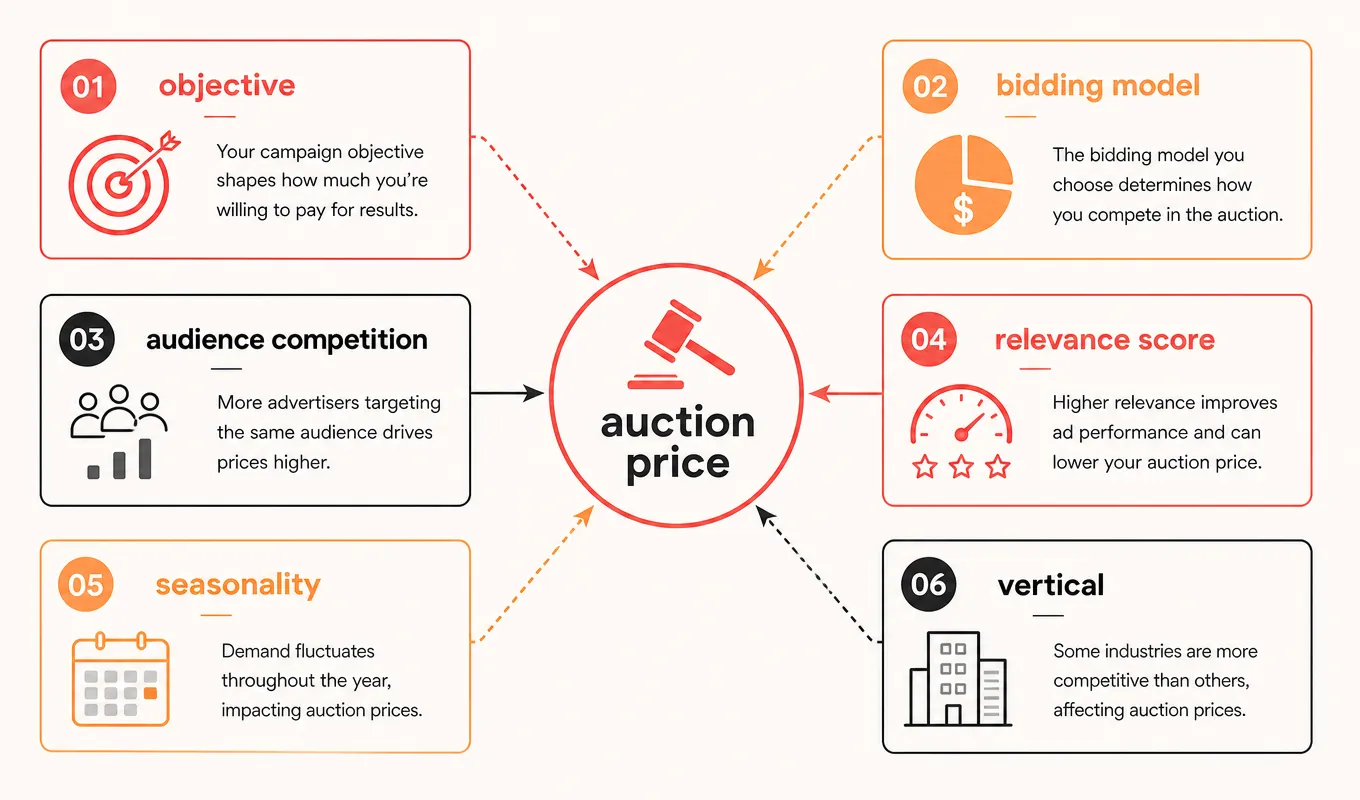
Every impression goes through a live auction. Meta scores each competing ad on bid, estimated action rate and ad quality, then serves whichever combination wins:
total value = bid × estimated action rate + ad quality and relevance
The campaign objective comes first because it tells Meta what to optimize for and what to bill you for. The bidding model is next – the lowest cost lets Meta spend freely to hit volume, while a cost cap holds your price down but can throttle delivery. Audience competition is the third lever: a 40,000-person radius around a single suburb costs more per impression than a statewide pool, simply because there are fewer slots.
Ad relevance and quality score is the one most contractors ignore. Meta scores your ad against positive signals like clicks and shares, and against negative signals like hides and complaints, and a higher score buys cheaper delivery at the same bid.
Seasonality moves everything. US CPMs climb through Q4, then reset sharply in January, with trades layering their own peaks on top. Vertical matters too – home services bids sit above the platform average year-round.
Two of the biggest levers in that auction are the objective you choose and the audience you’re competing against.
Campaign Objective and Bidding Strategy: CPC vs CPM vs CPL
Pick the traffic objective, and Meta optimizes for people likely to click. Clicks are cheap – often well under a dollar – but many of those visitors leave your estimate form untouched. The lead generation objective costs noticeably more per click, sometimes two to three times more on the identical audience, because Meta is hunting for people who’ll actually submit a form. That premium is usually worth paying if you’re chasing booked jobs.
Bidding strategy is the second dial. Lowest cost tells Meta to spend your budget on whatever volume it can find. A cost cap holds your ceiling but can starve delivery if you set it too tight. Facebook advertising costs can look low when you’re only watching CPC, but the real number to track is what you spend to generate a qualified lead.
Objective aside, the size and competitiveness of your audience shapes the price just as much.
Audience Size, Competition, And Ad Relevance Score
Home-service targeting is inherently narrow. You’re advertising to homeowners within a 20-mile service radius, which means a small pool of impressions and many contractors bidding for them. Shrink that radius further, and your CPM climbs.
Ad relevance score is your counterweight. Ads that earn clicks, comments, and shares instead of hides get cheaper delivery at the same bid – Meta rewards ads people actually want to see.
Then the calendar hits. Storm season sends every roofer in the metro into the same auction at once. HVAC peaks twice, in the first heat wave and the first hard freeze. Those spikes are predictable, so budget for them.
Once you understand what drives the price, it’s worth separating that media cost from what you might pay someone to manage it.
Ad Spend vs Management Fees: What You’re Actually Paying For
The number you set in Ads Manager goes to Meta. That’s media spend, full stop. Whoever runs the account charges separately – and contractors who budget one figure for both end up throttling campaigns mid-month when the invoice arrives.
A flat monthly retainer is the most common structure for local home-service accounts. You pay a fixed amount whether your ad budget is $1,000 or $4,000, which makes forecasting simple and doesn’t penalize you for scaling.
The other primary model is a percentage-of-ad-spend fee, commonly 10–20% of budget. At $3,000 in monthly media, that’s $300 to $600 on top. The percentage typically drops as spend grows, since managing $30,000 isn’t three times the work of managing $10,000. A few shops bill an hourly rate instead, and some use a hybrid – a smaller flat fee plus a percentage once spend crosses a threshold.
So when you’re pricing out how much do Facebook ads cost for your company, run two lines, not one:
total monthly cost = media spend + management fee
Your Facebook ads cost per month is the sum. Management is optional overhead layered on top of Meta’s bill – it never replaces it.
If you’d rather not manage creative testing and relevance scores yourself, Facebook ads management for home service companies handles both strategy and day-to-day optimization. Get a free estimate and start generating more leads for your construction business today.
Once you know the split between media spend and management fees, you can build your own number using a simple calculator.
How to Use a Facebook Ads Cost Calculator
A Facebook ads cost calculator is one line of arithmetic. It helps turn the cost of Facebook ads into a budget you can actually plan around. Decide how many leads you need this month, multiply by what a lead costs in your trade, and you have a budget you can defend.
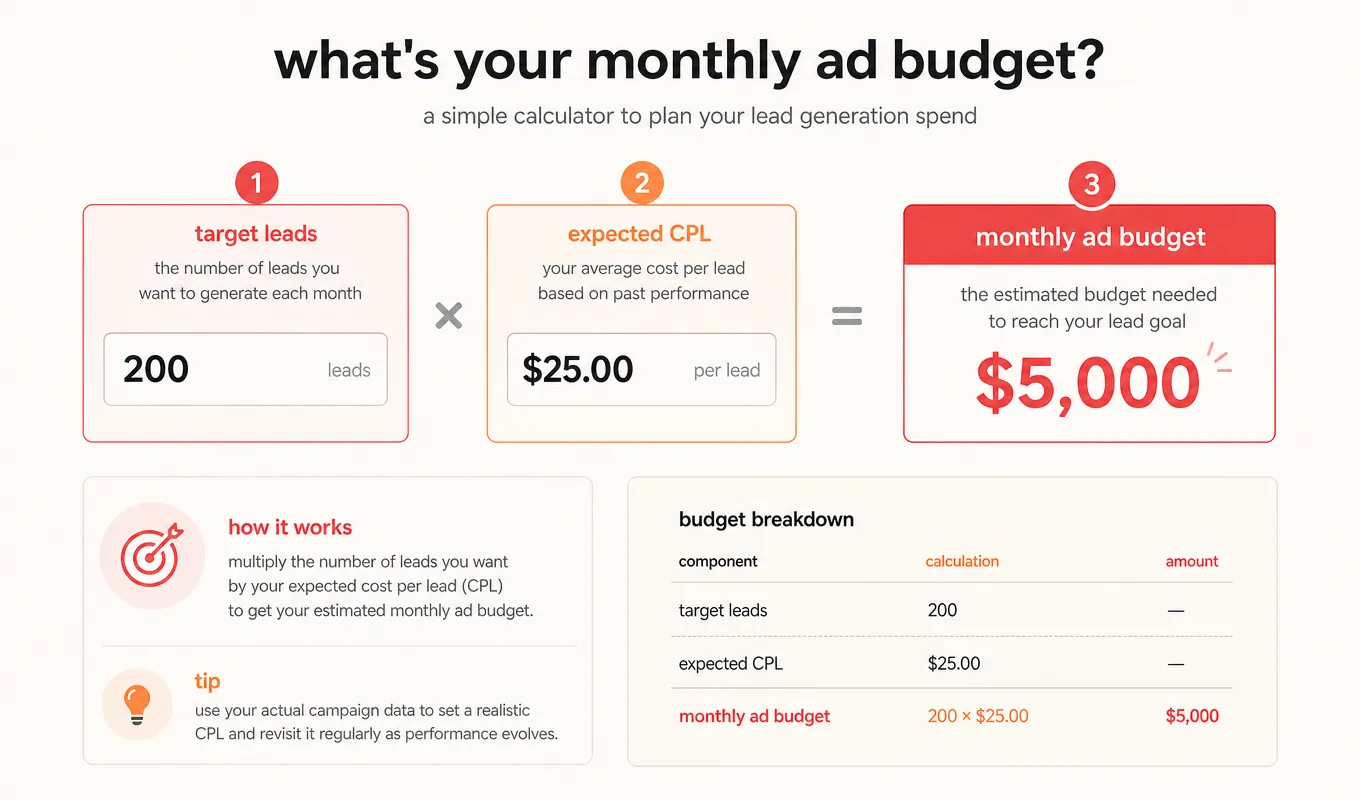
ad spend budget = target leads × expected CPL
For example, a remodeling company targeting a set number of leads at a given CPL can calculate its media spend by multiplying leads by cost per lead, and apply its close rate to estimate signed jobs – before management fees. That comparison tells you fast whether the resulting budget is cheap.
You can also run it backward, from revenue. Set a revenue goal and target ROAS:
required ad spend = revenue goal ÷ target ROAS
Chasing a large revenue goal at a typical ROAS target means a correspondingly large required spend – often bigger than most contractors expect, which forces an honest conversation about the goal or the timeline.
Most versions of a Meta ads cost calculator online just wrap these formulas in a form field. Sanity-check your math with one; don’t replace it.
Plug in your real close rate and average ticket, not benchmark defaults. A contractor doing $18,000 kitchen remodels absorbs a far higher CPL than one selling $400 tune-ups, and DIY SEO tips follow the same cost-per-outcome discipline.
With a budget in hand, see how Facebook stacks up against Instagram and Google.
Facebook Ads Cost vs Instagram And Google Ads
Facebook is the cheapest of the three. Instagram ads cost slightly more per click for the same Meta audience, and Google Ads cost per click in home services runs several times higher.
| Attribute | Google Ads | ||
|---|---|---|---|
| Click cost | Lowest of the three | Slightly above Facebook | Highest by a wide margin |
| Buyer intent | Interrupt, low intent | Interrupt, low intent | Active search, high intent |
| Best used for | Cold prospecting, offers | Visual proof, retargeting | Emergency and ready-to-buy jobs |
| Lead speed | Days to weeks | Days to weeks | Same day |
Fair trade – search intent is already there. Instagram shares the Meta auction, so any Instagram ad cost calculator is Meta math; Instagram ads cost per day isn’t set separately. That also answers how much do Meta ads cost per month for either platform – the same budget, objective, and audience math applies whether the ad runs on Facebook or Instagram.
How much do Google Ads cost? The cost of Google Ads for a small business scales with keyword competitiveness. First, check your Google ranking to see what you already earn for free.
Concrete levers lower cost anywhere, starting with Facebook.
How to Lower Your Facebook Ad Costs
Raising your bid is the laziest fix and the most expensive one. The cheaper path is fixing what Meta scores you on before the auction even runs.
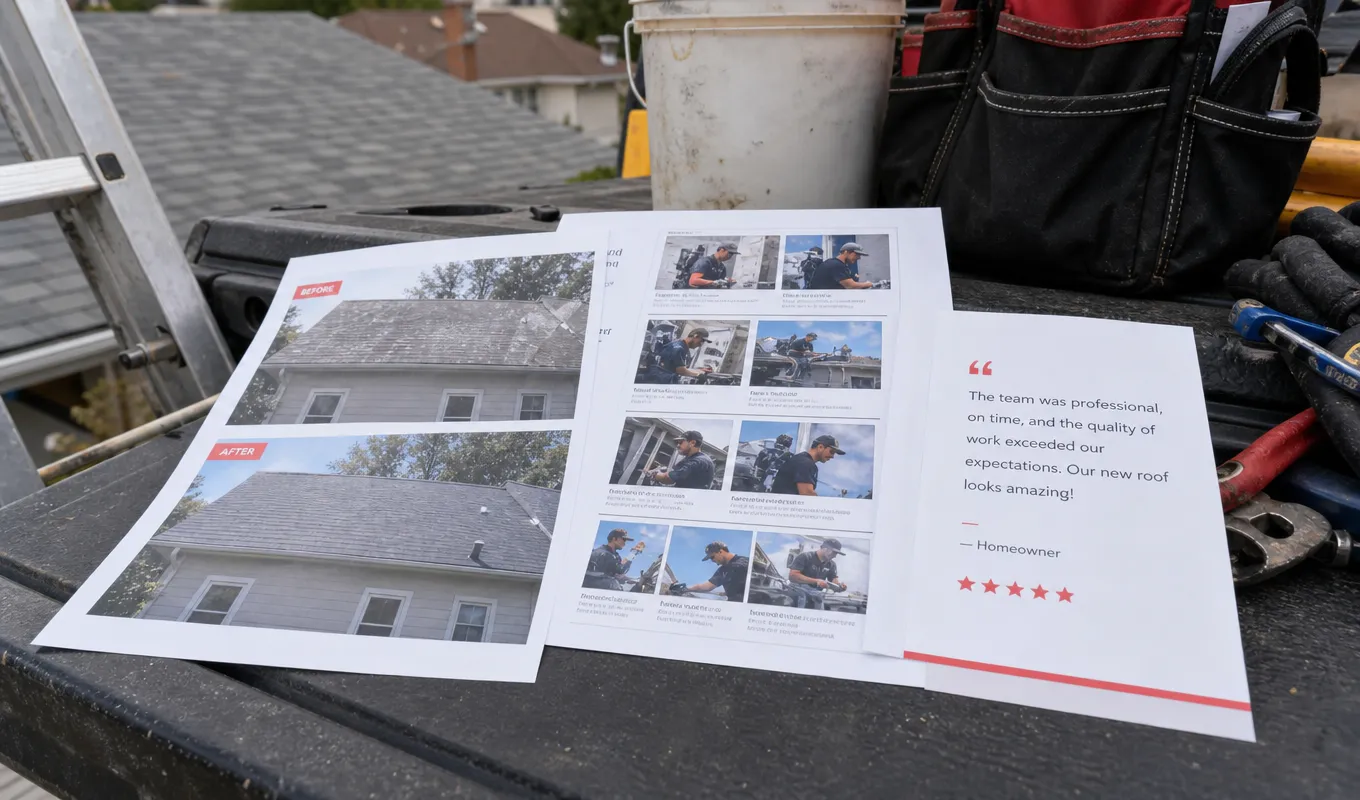
Creative testing and refresh come first because they move cost more than any other lever. Run three or four formats against each other – a static before-and-after, a short walkthrough video, a customer testimonial – and pause the losers instead of nursing them. Watch frequency: once the same homeowner has seen your roof ad four or five times, clicks dry up and your CPC climbs. Fresh creative every three to four weeks resets that.
Audience refinement and layering is next. Stack interests so you’re reaching homeowners with a real signal rather than everyone inside a 25-mile radius, build lookalikes from your highest-ticket past customers, and exclude anyone who already filled out a form.
Relevance-score management ties the two together. Ads that earn comments, shares, and watch time get cheaper delivery at the same bid, and the gap between a well-received ad and an ignored one is dramatic. Keep bid caps disciplined while you test – don’t loosen them to force volume.
Seasonality planning is the last piece. Build creative and budget before storm season or the first heat wave, not during it, and treat off-peak months as your testing window. A content marketing audit often surfaces messaging angles worth testing.
These are the same levers we pull in the home-service accounts we manage day to day.
Inside Our Home-Service Facebook Ad Accounts: Budgets, CPLs, And What Actually Moves the Needle
The pattern across Loona’s managed roofing, HVAC, and remodeling accounts is consistent enough to plan against: a moderate monthly Meta budget can keep a small sales team’s calendar full. Below that range, the campaigns generate leads, but not enough conversion volume for Meta to optimize with confidence. Push well past it, and growth usually requires a second closer before it requires a bigger budget.
Cost per lead in those accounts falls within the $10–$60 range, and the spread is trade-driven rather than random. Roofing sits high during storm response. HVAC runs cheapest in shoulder months and climbs when the first heat wave hits. Remodeling stays mid-range with a longer close cycle attached.
What keeps those CPLs from drifting upward is unglamorous: creative gets refreshed every three to four weeks, before frequency climbs and engagement decays. Skip two cycles and cost per lead starts creeping five or ten percent at a time – slow enough that most owners don’t notice until the quarter’s numbers land.
The results back the discipline. Loona’s paid-ads clients report lead volume growing severalfold once campaigns are managed against cost per lead rather than clicks, and one Meta engagement lifted a client’s Instagram profile visits by 50% on the same budget.
None of that requires a bigger bid. It requires someone watching frequency, relevance, and CPL weekly instead of monthly.
That real-world pattern is exactly why the worth-it question has a clear answer for home-service companies.
Is Facebook Advertising Worth It for Home Service Businesses
Yes – provided you judge it by cost per lead relative to booked-job value, not by clicks.
The evidence from home-service accounts is consistent. One widely cited HVAC case study saw Facebook produce a cost per conversion dramatically lower than the blended average across all of that company’s marketing channels – the same leads, at a fraction of the price. Contractor marketing research on roofing campaigns points in the same direction: Facebook lead forms generate leads at a meaningfully lower cost than direct mail or print, which is why so many roofers have shifted their budgets away from postcards.
For planning, use a 2.24x–4x return on ad spend range. The lower end reflects the median advertiser across all verticals; the upper end is what well-managed small and mid-size accounts see. Home services usually clear the middle of that band because a single roof replacement or system installation accounts for much of the lead cost.
Run the check yourself:
profit per lead = (average job value × close rate × margin) − cost per lead
If a modestly priced lead closes at a reasonable rate on a high-value job, the arithmetic isn’t close. That’s the honest way to answer how much do Facebook ads cost for your business – cost only means something next to what it returns.
Paid ads work best alongside organic efforts, so pair them with a content marketing strategy to grow businesses.
Want the forecasting and day-to-day optimization handled? Get a free estimate and start generating more leads for your construction business today, or browse more marketing guides on the Loona blog.
What Facebook Ads Will Actually Cost You
Three numbers matter. Clicks run $1–$3, CPMs land between $10 and $15, and a workable monthly budget starts at $500 for testing and moves to $1,500–$3,000 once you’re scaling. Management fees sit on top of all of it, never inside it.
The number that decides everything is cost per lead measured against what a booked job is worth. A $50 lead that closes a roof replacement is cheap. A $0.70 click that never fills out a form is expensive.
Start with a budget you can defend for 60 days, refresh creative every three to four weeks, and check frequency before you touch your bid. That’s the whole discipline.
If you want to see what those numbers look like in live home-service accounts, the Loona case studies show budgets tied to actual lead volume.
More breakdowns on paid ads and local search sit in the marketing blog.
Ready to put a real number on it? Reach out to the Loona team – get a free estimate and start generating more leads for your construction business today.
FAQ
01 Is $500 enough for Facebook ads?
It's enough to test 2–3 audiences and a few creatives, not to run full-scale lead generation. Expect limited data and a longer learning phase. Use it as a controlled test on one service line or zip code before you scale.
02 Is it worth paying for ads on Facebook?
Yes, if you track cost per lead against booked-job revenue instead of clicks. Home-service case studies show Facebook leads costing far less than direct mail. Your close rate and average job value decide the return, not the platform.
03 Is $10 a day good for Facebook ads?
That's about $300/month – workable for retargeting or one tightly defined local audience, tight for anything broader. Meta's learning phase needs conversion volume. Most home-service advertisers need $500+/month to optimize meaningfully.
04 How much do Facebook ads cost per month?
Basic testing runs $500-$1,000/month. Standard scaling sits at $1,500-$3,000/month. Multi-market roofing, HVAC and remodeling operators often spend $5,000+/month once several service areas are running at once.
05 What’s the difference between ad spend and management fees?
Ad spend goes directly to Meta for placements and impressions. Management fees pay an agency or freelancer for strategy, creative, and optimization. Fees are usually a flat retainer of $500–$5,000+/month or 10–20% of your ad spend.
06 How expensive are Facebook ads?
That depends less on a fixed platform price and more on your objective, audience, competition, and the quality of the leads you're trying to generate.
Love what you’re reading? Sign up for our newsletter to get our newest articles, helpful tips, and fresh marketing updates delivered right to you. No spam, just the good stuff.