




How much does SEO cost? Most home service businesses pay $1,000 to $4,000 per month for an active program, while multi-location brands can spend well into five figures. The spread comes down to scope, competition, and whether you hire a freelancer, agency, or in-house specialist.
Loona’s 2026 client data puts most active roofing, HVAC, and remodeling programs at $2,500–$4,000 monthly. That figure only makes sense once you know what it buys: pages shipped, links earned, and technical fixes closed every month.
This guide covers pricing models, cost drivers, one-time versus ongoing spend, and the payback math that tells you whether a quote is worth signing. You’ll be able to compare proposals line by line instead of by headline price.
Start with a quick snapshot of what the market charges in 2026.

SEO Pricing at a Glance for 2026
How much does SEO cost in 2026? Most pay anywhere from a few hundred dollars to well into five figures monthly, depending on scope. The average SEO cost per month is $2,917, according to a 2026 SEO pricing guide. Agencies average $3,200, while freelancers average $1,350.
| Freelancer | Agency | Enterprise program | |
|---|---|---|---|
| Typical monthly cost | $500–$1,500 | $1,500–$7,000 | $10,000–$50,000+ |
| Best fit | Single-location, narrow scope | Growing multi-service firms | Multi-location or franchise brands |
| Output capacity | One person’s hours | Full specialist team | Dedicated team plus tools |
| Main risk | Limited bandwidth | Unused tier hours | Slow internal approvals |
Freelancer SEO pricing buys one person’s time. Agency SEO pricing can provide access to writers, technical specialists, and strategists. Enterprise SEO pricing scales across many locations.
Loona’s home service engagements start at $2,500/month, while most invest $2,500–$4,000. An SEO cost calculator gives ballparks, not quotes. SEO pricing packages vary too much by market to standardize.
SEO Pricing Models Explained
Two quotes for similar work can look wildly different. One provider may charge a monthly retainer, while another bills by the hour or project. So before asking how much does SEO service cost, ask how the provider bills.
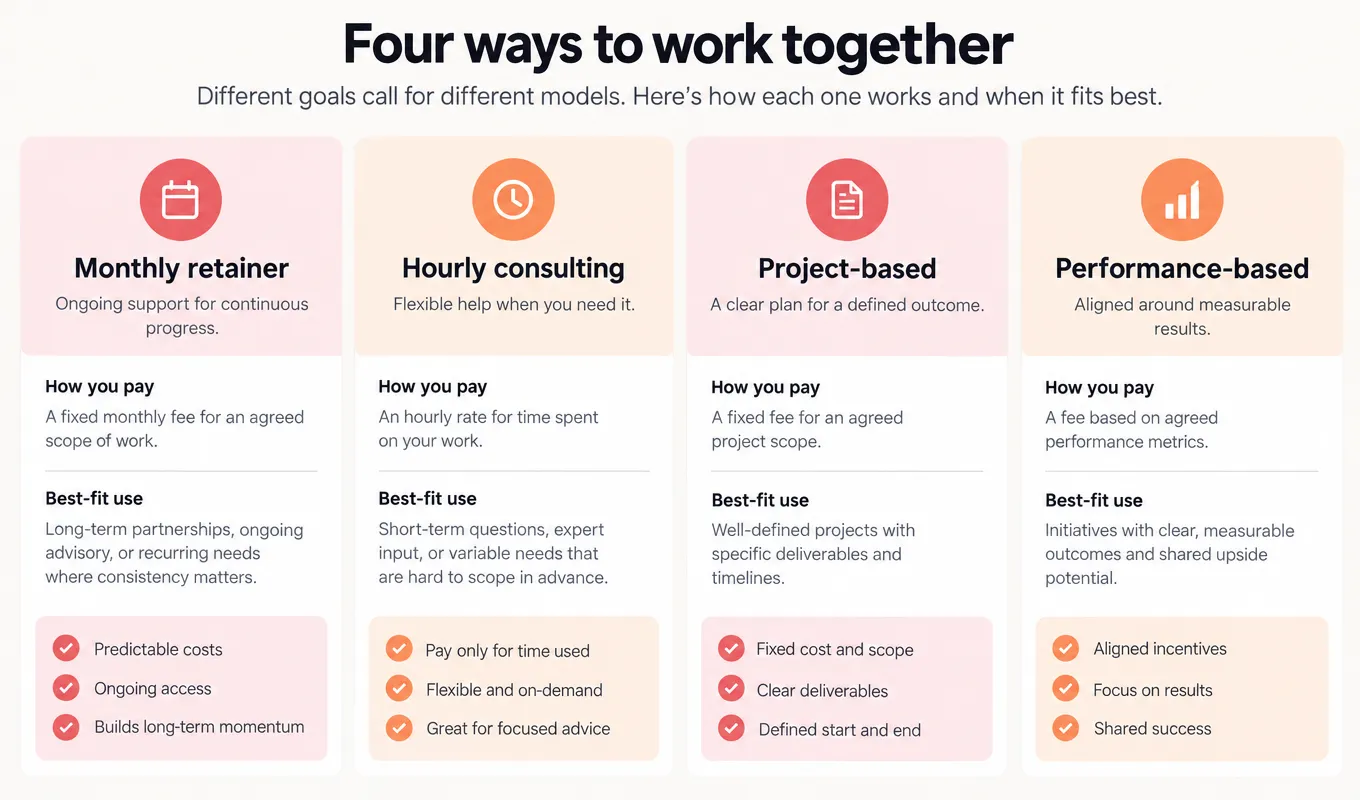
A 2025 SE Ranking survey found that 78.2% of SEOs charge monthly retainers, 48.9% charge project fees, 34.8% bill hourly, and only 9% use performance-based pricing. Many providers combine them.
| Monthly retainer | Hourly consulting | Project-based / flat fee | Performance-based pricing | |
|---|---|---|---|---|
| How you pay | Fixed monthly fee | Per hour billed | One upfront price | Tied to rankings |
| Best for | Ongoing growth work | Strategy calls | Audits and migrations | Rare edge cases |
| Main risk | Unused tier hours | Costs creep | Nothing after delivery | Shortcut tactics |
The model shapes your cash flow and your vendor’s incentives. A remodeler on retainer gets steady monthly work. Buying the same hours as one project means a big check, then silence for a quarter. When comparing SEO pricing packages, match the hours and deliverables, not the headline price.
The retainer model dominates the market, so it’s worth breaking down what it actually buys you.
Monthly Retainer Pricing
SEO requires ongoing attention as competitors, search algorithms, and customer behavior change. Monthly retainers give businesses a consistent budget for that work.
| Entry-tier retainer | Mid-tier retainer | Premium/enterprise retainer | |
|---|---|---|---|
| Monthly cost | ~$1,500–$3,000 | ~$3,000–$7,000 | $7,000+ |
| Hours included | 10–15 | 20–25 | 30–40+ |
| Typical fit | Single-location contractor | Multi-service growth | Multi-location brands |
How much does SEO cost per month? Ask what the hours actually buy. Entry-tier covers fixes; mid-tier adds content and links. Hourly sometimes fits better.
Hourly, Project & Performance-Based Pricing
Three other models cover narrower needs.
| Hourly consultant/specialist rates | Flat project fees (audits, migrations) | Performance-based / risk-reward pricing | |
|---|---|---|---|
| Best for | Strategy advice | One-off deliverables | Narrow goals |
| Budget | Open-ended | Fixed upfront | Tied to results |
| Main risk | Hours creep | Nothing after delivery | Shortcut tactics |
Hourly billing gets you quick expert direction. A flat fee fits a roofer’s site migration. Performance deals reward fast ranking wins rather than lasting lead growth.
Whichever model you choose, several concrete factors push the final number up or down.
What Drives Your SEO Cost Up or Down
How much does SEO cost monthly for your business? Most home service companies fall somewhere in a wide range, and several variables determine where they land.
Start with scope: local vs. national vs. e-commerce. A roofer targeting one metro may only need pages for core services and priority locations. National or e-commerce brands often manage much larger sites, and the hours climb right along with them.
Next is site size and technical condition. A clean 20-page site costs far less to maintain than 400 pages riddled with broken redirects. Market competitiveness matters too. Ranking for “AC repair” in Phoenix demands deeper content and stronger links than ranking in a small town does.
Then there’s content volume needed. Every new service line or city may require dedicated content to reach customers searching for those services in that location.
Link-building requirements rise with your rivals. When competitors hold stronger backlink profiles, you may need more time and resources to earn relevant, authoritative links. Finally, weigh one-time fixes against ongoing work. An audit is a single check, but rankings need monthly effort to hold.
Before asking how much does SEO marketing cost, list your pages, target markets, top competitors, and current backlinks. You’ll get sharper quotes that way. These variables show up most clearly when you compare pricing across different business sizes.
SEO Cost by Business Size
Company size is the most reliable predictor of your SEO bill. More locations mean more pages, more markets, and more hours.
Small business budgets sit at the bottom of the ladder. A single-location roofer or HVAC shop needs a tight set of service pages, one Google Business Profile, and steady local links. So how much does SEO cost for a small business? For most contractors, it runs in the low four figures per month.
Mid-market and multi-location companies land in between. They pay more as each new city adds pages to build and rankings to defend.
Enterprise and franchise brands sit at the top. Dozens of locations, overlapping service lines, and competitive metros push their programs well into five figures a month.
Home service businesses have one advantage here. Broad market averages blend in e-commerce stores and national brands, which inflates the numbers. SEO for a home service business typically costs $1,000 to $3,500 per month, according to a 2026 home services guide. Loona’s 2026 data sits at the upper end of that band. Most of its clients invest $2,500–$4,000 monthly for an active program.
Here’s what that looks like at the small-business end of the spectrum versus multi-location enterprise brands.
Small Business SEO Pricing
A single-location roofing, HVAC, or remodeling company should budget $1,000–$3,500 per month. Where you land depends on your metro’s competition and how many service pages you still need to build out.
So how much does SEO cost for small business owners in practice? Tie it to revenue. A healthy marketing budget runs 6–12% of revenue, and SEO should take a steady slice of that, not whatever’s left over at the end.
Judge the spend by booked jobs, not rankings. Page one for a term nobody searches pays nothing. Multi-location and franchise brands operate in a different pricing tier entirely.
Enterprise SEO Pricing
So how much does enterprise SEO cost? Multi-location and franchise home service brands typically budget $10,000–$50,000+ per month. Three factors drive it.
Pages come first. Twenty locations offering five services each could require up to 100 location-service pages, depending on search demand and how distinct each service area is. Every page needs a clear purpose and unique local value.
Markets stack next. Each metro brings its own competitors, Google Business Profile, and reviews to manage. Competition sets the ceiling. A franchise fighting for “roof replacement” in Dallas, Atlanta, and Denver needs link building running in every market at the same time.
Regardless of size, it helps to separate the one-time work from the ongoing retainer that keeps results compounding.
One-time SEO Costs vs. Ongoing Retainers
Some SEO work is paid once. Most isn’t.
A technical SEO audit is the classic one-time expense: $500–$15,000, spanning anything from a 20-page roofing site to franchises with hundreds of location pages. Fixes cost extra; reports alone rank nothing.
Migration/redesign fixes are the other one-off: map redirects before launch, not after the fact.
The retainer isn’t optional: algorithms shift, competitors earn links, content ages, rankings slide. A content marketing audit flags stale pages.
| Technical SEO audit | Migration/redesign fixes | Ongoing retainer | |
|---|---|---|---|
| Payment | One-time fee | One-time project | Monthly fee |
| Triggered by | Traffic slump | CMS switch or rebuild | Growth goals |
| What it delivers | Prioritized fix list | Protected rankings | Compounding leads |
| Result lifespan | Until next change | Launch period | As long as funded |
In-House vs. Freelancer vs. Agency SEO Cost
How much does SEO services cost depends on who does the work. Freelancers often suit smaller projects, agencies provide access to multiple specialists, and in-house hires offer dedicated attention to your business. Each comes with different costs and management requirements.
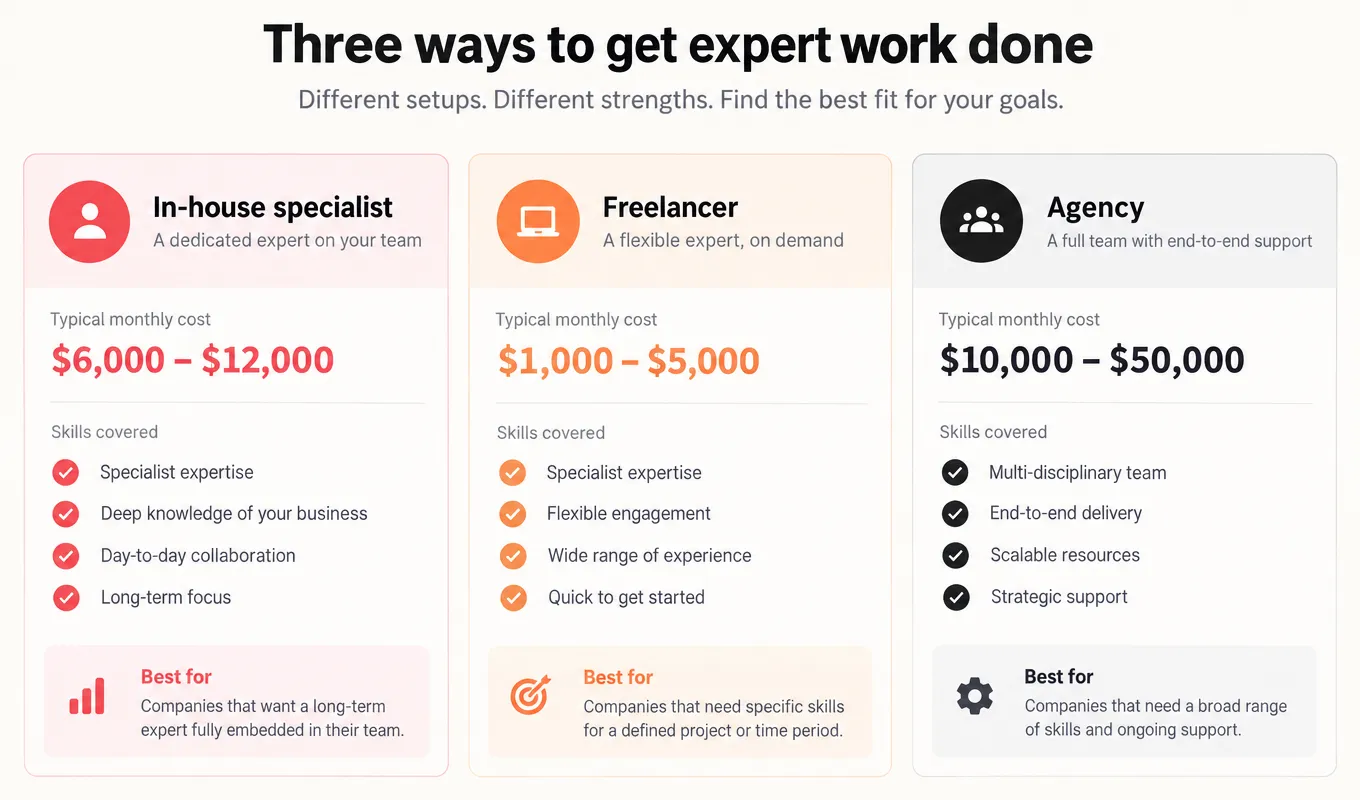
How much does an SEO specialist cost on payroll? More than salary alone:
in-house cost = salary + benefits + tools + management time
| In-house SEO specialist (salary + overhead) | Freelancer | Agency | |
|---|---|---|---|
| Monthly cost | $6,000–$10,000 loaded | $1,000–$2,500 | $2,500–$4,000 |
| Skills covered | One generalist | One specialty | Full team |
| Best fit | Large franchises | Narrow single-location scope | Multi-service growth |
Freelancers suit narrow single-location needs. Agencies split cost across specialists, which is how Loona’s 21-specialist team delivered 100+ projects.
Whether you’re comparing SEO quotes or asking how much does it cost to hire an SEO company, judge it per booked job. For single-location home service businesses specifically, local SEO usually costs less than any of these full-scope options.
Local SEO Pricing
Single-location local SEO pricing typically runs on the lower end of the market compared to national or e-commerce SEO. Quiet towns sit near the bottom, while busy metros with aggressive rivals push toward the top.
Why does it cost less than national or e-commerce SEO? The scope is smaller. A roofer serving one metro manages one Google Business Profile, a modest site, and a short list of service-plus-city pages. No multi-state rankings to chase and no product catalogs to maintain.
The work concentrates on a few high-impact tasks:
- Google Business Profile optimization, posts, and photos
- Review generation and response
- Citation cleanup across directories
- Service and city pages built around local intent
- Local links from suppliers, chambers, and sponsorships
Two things push you past the low end. Competition is the first: an HVAC company in Houston fights far more rivals than one in a small town. New service areas are the second, because every added suburb needs its own page and citations.
For packages and deliverables, see the full breakdown of local SEO cost. If you’d rather hand off the profile, reviews, and pages entirely, local SEO services cover single-location contractors.
It’s also worth weighing SEO spend against the other channel most home service owners consider: paid ads.
SEO Cost vs. Google Ads Cost
Google Ads rents you leads. SEO builds an asset you own.
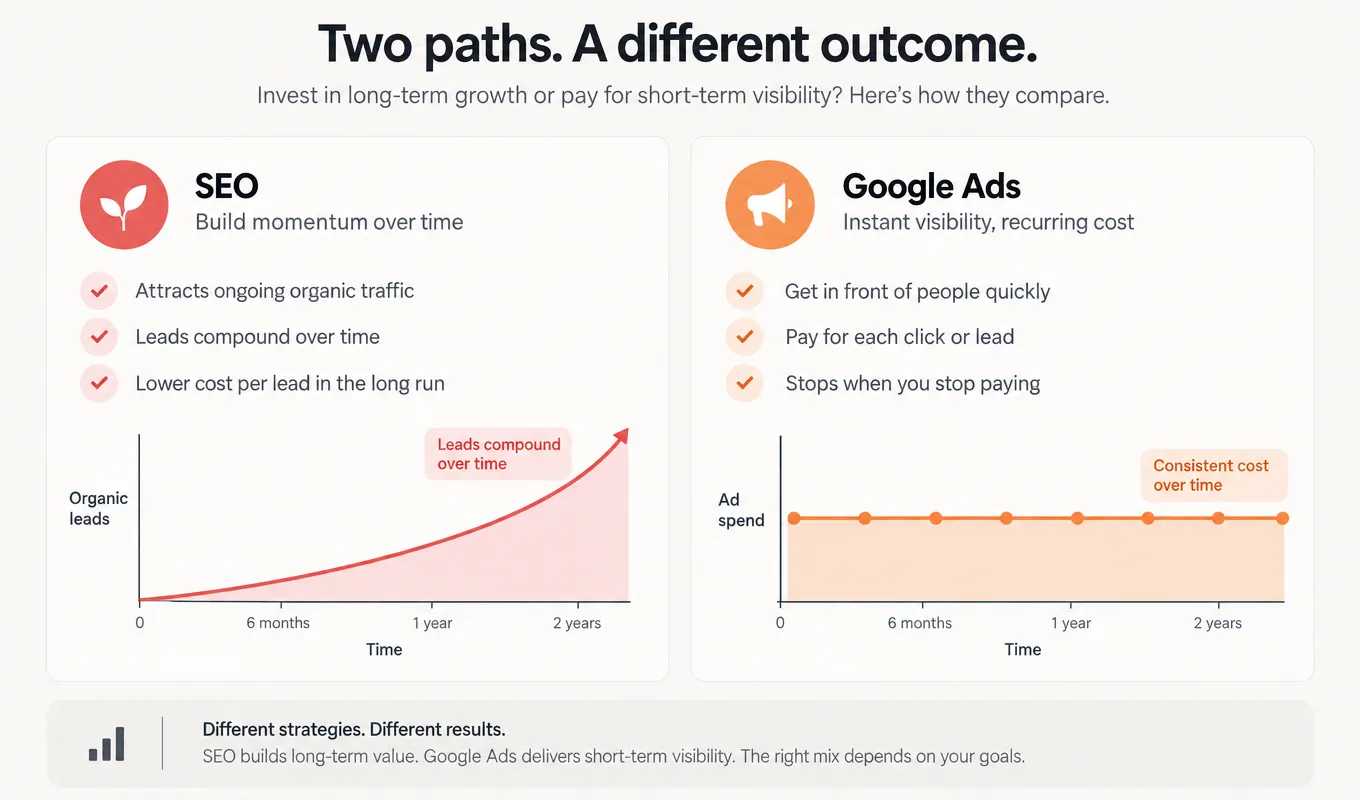
Home services rank among the priciest Google Ads categories. Roofers, HVAC contractors, and remodelers pay the same toll for every lead, month after month:
cost per lead = ad spend ÷ leads
Stop the budget, and the leads stop. Ads leave no residual value behind.
Google SEO cost works the other way. A page ranking for “furnace repair” in your city can continue attracting potential customers without a per-click charge. Each new page and link can strengthen your organic visibility and improve cost per lead as traffic and conversions grow.
| SEO | Google Ads | |
|---|---|---|
| Time to first leads | Several months | Days |
| Cost structure | Monthly retainer | Pay per click |
| When spending stops | Rankings hold awhile | Leads stop instantly |
| Long-term value | Compounding asset | No residual value |
Ads still fit launches and seasonal spikes. Paid social also rents leads, so check Facebook ads cost before you split your budget.
Both channels depend on a site that converts. Factor in how much a website costs before you commit spend to either one. None of that compounding value matters if you can’t stomach the payback timeline, so let’s look at ROI directly.
Is SEO Worth the Cost? ROI & Payback
The cost of SEO tells half the story – payback speed matters more. Most home service businesses break even in 6–9 months, longer for competitive metros and new sites.
The math:
net SEO return = cumulative organic gross profit − cumulative SEO investment
Your SEO investment breaks even when the additional gross profit attributable to organic search covers the total amount you’ve spent on the campaign. A roofer spending $3,000 monthly and earning $6,000 monthly organic gross profit from month five would break even around month eight if no additional organic profit was generated during the first four months and monthly profit remained constant thereafter. From there, additional organic profit can contribute to a positive return, provided the campaign keeps delivering results.
So how long does SEO take to work? Expect movement in three to six months; budget accordingly.
Zero-click AI answers resolve more queries now, but leaking roofs still need phone numbers, and AI tools tend to cite trusted, well-structured pages.
One Loona client grew organic traffic 900% – another lifted organic from under 10% to 40% of sign-ups.
Want a payback forecast? Loona models it upfront. Need calls faster? Pair organic work with lead generation services.
Inside Home Service SEO Accounts: Budget Patterns from Roofing, HVAC, and Remodeling Clients
Most active home service programs run $2,500–$4,000 per month, according to Loona’s 2026 client data. The tier matters less for its price than for the monthly output it funds.

Roofing, HVAC, and remodeling accounts all show the same link. Budget tier sets the pace of lead growth, because tier sets output.
Here’s how it works. A lower tier covers technical fixes and a few pages each month. A higher tier runs content, local links, and profile work in parallel, so rankings climb across more service-plus-city terms at once.
That’s why two contractors in the same metro can see very different growth curves. One may need technical fixes and a stronger website structure, while another needs more service content and local authority. Their budgets should reflect those differences rather than follow identical monthly packages.
Three drivers explain most of the gap:
- Pages shipped per month
- Links earned per month
- Speed of fixing audit findings
The bottleneck is rarely budget alone. It’s whether the tier matches the market. Size your tier by counting the pages and links you’d need to beat your top three local competitors, then fund that output.
Final Thoughts on SEO Cost
So how much does SEO cost? For most home service businesses, an active program runs $1,000–$4,000 per month. Local-only work costs less, and multi-location brands pay far more. The right number isn’t the cheapest quote but the tier that funds enough pages, links, and fixes to beat your top local competitors.
Treat SEO as an asset, not an expense. Separate one-time audit costs from the monthly retainer, and pick a billing model that fits your cash flow. Then measure every dollar against booked jobs and payback period, not rankings alone.
Your next step is simple. List your service areas, count the pages you’re missing, and note who outranks you today. That snapshot turns vague quotes into comparable ones.
Want proof before you commit? Browse real contractor results to see how budget tiers turn into organic leads. The Loona blog has more breakdowns on ad spend, website builds, and local SEO.
Ready to size your program? Find out what your SEO investment could look like based on your market, competition, and growth goals. Contact the Loona team to get a free estimate.
FAQ
01 Is SEO still worth it in 2026?
Yes. SEO builds a traffic asset that keeps working after spend stops, while ads go dark the day the budget ends. Most home service campaigns break even in 7–9 months. After that, organic leads keep arriving at a falling cost per job.
02 Can I do SEO on my own?
Partly. Claiming and optimizing your Google Business Profile is a realistic DIY task. Competitive or multi-service markets need technical, content, and link skills that take years to build. Every hour you spend on SEO is an hour you aren't closing jobs.
03 What is the 80/20 rule in SEO?
About 20% of the work drives 80% of the results: technical health, high-intent local pages, and core service keywords. Fix crawling and indexing first, then build the pages closest to a booked job. Small budgets should stay focused instead of spreading thin.
04 How long does SEO take to work?
Expect ranking movement in 3–6 months and meaningful lead growth in 6–12 months. Full payback usually lands around months 7–9. It comes sooner in quiet towns and later in competitive metros or on brand-new sites.
05 How much does it cost to hire an SEO company vs. a freelancer?
Freelancers typically charge $1,000–$2,500 per month for narrow scopes. Agencies run $2,500–$4,000 and bring a strategist, technical SEO, writers, and link builders. A fully loaded in-house hire costs $6,000–$10,000 monthly for one generalist.
Love what you’re reading? Sign up for our newsletter to get our newest articles, helpful tips, and fresh marketing updates delivered right to you. No spam, just the good stuff.