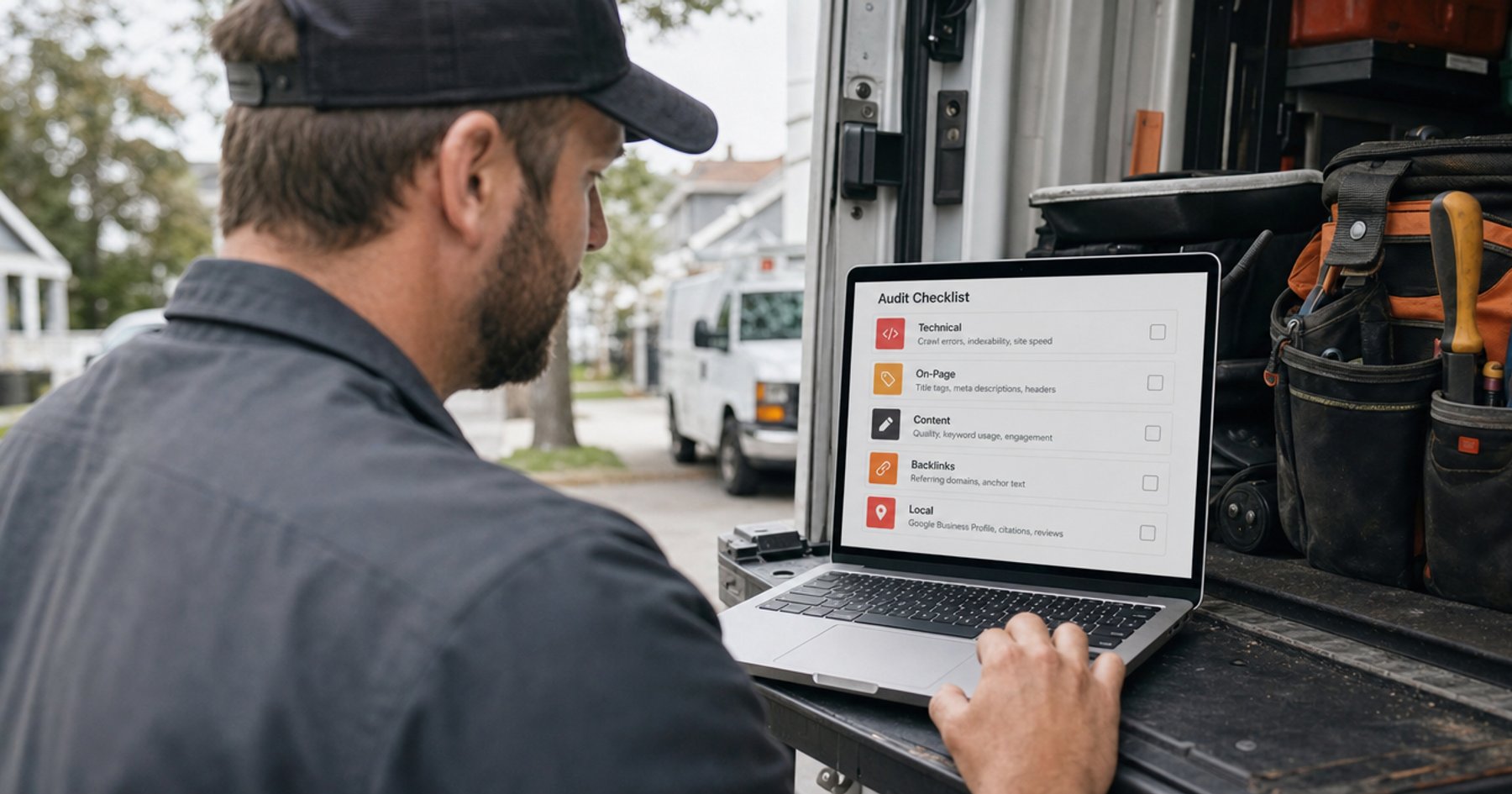




A working SEO audit checklist covers five categories in order: technical, on-page, content, backlinks, and local. Run them in that sequence, then fix in order of impact – indexation blocks before cosmetic warnings, always. That prioritization is what separates an actionable audit from a report that never gets implemented.
How much does a proper audit actually surface? On one plumbing client, a technical audit alone turned up 86 distinct issues – mostly small crawl, indexation, and structural gaps stacked up over years, per Loona’s audit work. None of them were catastrophes. Together, though, they were capping every page on the site.
Your checklist should work the same way: diagnose everything, rank by lost calls, fix top-down. Here’s what belongs in each of the five categories.
What to Include in an SEO Audit Checklist
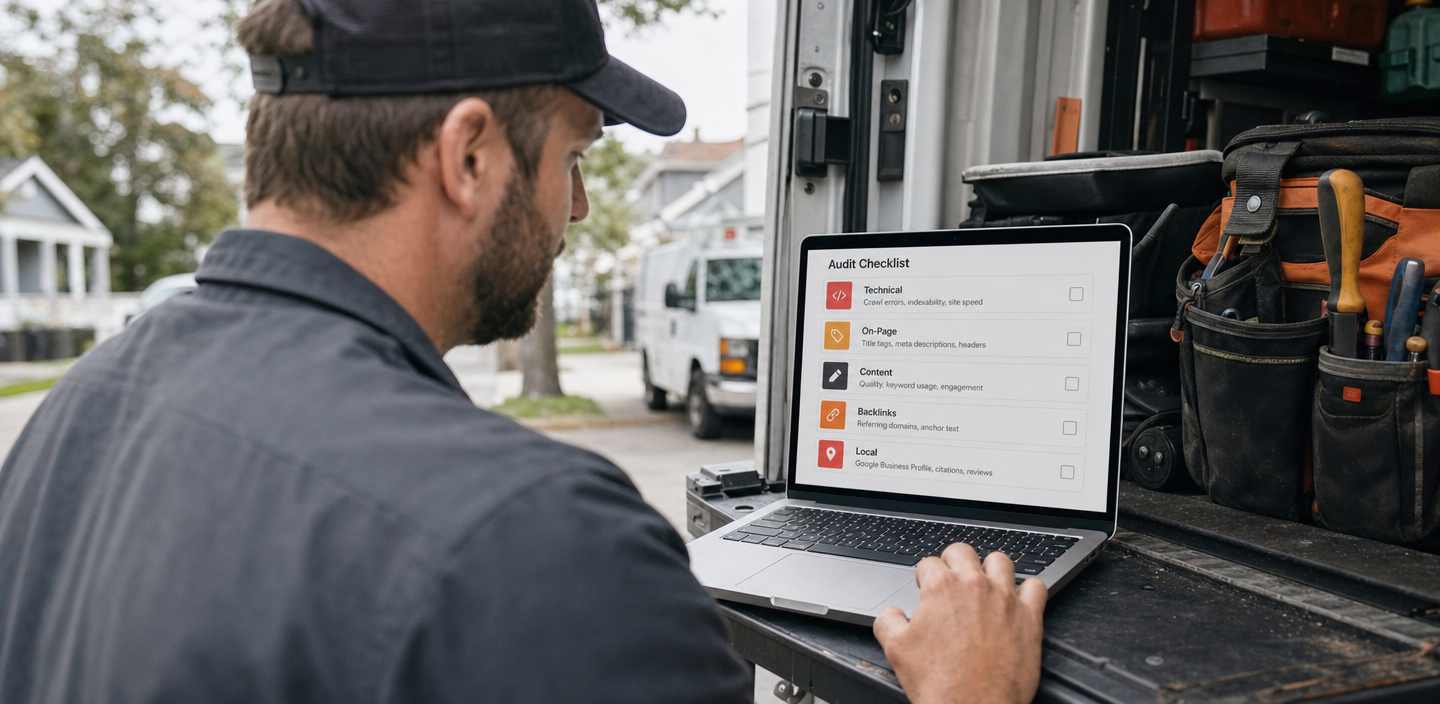
A useful SEO audit checklist has five categories, and skipping one usually means fixing symptoms rather than causes. Technical SEO comes first: crawlability, indexation, page speed, mobile setup, site architecture, structured data. On-page SEO covers title tags, meta descriptions, header structure, keyword placement, and internal linking across service and location pages.
Content is third – keyword gaps, thin or duplicated service pages, outdated posts, missing FAQ opportunities. Backlinks and off-page SEO come fourth: link quality, competitor link gaps, citation consistency. Local SEO closes it out – Google Business Profile accuracy, NAP consistency, reviews, service-area coverage. Those buckets match how Ahrefs defines an SEO audit, which is a reasonable sanity check on scope.
Why score all five before fixing anything? Because a roofer who rewrites every title tag while three location pages sit blocked by robots.txt just wasted a week. A website seo audit checklist diagnoses first, repairs second.
Note what passes and fails, then rank failures by lost traffic and calls. That ranked list is the real deliverable of any SEO site audit checklist – and for home service companies, the local SEO audit checklist section usually holds the biggest wins.
Technical SEO Audit Checklist
Technical SEO is infrastructure: crawlability, indexation, speed, mobile, HTTPS, architecture, structured data. Fix it first; everything else depends on Google indexing your pages. A technical SEO audit checklist runs in four passes:
- Search Console coverage
- Speed and Core Web Vitals – LCP, INP, CLS on mobile data
- Mobile-friendliness, HTTPS – mobile-first indexing, secure forms
- Architecture, URL hygiene, structured data – flat service/location paths, LocalBusiness schema
Two free tools cover most of it: Search Console handles indexation and PageSpeed Insights handles Core Web Vitals, no enterprise software needed on a 40-page HVAC site.
Crawlability & Indexation
Start by checking index coverage in Search Console, then review robots.txt and sitemap directives for crawl restrictions. One stray disallow line can hide your entire /services/ directory – check it early in the diagnostic process. Then open your XML sitemap and confirm that every service and location page is listed, with no 404s or redirects.
Next, hunt for orphan pages. A crawl will show which pages have zero internal links pointing to them; those pages are effectively invisible, and location pages are the usual victims. Finally, read the Search Console index coverage report. Excluded, crawled-not-indexed, discovered-not-indexed – each label tells you where Google stopped.
Once pages are indexable, speed becomes the next lever – especially on service-area sites with dozens of location pages.
Site Speed & Core Web Vitals
Measure three numbers on mobile, not desktop. Pass Core Web Vitals by targeting LCP under 2.5 seconds, INP under 200 milliseconds, and CLS below 0.1. Hero images and heavy review widgets are the usual culprits on contractor sites.
Picture a homeowner with a leaking water heater at 11 p.m. – how long will they wait for your page? Two seconds, maybe. If your click-to-call button shifts position while loading, you’ve lost that job. Speed is only half the mobile story – the site also needs to pass mobile-first indexing and basic security checks.
Mobile-Friendliness & HTTPS
Google ranks what its mobile crawler sees, so run a mobile-first indexing check: the same content, the same links, the same schema on mobile as on desktop. Cramped tap targets and phone numbers buried in images fail this test.
Then confirm HTTPS on every URL, including your forms. Chrome warns visitors when a form isn’t secure – would you type your address into that? Submit a test request through your own quote form and verify the lead actually lands in your inbox. With mobile and security squared away, the last technical layer is how the site is structured and marked up for search engines.
Keep a flat architecture for service and location pages – every one reachable within three clicks of the homepage. Clean URL structure matters too: /services/water-heater-repair beats /page-id=4472?cat=12.
Then check LocalBusiness/Service schema markup. Is your name, address, phone, and service area actually in the code, or only in the footer text? This is where a technical SEO audit checklist gets granular.
Once the technical foundation is solid, the next checklist covers what’s actually written on each page.
On-page SEO Audit Process
On-page fixes ship fast – often in an afternoon. Run this on-page SEO audit checklist across every service and location page, not just the homepage.
Title tags: keep them 50–60 characters, primary keyword near the front, brand name at the end. Meta descriptions: 140–160 characters with a reason to click, since Google rewrites weak descriptions that don’t match the page.
Header structure (H1/H2/H3) should read like an outline. One H1 per page, keyword variations in the H2s and H3s below it. Keyword placement follows the same logic – the target phrase in the title, H1, first paragraph, and one subhead, then stop. Stuffing “emergency plumber Tampa” nine times helps nobody. Content quality gets a fuller pass in the next section.
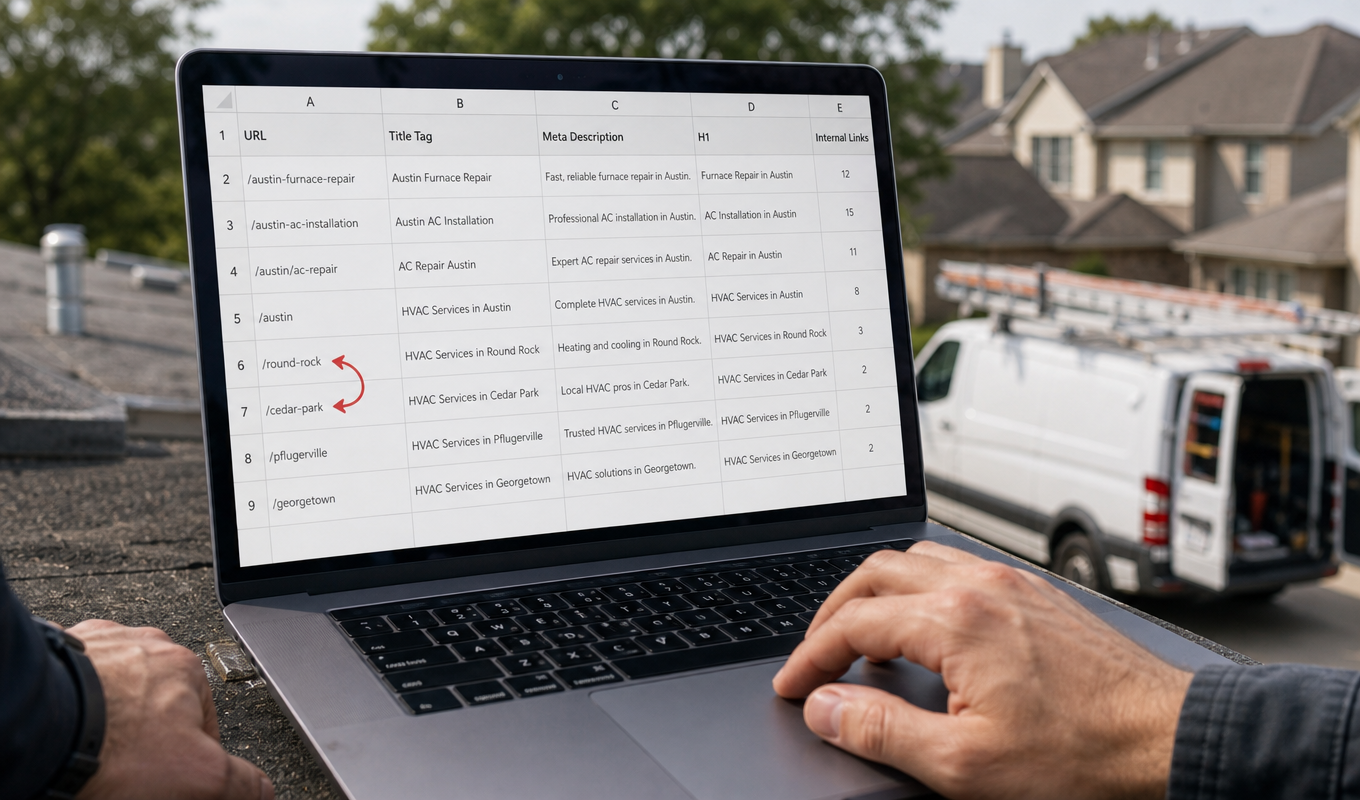
Then internal linking on service and location pages, which most contractor sites ignore. Does your homepage link to every city page you serve? An HVAC site should link its Austin page to Furnace Repair in Austin and AC Installation in Austin, and back again.
Isolated location pages compete with each other instead of ranking. Your action step: build a spreadsheet with one row per URL and columns for title, meta, H1, and inbound internal links – the gaps become obvious in ten minutes.
Strong on-page elements only work if the underlying content is actually worth ranking – which is where a content audit comes in.
SEO Content Framework
An SEO content audit asks one question of every URL: does this page earn its spot? List keyword and content gaps – services you sell with no page – then flag outdated content like a 2019 rebate post still pulling traffic.
Thin and duplicate service pages are the bigger problem on contractor sites, in most cases. Pull every indexable URL and check unique word count, excluding nav and footer boilerplate. Short pages deserve review when they fail to answer customer questions, demonstrate expertise, or satisfy search intent.
Scan for duplicate titles, metas, and H1s. Google may struggle to determine which page deserves visibility when location pages provide nearly identical content. Consolidate the weaker into the stronger, then 301 redirect the retired URL.
Next, missing FAQ/schema. Most service pages already answer homeowner questions – pricing, response times, permits – but never mark them up as FAQPage schema. FAQ content can improve a page’s usefulness and address search intent. Add FAQ schema only when it accurately represents visible FAQ content and meets Google’s guidelines. Our guide to how content strategy supports SEO growth goes deeper.
Your next step: one spreadsheet, one row per URL, marked keep, merge, rewrite, or delete.
Good content won’t rank if backlinks drag it down – that’s next.
Backlink & Off-page SEO Audit Checklist
Start with a toxic/spammy link review – but hold off on the disavow file. Google’s systems already ignore most junk links, so disavowal belongs to sites carrying a manual action for artificial links in Search Console, not to routine cleanup. Third-party toxicity scores are a triage tool, not a verdict; Google’s disavow guidance treats manual removal as the first step. Email the webmaster, document it, wait two to four weeks.
Then run a competitor backlink gap analysis to see which local directories, supplier pages, and chamber listings your three closest competitors have, and you don’t. Local citation and NAP consistency deserve more attention than either. Per Whitespark’s 2026 Local Search Ranking Factors survey, citation signals account for roughly 7% of local pack weight – modest on paper, but fully within your control. Pull every listing for your business and check name, address, and phone character by character. An old suite number on Yelp or a tracking number on Angi splits your identity.
Last, anchor text diversity. If 40 of your 60 links read “emergency plumber Dallas,” that’s a pattern no natural link profile produces. A natural backlink profile usually contains a mix of branded, URL, topical, and occasional keyword-focused anchors.
Action step: one tab per category, owner assigned, citations first. Backlinks and citations both feed into the category that matters most for home service companies: local search.
Local SEO Audit Checklist for Home Service Companies
For contractors, this is the category that decides whether the phone rings. Google Business Profile signals are among the most important local SEO factors you can directly influence, so they should be audited first.
Google Business Profile accuracy and optimization: right primary category, every service listed, service-area business settings with real cities or ZIP codes, a consistent phone number that customers can use to contact the business, and current photos of your crew and trucks. Then NAP consistency across directories – the same name, address, and phone everywhere, checked against what your profile says.
Next, review volume and velocity. Total count matters, but so does pace; target a steady, consistent pace of new reviews each month rather than a sudden burst after a push. Which sounds more real to a homeowner comparing three roofers?
Last, service-area page coverage. A Tampa HVAC company serving Brandon, Riverview, and Clearwater needs a genuine page for each – not a city name swapped into the same paragraph – linked from navigation and service pages. That’s the part of any local SEO audit checklist that most sites fail at.
What Industry Observers Have Noted Across Home Service SEO Audits
Across roofing, HVAC, plumbing, and electrical audits, industry observers have consistently noted the same three problems recurring – and they account for much of the loss of local visibility.
Inconsistent NAP data is first, and it’s almost always accidental. A contractor moves suites, changes answering services, or runs a call-tracking number on one directory and the main line on another. Nobody updates the older listings, and Google ends up with three versions of the same business.
Missing service-area pages come second. A roofer serving five suburbs often has one page – “Service Areas” – with a bulleted list of city names and nothing else. There’s no page to rank for four of those five markets.
Thin location content is the close cousin. The pages exist, but each one is the same 200 words with the city swapped in. Would a homeowner in Riverview find anything on that page that wasn’t written for Brandon? Fixing those three, in that order, tends to move rankings faster than any other work on the list. Start with citations, since they cost nothing but time. That pattern is exactly why prioritization matters more than perfection when working through a checklist.
Step-by-step SEO Audit Process: 7 Things to Do
Here’s the order to run a full SEO audit checklist without getting lost.
Step 1: Set up Analytics and Search Console. Connect GA4 and verify your property, then pull 12 months of query data. Search Console shows indexation and crawl errors; GA4 shows behavior. Pages with high impressions and almost no clicks are your first clue.
Step 2: Crawl the site. Run Screaming Frog or a similar crawler across every URL, the way Googlebot would, to expose broken links, redirect chains, duplicate titles, and orphan pages.
Step 3: Check indexation. Compare crawled URL count against indexed pages in Search Console, then use URL Inspection on your three most important service pages. If a Tampa drain-cleaning page isn’t indexed, nothing else you do on it will matter.
Step 4: Review on-page elements.
Step 5: Audit content.
Step 6: Review backlinks – covered in detail above.
Step 7: Prioritize fixes by impact. Sort every finding by lost traffic or lost calls, not by how easy it is. Indexation blocks first, local and speed issues second, cosmetic warnings last. Assign an owner and a date to each, then track your rankings after fixing audit issues so you know what actually worked.
Running this process manually takes time, so most owners will want a template and a few free tools to speed it up.
Free SEO Audit Checklist Template And Tools
| Tool | Cost | Best for | Limit |
| Google Search Console | Free | Indexation, queries | Verified properties |
| PageSpeed Insights | Free | Core Web Vitals | One URL analysis |
| Screaming Frog | Free tier | Crawling issues | 500 URLs |
Screaming Frog’s 500-URL cap is sufficient for most home service sites. Prefer someone else dig? Get a free estimate.
Can AI Tools Like ChatGPT Run an SEO audit?
Partly. ChatGPT is genuinely useful for interpreting audit findings and drafting fixes – paste in your Search Console query export or a crawler’s duplicate-title report, and it will group the issues, explain what each one means, and write replacement title tags and meta descriptions faster than you would by hand.
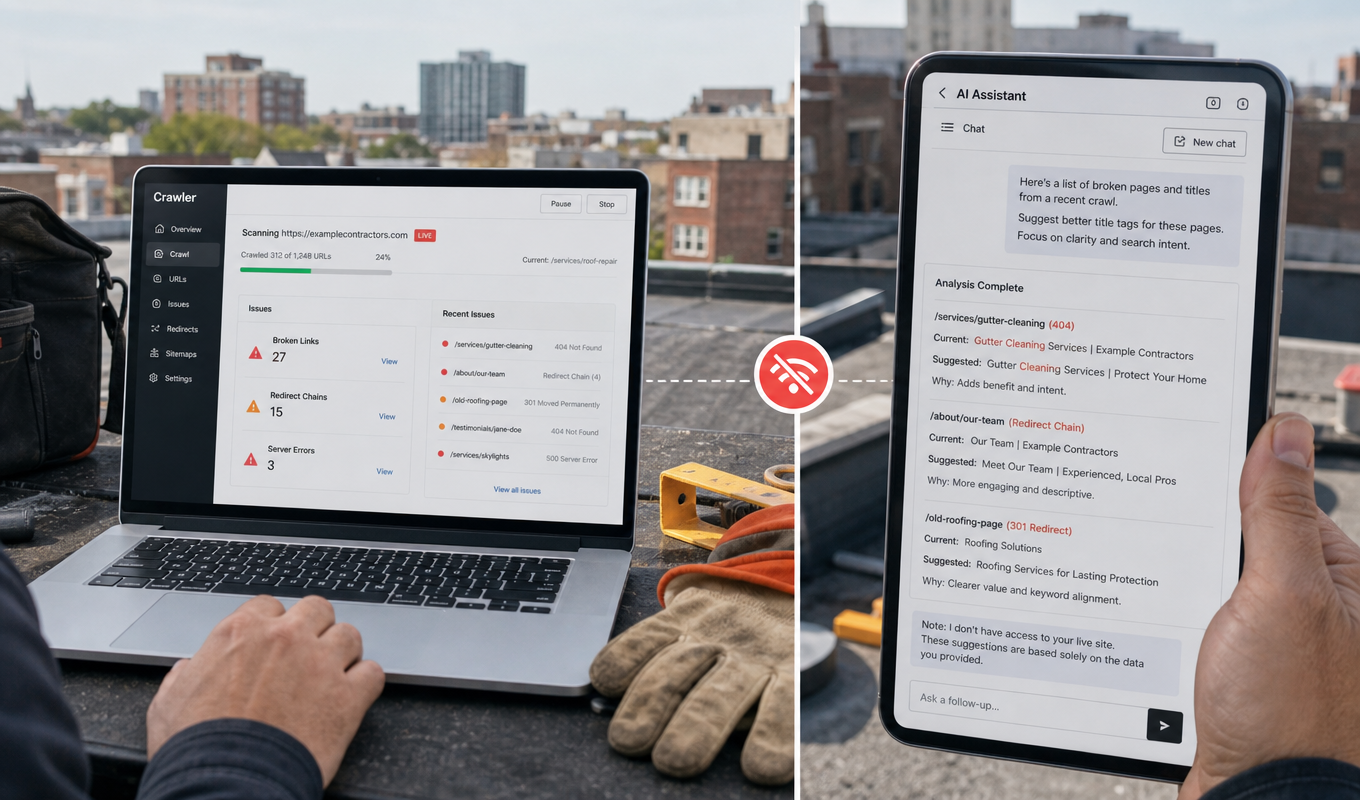
What it can’t do is see your site. ChatGPT cannot crawl a live site, so broken links, redirect chains, orphan pages, and schema errors stay invisible to it. It also can’t render JavaScript, which matters if your booking widget or review feed loads client-side.
Second limit: ChatGPT cannot pull real Search Console or analytics data. Ask it how many of your Cleveland roofing pages are indexed and it will guess – sometimes confidently and wrongly.
So what’s the workable split? Run the crawl and pull the data yourself, then hand the output to AI for analysis and to draft copy. That order keeps every recommendation tied to something measured rather than invented, which is the whole point of an SEO audit checklist.
Treat it as a fast assistant working from your numbers, never as the source of them.
Because AI can’t crawl or pull data, most home service owners are better off having a real SEO audit run for them.
How Loona Audits Home Service Websites
Every engagement starts with an Initial Website Audit before a single fix ships. The crawl covers the full site, then indexation is checked against Search Console, and findings are sorted into a structured, ranked fix list – each item tied to rankings or lead volume rather than a severity color.
What does that depth actually surface? On a recent plumbing client audit – a 24/7 emergency service company – the technical audit found 86 distinct issues, which then fed a three-month content plan. Not 86 catastrophes. Mostly small crawl, indexation, and structural gaps that had been quietly stacking up for years.
The deliverable matters as much as the findings. A 200-line report nobody actions helps no one, so items get grouped by category, ordered by impact, and assigned owners you can hold to a date.
You can get a free SEO audit from Loona to see your own issue list before committing to anything. Get a free estimate and start generating more leads for your construction business today.
That same audit work, repeated across dozens of home service clients, has shown a few clear patterns worth sharing.
Start With What’s Blocking You
An audit only pays off when it ends in a ranked list someone owns. Diagnose all five categories, then fix in order of impact: indexation blocks, local signals, on-page, content, and backlinks last.
You don’t need enterprise software to begin. Search Console, PageSpeed Insights, and a free 500-URL crawl will surface most of what’s holding a 40-page contractor site back – and one afternoon of title-tag and internal-link work on your service-area pages often moves things faster than a redesign would.
The pattern across past home service audits is consistent: small stacked problems, not single disasters. That’s good news, because small problems are fixable.
More checklists, tool walkthroughs, and local SEO breakdowns live on the Loona blog if you’d rather work through it yourself.
Prefer someone else run the crawl and hand you the ranked fix list? Reach out to the team and get a free estimate and start generating more leads for your construction business today.
FAQ
01 What should be included in an SEO audit?
Five categories: technical (crawlability, indexation, speed, mobile, HTTPS, structured data), on-page (titles, metas, headers, keyword placement), content (thin or duplicate pages, keyword gaps), backlinks and citations, and local signals like profile accuracy, NAP, and reviews.
02 What are the steps of an SEO audit?
Set up analytics and Search Console, crawl the site with a tool like Screaming Frog, check the index coverage report, review on-page elements page by page, audit content for thin or duplicate pages, review backlinks, then prioritize fixes by impact and effort.
03 Can ChatGPT do an SEO audit?
Only partly. It can interpret findings, summarize exports, and draft fixes, but it can't crawl your site, render JavaScript, or pull real Search Console, analytics, or backlink data. You still need a crawler plus your own data.
04 How long does an SEO audit take?
A small single-location site: a few hours to a full day with free tools. Multi-location sites typically require noticeably more time than single-location sites. Deeper findings take longer but produce a better fix list.
05 Is there a free SEO audit checklist template?
Yes. A spreadsheet or PDF covering technical, on-page, content, backlink, and local categories costs nothing. Pair it with Google Search Console, PageSpeed Insights, and Screaming Frog's free 500-URL crawl – enough for most sites under 500 URLs.
06 How often should home service companies audit their site?
Run a full audit once or twice a year. Check local elements – your Google Business Profile, NAP data, and reviews – monthly, since they change often. Audit again after a redesign, a migration, or any sudden ranking drop.
Love what you’re reading? Sign up for our newsletter to get our newest articles, helpful tips, and fresh marketing updates delivered right to you. No spam, just the good stuff.