



Marketing for plumbers works when it does two things at once: it wins the emergency call tonight and fills next month’s schedule with water heaters, repipes and sewer lines. The plan below covers both, season by season, and it judges every channel by cost per booked job rather than cost per lead.
That distinction changes where your money goes. SearchLight Digital’s Q1 2026 data from 230 accounts puts Google Local Services Ads at $57 per plumbing lead with a 44.5% book rate, which works out to roughly $128 per booked job. A cheaper lead that rarely books can end up costing you more.
Here is what’s ahead: the foundation to fix first, the channels for each kind of demand, a quarter-by-quarter calendar, a bottom-up budget and the tracking that ties it all together.
First, the two jobs your marketing has to do. Emergency callers and high-ticket buyers behave very differently.
What Marketing Must Do: Emergency vs High-Ticket Jobs
Marketing for plumbers has two jobs. The first is winning emergency calls today: a burst pipe, no hot water, a clogged drain backing up on a Sunday. The second is growing planned, high-ticket work like water heaters, repipes, and sewer lines, where the homeowner may take days or weeks to decide.
The emergency caller picks the first credible plumber who answers. The repipe buyer reads reviews, compares quotes, and asks about financing.
| Attribute | Emergency demand | Planned high-ticket demand |
|---|---|---|
| Typical jobs | Burst pipe, clogged drain | Water heater, repipe, sewer |
| Decision time | Minutes | Days to weeks |
| Buyer priority | Speed and availability | Proof, price, financing |
| Main channels | Map Pack, LSA, call ads | Service pages, SEO, search ads |
| What loses the job | Missed call | Thin pages, weak reviews |
The split matters because the field is crowded. IBISWorld’s Plumbers in the US report (2024) counts about 112,000 businesses sharing $121.5B in revenue, and most are small shops chasing the same calls.
Discovery is shifting, too. BrightLocal’s 2026 survey found 45% of consumers now use ChatGPT or other AI tools for local recommendations, up from 6% a year earlier.
So the best marketing for plumbers isn’t a single channel. It’s a plan that funds both demand types and judges each by cost per booked job, not cost per lead.
Before spending on any channel, though, the basics need to be solid, because every channel sends people to the same site, profile, and brand.
Start With the Basics: Website, GBP, Brand, Trucks
Every channel you pay for sends people to the same places: your website, your Google Business Profile, and your brand. If those are weak, each ad dollar buys fewer booked jobs. Fix them first.
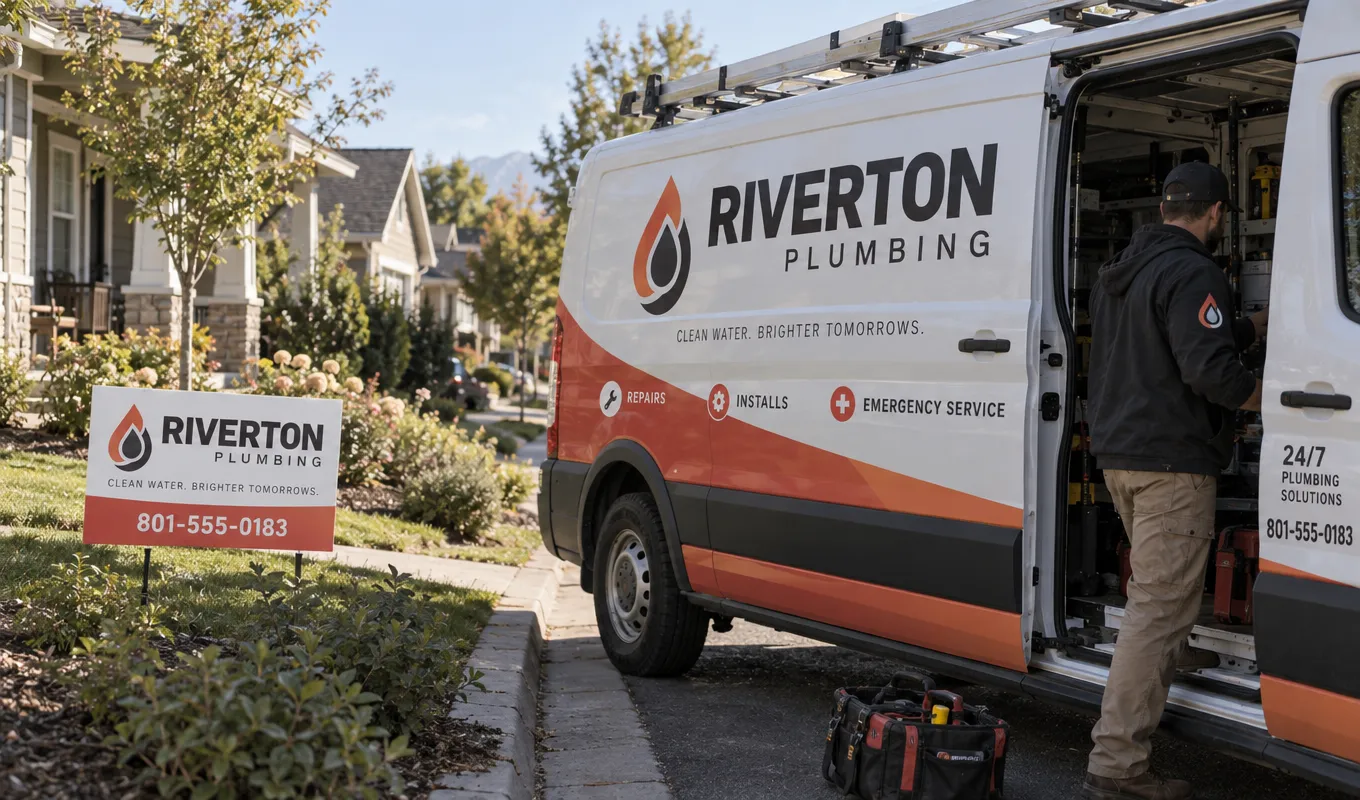
Begin with a mobile-first site with tap-to-call. Most homeowners search from their phones, so put your number in a sticky header as a live link, not plain text. Pop-ups and chat widgets that cover the button cost you calls. Good website marketing for plumbers removes friction between the search and the ring.
Next, look at your speed to lead. A 2011 Harvard Business Review study found that firms contacting a web lead within an hour were about 7x as likely to qualify it as firms that waited an hour longer. That data predates 2011 and isn’t plumbing-specific, and a homeowner with water on the floor probably won’t wait even that long.
Finally, build service-area and job pages that are real. A page with only the city name swapped won’t rank, and it won’t convince anyone. Each page should name the job and the town, show local photos or reviews, and cover only markets where you can add real local proof.
Keep your trucks, uniforms, and online profiles under the same name, phone number, and look. Here is a short checklist to run through this week.
Website and Google Business Profile Checklist
Most lost calls trace back to a handful of small gaps. Check each one on your phone.
- Tap-to-call phone number: every number on your mobile site is a live link, and it matches your profile exactly.
- Service areas and job pages: your profile lists only the towns you actually serve, and each core job (water heater, repipe, sewer line) has its own page.
- Categories, photos and hours: choose “Plumber” as the primary Google Business Profile category, add real job and truck photos, and set holiday hours so late-December searchers don’t see “closed.”
Fix whatever fails today. It’s among the cheapest local marketing for plumbers you can do, and it makes every paid channel work harder.
Online consistency is half the story. The other half rolls down the street.
Brand Consistency: Trucks, Uniforms, Yard Signs
A wrapped truck parked in a driveway for a few hours is a billboard the whole street sees. Uniforms and yard signs carry the same message to the front door and the curb: a real local company is working here.
The catch is consistency. Use the same name, phone number, logo, and colors on trucks, uniforms, and signs as on your website and Google profile. A neighbor who searches the name on your van should find you first, not a competitor with a similar name. That branded search is often your cheapest lead.
With the foundation set, we can turn to the channels that win emergency calls.
Channels for Emergency Calls
Emergency buyers call whoever answers first.
Google Local Services Ads top results at $57 per lead, 44.5% book rate (SearchLight Digital, Q1 2026, 230 accounts). Learn how Google Local Services Ads work.
cost per booked job = cost per lead ÷ book rate (~$128)
Call ads catch LSA scrollers at $129.02 per tracked lead, not booked job (LocaliQ, 2025). Check Google Ads cost locally.
Keep Google Business Profile reviews and hours current, since Map Pack calls are free.
| Attribute | LSA | Call ads | Map Pack |
|---|---|---|---|
| You pay for | Each lead | Each click | Nothing |
| Benchmark | $57 per lead | $129.02 per lead | No ad spend |
| Main risk | Charged missed calls | High click costs | Stale profile |
A missed 2 a.m. call is the biggest leak in online marketing for plumbers, so cover nights and weekends. Turn more plumbing leads into jobs.
Judge your digital marketing for plumbers by booked jobs. Get a free estimate and generate more leads for your construction business.
Planned water heater and repipe buyers, meanwhile, compare.
Channels for High-Ticket Work
A homeowner pricing a repipe or sewer line doesn’t call the first number they see. They search the job, compare company pages, check reviews, and collect quotes. For these jobs, plumber marketing means being the most convincing option, not the fastest.
Start with service pages and plumber SEO. Give every high-ticket job its own page: water heater replacement, tankless installs, repipes, and sewer line repair. Each page should answer the questions buyers ask before they call, including price ranges, timelines, permits, and cleanup.
Then add search ads for high-ticket jobs. Bid on terms like “water heater replacement cost,” and send each click to the matching job page, not your homepage. Expect pricier leads. SearchLight Digital’s January 2026 data put Google Ads water heater leads at about $343 per lead.
Benchmarks conflict, so treat every figure as directional. Contractor Magazine (Aug 2026, combined with agency observations) puts high-intent search and LSA plumbing leads at about $25–$75, with 30–45% close rates on jobs from ~$300 to ~$8,000. Judge your internet marketing for plumbers by cost per booked job, not by lead price.
Technical problems can also hold job pages back without anyone noticing. Loona’s audit for Precise Plumbing found mostly small crawl and indexing gaps that had piled up over years. Strong digital marketing strategies for plumbers close those gaps before adding new content.
Two things help most on a big-ticket job: a way to pay and proof that you have done it before.
Financing And Reviews That Mention the Job
A financing offer on big-ticket jobs changes the conversation. Many homeowners can’t write one check for a repipe or sewer line, so they delay or pick the cheapest quote. Show a monthly payment option on every high-ticket job page, in your ads and on the estimate. It can beat discount-based plumbing promotions because it speaks to the real barrier: cash flow, not price.
Reviews that name the job do the rest. “Great service” helps a little. “They replaced our sewer line in two days and cleaned up” helps a lot. When you ask for Google reviews, prompt customers to mention the work done and their town.
The cheapest growth, though, is already sitting in your customer list.
Marketing to Past Customers
The homeowner whose water heater you replaced last year already trusts you, and you already have their address and phone number. Winning their next job costs a text message, not a paid lead.
ServiceTitan’s residential services report, based on 2022 data from more than 1,000 contractors, found that repeat customers made up 39% of annual revenue. Secondary summaries of the same survey put repeat customers at 58% of completed work. The labels vary by source, but the direction holds: your customer list is a pipeline.
Most shops let that pipeline go cold once the invoice is paid. A simple after-job follow-up sequence keeps it active:
- Send a check-in text about 48 hours after the job.
- If there are no issues, send a review request with a direct link, then one polite reminder after 5–7 days.
- If the customer reports a problem, pause the review request and route it to service recovery first.
- For water heater installs, repipes and sewer lines, ask for the review 2–4 weeks later, once the work has held up.
- Add every customer to a 6-month maintenance reminder.
Among marketing ideas for plumbers, this one usually has the lowest cost per booked job, since there’s no click or lead fee. Consistency is what makes it work. Assign one person in the office to own the sequence and run it after every job, and your marketing for plumbers starts earning twice from the same customer.
Memberships give those follow-ups a reason to exist.
Memberships & Maintenance Reminders
A maintenance membership gives customers a reason to call you before anyone else. Keep it simple: one yearly price, an annual inspection, priority scheduling, and a repair discount. Offer it at the end of every service call, right after the tech has earned their trust.
Then put reminders on a calendar. Timed email/SMS reminders for a water heater flush or drain maintenance bring members back and nudge non-members to book. Good email marketing for plumbers is short and specific: the task, why it matters, and a link to book.
Texts get read fast, while emails carry the detail. Assign one office owner to schedule both.
Reminders work best when paired with a steady stream of fresh reviews and referrals.
Review Requests & Referral Asks
Ask while the customer is still relieved. On service calls, send a text review request with a direct link before the truck leaves the driveway. One tap should open your Google review form, not your homepage. Ask them to mention the job and their town.
Then make a referral ask or thank-you offer. Keep it short: ask them to pass your number to any neighbor who needs a plumber, and offer a small credit on their next visit when that referral books. A post in a neighborhood group often outperforms paid social media marketing for plumbers. Track who referred whom.
Now let’s put it all on a calendar so the right work happens in the right month.
A 12-month Plumbing Marketing Calendar
Demand isn’t flat, so your spend shouldn’t be either. Match budget to the season, and use quiet weeks for work that pays off later. Timing shifts by climate, so adjust the months to your market.
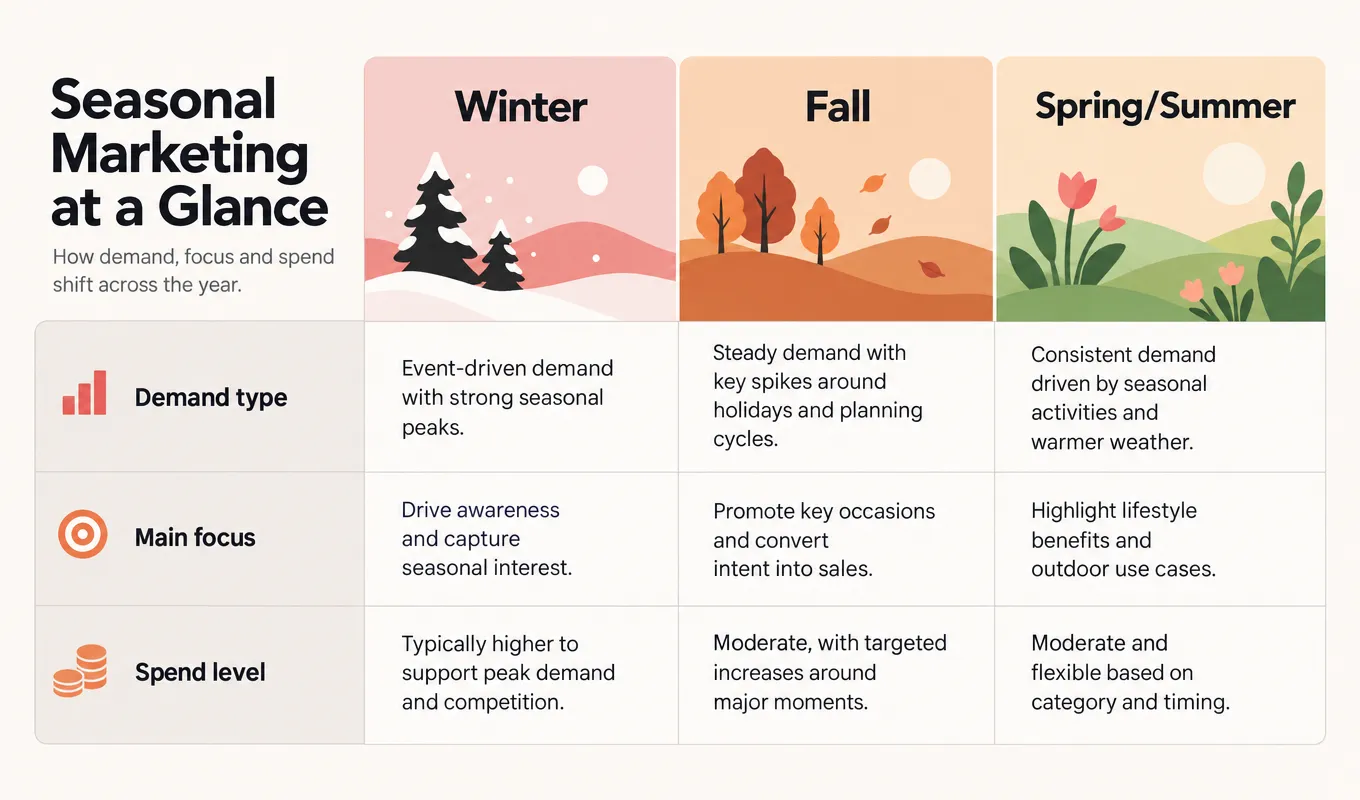
Winter (Dec-Feb): emergency peak. Frozen pipes, burst lines, and overworked water heaters make this the busiest stretch of the year. Raise LSA and call-ad budgets before the first hard freeze, set holiday hours, and staff the phone 24/7. Keep planned-work ads running too, because water heaters still fail in January.
Fall (Sep-Nov): winterization and water heater campaigns. Promote pipe insulation, outdoor faucet shutoffs, and water heater inspections, with search ads on terms like “water heater replacement cost.” Launch a month or more before the cold arrives, and add a drain cleaning push before Thanksgiving.
Spring/summer: SEO, reviews, memberships. Slower weeks are for building job pages, fixing technical issues, collecting reviews, and selling maintenance plans. These marketing strategies for plumbers tend to compound into next winter.
| Attribute | Winter (Dec-Feb) | Fall (Sep-Nov) | Spring/summer |
|---|---|---|---|
| Demand type | Emergency calls | Planned and prep | Slower, mixed |
| Main focus | LSA, call ads | Water heaters, winterization | SEO, reviews, memberships |
| Spend level | Highest | Ramping up | Steady, lower |
Good marketing for plumbers follows the weather. Schedule your plumbing marketing ideas a quarter ahead, not the week demand hits.
A calendar needs a budget behind it, so here is how to size one.
How Much Plumbers Should Spend on Marketing
A practical starting point is to set a target cost per booked job based on your average ticket and margins. For a shop that wants extra booked jobs each month, multiply the target job count by your cost per booked job to size the monthly budget. The number moves with your market, your mix of jobs, and how well you answer the phone.
Build the budget bottom-up. Start with how many extra jobs your crews can actually run, then multiply that by what each booked job costs you.
monthly budget = target booked jobs × cost per booked job
cost per booked job = cost per lead ÷ book rate
Take Local Services Ads as an example. SearchLight Digital’s Q1 2026 data shows $57 per plumbing lead and a 44.5% book rate, which works out to about $128 per booked job. Contractor Magazine (Aug 2026) puts high-intent leads at $25–$75 with 30–45% close rates. That lands in a wide range of costs per booked job depending on lead price and close rate. Run the same math for each channel, then split the total between emergency calls and high-ticket job pages based on what each ticket earns.
Use percent-of-revenue rules as a sanity check only. General small-business guidance suggests a single-digit to low-double-digit share of revenue, and shops in growth mode sit at the higher end. If your bottom-up number falls far outside that, check your close rate before you cut or add spend.
Then flex the budget by season. Spend more ahead of winter and fall, and hold it steady through spring and summer. A detailed marketing budget guide walks through the full model. Size digital marketing for plumbers to crew capacity, not to a competitor’s ad spend, and marketing for plumbers stays profitable.
Once money is moving, you need to know which channel actually books jobs.
How to Track What Works: Cost Per Booked Job
Clicks and leads show what a channel costs to touch. Booked jobs show what it costs to earn revenue.
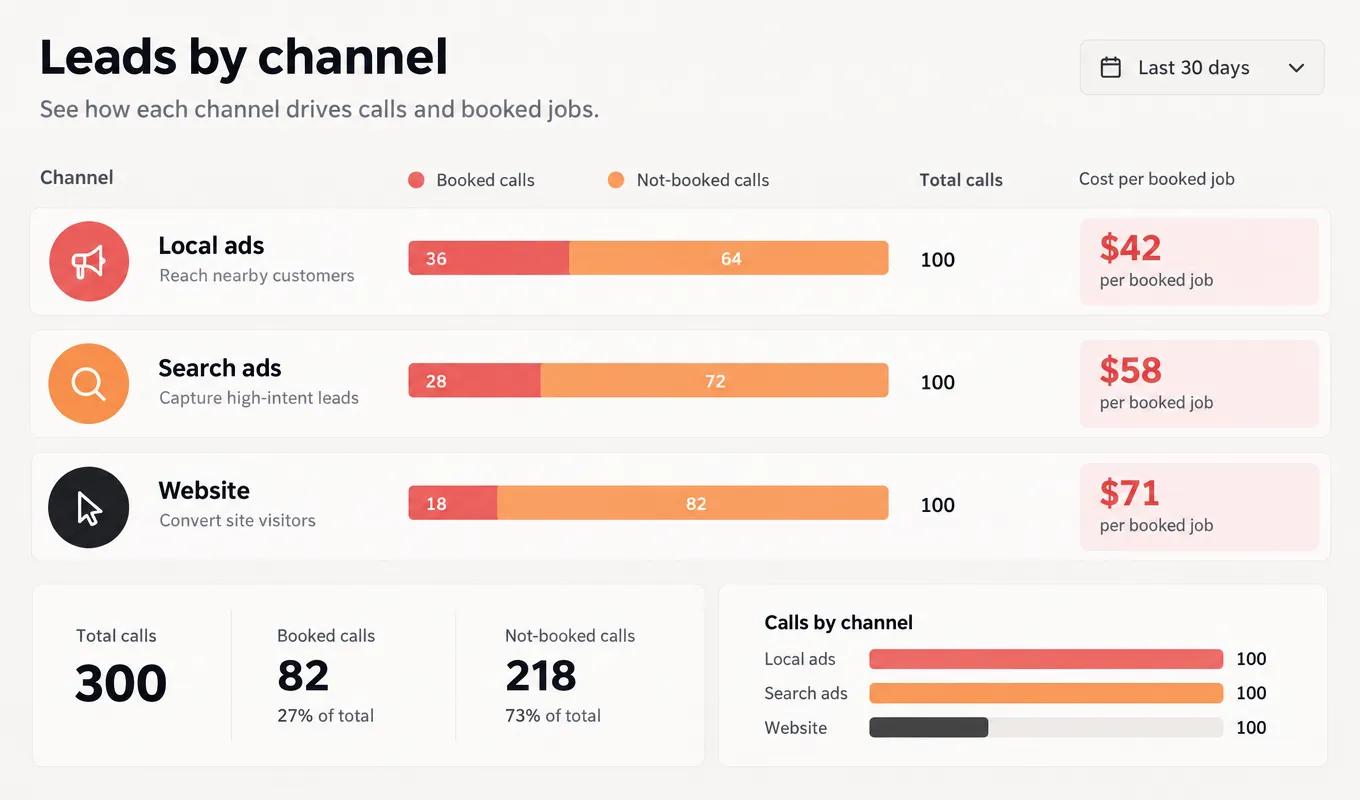
Cost per booked job is channel spend divided by the jobs that spend actually put on the schedule:
cost per booked job = channel spend ÷ jobs booked
Take Local Services Ads again. SearchLight Digital’s Q1 2026 benchmark (230 accounts) shows $57 per plumbing lead and a 44.5% book rate, or roughly $128 per booked job. Other summaries of the same data land higher because book rates vary by account, and a shop that misses calls pays far more.
To get your own number, set up GA4 and Google Tag Manager to capture form fills and tap-to-call clicks. Add call tracking with a separate number for each channel. Have the office tag every call as booked or not booked, then push that outcome back into GA4 and Google Ads. Without that step, ad platforms count any call that runs past a minimum length as a win, even if it doesn’t book.
Now website marketing for plumbers and paid ads share one scoreboard. Smart digital marketing strategies for plumbers move money toward the channel with the lowest cost per booked job, not the one with the cheapest lead.
Get a free estimate and start generating more leads for your construction business today. Tracking keeps marketing for plumbers honest.
Here is what that looks like in practice from our own work.
What We Have Seen: Marketing Plumbing Companies
Most plumbing campaigns don’t fail on strategy. They leak in small, boring places that nobody checks until the phone goes quiet.
On the emergency side, the biggest leak is almost always the phone. Ads keep running at night and on weekends while calls roll to a full voicemail box. Local Services Ads make that worse, because a profile marked open can still be charged for a call nobody picked up. The fix is to match ad hours to the hours someone actually answers and tag every missed call.
On the high-ticket side, the leak is usually the website. Job pages exist, but search engines can’t crawl them cleanly, or several pages compete for the same water heater search. Paid clicks land on the homepage instead of the matching job page, and comparison shoppers leave.
Precise Plumbing, a 24/7 emergency plumbing company, is a clear example. Loona’s technical SEO audit found 86 issues, mostly small crawl, indexing, and structure gaps that had built up over years. None was a disaster on its own. Together, they held back the pages that should have been winning planned work.
Loona also benchmarked 15+ local competitors, and the audit fed a 3-month content plan built around the jobs that matter most. The lesson is the order: fix the site, then publish.
Your next step is to pull last month’s missed calls and crawl your job pages. Assign one person to own both fixes.
Putting your plumbing marketing plan to work
Marketing for plumbers comes down to two jobs done well. Win the emergency call tonight with a sharp Google Business Profile, Local Services Ads and a phone someone answers 24/7. Win the $6k-$8k repipe next month with job pages, reviews that name the work, and a financing offer.
Then stop chasing cheap leads. Track every call in GA4, tag it booked or not booked, and move budget toward the channel with the lowest cost per booked job. Past customers usually win that comparison, so keep reminders, memberships, and review requests running after every job.
Order matters more than budget. Fix the site and the phone first, then spend. You can see what that foundation-first approach looks like in real contractor case studies.
For channel-by-channel walkthroughs on SEO, Local Services Ads, and seasonal budgets, browse the home services marketing blog.
Start this week. Pull last month’s missed calls and assign one person to own after-job follow-ups. When you’re ready for a plan built around your crews and your busy season, contact the Loona team. Get a free estimate and start generating more leads for your construction business today.
FAQ
01 What is the best marketing for plumbers?
Pair a complete Google Business Profile and Local Services Ads for emergency calls with job pages and SEO for high-ticket work. Add reviews, reminders and memberships for past customers. Answer every call, because missed calls are the biggest leak.
02 How much should a plumbing company spend on marketing?
Build it bottom-up: target booked jobs × cost per booked job. Start with $57 per LSA lead (SearchLight Digital, Q1 2026) and $129.02 per search ad lead (LocaliQ, 2025). Spend more before winter, and use percent of revenue only as a sanity check.
03 Is SEO or Google Ads better for plumbers?
Google Ads bring calls fast. SEO compounds over time and suits planned, high-ticket work. Most shops need both, weighted toward ads in peak emergency season, and should compare them by cost per booked job.
04 Are Local Services Ads worth it for plumbers?
Often, yes. SearchLight Digital's Q1 2026 data shows $57 per lead and a 44.5% book rate, or roughly $128 per booked job before credits. Answer fast and dispute bad leads to keep that cost down.
05 How do plumbers get more repeat customers?
Follow up after every job with a review request and maintenance reminders, and offer a simple membership. ServiceTitan's 2022 data found repeat customers brought 39% of annual revenue and 58% of completed work.
06 How do I track which marketing brings booked jobs?
Use call tracking plus GA4 and Google Tag Manager for form and tap-to-call tracking. Record calls and tag each one as booked or not booked. Then review cost per booked job by channel every month.
Love what you’re reading? Sign up for our newsletter to get our newest articles, helpful tips, and fresh marketing updates delivered right to you. No spam, just the good stuff.